Aloha Friday Message – March 22, 2019 – 2019 Lenten Series #3

1912AFC032219 – 2019 Lenten Series #3

A Frank and Earnest Conversation – Act 2

Read it online here, please. And please, when you visit there, use one of the social media links at the bottom of the page to share this post. Thank you! And remember, we now have a READER VIEW available, so share this link or this email often.

    Psalm 103:11 11 For as the heavens are high above the earth, so great is his steadfast love toward those who fear him

May blessing always be with you and may God bless you, Belovéd! Today we pick up in the middle of a conversation between two buddies named Frank (F:) and Earnest (E:) with some help from the Narrator (N:). We finished up where Frank had just asked Earnest about what would happen if he stopped taking his diabetes medication.

N: (Previously on A Frank and Earnest Conversation:)

E: You quit smoking by continually quitting, right? How about your medicine for diabetes? What happens if you don’t take it?

F: I get sick and die?

E: Right! Now, let’s remember what Jesus said at the start of his ministry: “Repent and believe the Gospel.” That’s the process called conversion. You decide to change, to embrace “metanoia,” and then you place your faith in him. That’s conversion. Once you experience conversion, you’re ready to follow him. Remember? “Come, follow me.”?

F: That’s all well and good, but it doesn’t last.

E: Unless you make it last. Think of it as a four-step process: Repent, believe, follow, repeat. When we repent and believe, that’s conversion. When we follow and repeat, that’s action. Conversion plus action equals … holiness.

F: I don’t know. It sounds too easy. And, like I said, it doesn’t last.

E: Frank, it’s never “once and done.” Remember, it has to become a habit – like not smoking. Most days you don’t even have to think about that, right?

F: Yeah, that’s true, but this is different. I don’t know how to be holy.

N: (And now ….)

E: Narrator?

N: (1 Thessalonians 3:12–13 12 And may the Lord make you increase and abound in love for one another and for all, just as we abound in love for you. 13 And may he so strengthen your hearts in holiness that you may be blameless before our God and Father at the coming of our Lord Jesus with all his saints.)

E: YOU can’t do it without HIS help, and his help comes through Love: Matthew 22:37-39 37 He said to him, “‘You shall love the Lord your God with all your heart, and with all your soul, and with all your mind.’ 38 This is the greatest and first commandment. 39 And a second is like it: ‘You shall love your neighbor as yourself.’” In other words, we make a conscious decision to correct our thinking, our communications, and our behaviors and we make that decision continuously public through our actions. That’s repentance in a nutshell. Narrator, what’s your take?

N: (The Catechism of the Catholic Church [CCC] §982 begins with “There is no offense, however serious, that the Church cannot forgive. “There is no one, however wicked and guilty, who may not confidently hope for forgiveness, provided his repentance is honest. Christ, who died for all men, desires that in his Church the gates of forgiveness should always be open to anyone who turns away from sin. §983 Catechesis strives to awaken and nourish in the faithful faith in the incomparable greatness of the risen Christ’s gift to his Church: the mission and the power to forgive sins through the ministry of the apostles and their successors.)

F: Who is that guy? What’s going on, anyway?

E: We’re just trying to tell you two things [1] if you sincerely confess your sins, there’s forgiveness – you acknowledge your sins and repent. That’s necessary because repentance is turning away from sin – which we recognize and regret – so that we turn again toward God. In this case, repentance involves something many people don’t think about: Conversion.

F: You mean like the “born-again Christians” on TV?

E: In a way, yes, we do need real conversion. Here, let’s ask that narrator again for some help.

N: (CCC §1427: Jesus calls [us] to conversion. This call is an essential part of the proclamation of the kingdom: “The time is fulfilled, and the kingdom of God is at hand; repent, and believe in the gospel.” §1429 St. Peter’s conversion after he had denied his master three times bears witness to this. Jesus’ look of infinite mercy drew tears of repentance from Peter and, after the Lord’s resurrection, a threefold affirmation of love for him. The second conversion also has a communitarian dimension, as is clear in the Lord’s call to a whole Church: “Repent!” St. Ambrose says of the two conversions that, in the Church, “there are water and tears: the water of Baptism and the tears of repentance.” §1431 Interior repentance is a radical reorientation of our whole life, a return, a conversion to God with all our heart, an end of sin, a turning away from evil, with repugnance toward the evil actions we have committed. At the same time it entails the desire and resolution to change one’s life, with hope in God’s mercy and trust in the help of his grace. This conversion of heart is accompanied by a salutary pain and sadness which the Fathers called animi cruciatus [affliction of spirit] and compunctio cordis [repentance of heart]. Emphasis added.)

E: It’s that interior repentance, the “radical reorientation of our whole life” you seem to be wondering about. Trust me, everyone feels the same way, like we should be able to stop being so sinful. Even the Apostle Paul wrote about that.

N: (Take a look at what the Apostle Paul said: Romans 7:15-20 15 I do not understand my own actions. For I do not do what I want, but I do the very thing I hate. 16 Now if I do what I do not want, I agree that the law is good. 17 But in fact it is no longer I that do it, but sin that dwells within me. 18 For I know that nothing good dwells within me, that is, in my flesh. I can will what is right, but I cannot do it. 19 For I do not do the good I want, but the evil I do not want is what I do. 20 Now if I do what I do not want, it is no longer I that do it, but sin that dwells within me.)

E: Now, Frank, do you think Paul worried about whether or not God could forgive him even if he never lost his sinfulness? You see, God can, and does, forgive our sins, and then he forgets them. We don’t need to keep reminding him of stuff he’s already forgiven and forgotten. Think about conversion. Is that something you can do?

F: Like that song “Just As I Am?” (↔ Music Link)

E: Not quite. Jesus expects you to repent, not just show up without doing anything about your sin. He does certainly accept you as you are as a sinner – you don’t have to wait until you’re holy to repent, because you repent to approach holiness – but he wants you to take it through the process of conversion. Remember he said, “Repent, and believe the Gospel.” Believing the Gospel without repentance will leave you dissatisfied. Is that how you feel now?

F: I admit, I was feeling like that, but it I feel have some things to think about. It seems that metanoia is a change not only in heart and mind but also – and most importantly – a change in actions and behavior. I can change my actions and behavior at least a little and if it doesn’t last long, I can try again, right?

E: That’s right. There’s no limit (N: ← Check it out!) on how many times you can repent – of anything or everything – as long as it includes the aspect of conversion – that “firm purpose of amendment” in the Act of Contrition. Conversion is the key to sincere contrition and effective repentance no matter how many times you have to do it. If Jesus is as real to you as he was to the Disciples at the Ascension, then that should help you realize that you’re confessing to him, not “just Fr. Kelly.” That’s because God’s Mercy is the result of his Justice being dispensed in Love that is so complete and unwavering, so steadfast and constant that we cannot comprehend its full extent. The best we can do is to think of Grace, “the free gift and unmerited favor of God,” which is always available to everyone.

F: You’ve given me a lot to think about. That narrator, too. Maybe I should get home and pull out the laptop and find the Catechism of the Catholic Church (↔ Click Link) and look for the word “repent” I can get some more ideas.

E: Good thinking. RIGHT THINKING! Say hi to Ethel when you get home.

F: Thanks. I will. I wonder if that narrator will be around?

E: I imagine so. He’s got some closing remarks to do here.

N: (Thank you guys for being frank and earnest in your conversation. )

E: Very funny.

F: Yeah, like who else could we be?

N: (It sounds like maybe we need to think more about why we DON’T repent. You folks out there, reading this, WHAT STOPS US FROM REPENTING? That’s something to think about, OK? For next week try thinking about who repents to whom, and why we often decide not to repent.)

Unless otherwise indicated, all scripture passages are from the New Revised Standard Version Catholic Edition (NRSVCE) New Revised Standard Version Bible: Catholic Edition, copyright © 1989, 1993 the Division of Christian Education of the National Council of the Churches of Christ in the United States of America. Used by permission. All rights reserved.

Biblical languages inserts from Bible Hub (Bible Hub: Search, Read, Study the Bible in Many Languages) Visit at http://biblehub.com

Creative Commons License
Aloha Friday Messages by Charles O. Todd, III is licensed under a Creative Commons Attribution-ShareAlike 3.0 Unported License


Aloha Friday Message – March 15, 2019 – 2019 Lenten Series #2

1911AFC031517 – 2019 Lenten Series #2

Read it online here, please. And please, when you visit there, use one of the social media links at the bottom of the page to share this post. Thank you! And remember, we now have a READER VIEW available, so share this link or this email often.

   Acts 1:11 11 They said, “Men of Galilee, why do you stand looking up toward heaven? This [same] Jesus, who has been taken up from you into heaven, will come in the same way as you saw him go into heaven.”

¡Que la bendición esté siempre con ustedes y que Dios los bendiga, Amados! (May blessing always be with you and may God bless you, Belovéd!) Today we continue with our discussion of μετάνοια. Last week we said that metanoia is a change not only in heart and mind but also (and most importantly) a change in actions and behavior. Today I’d like to share with you a frank and earnest conversation about the “WHY” of repentance. Actually, we’re going to eavesdrop on a conversation between Frank (F:) and Earnest (E:).

A Frank and Earnest Conversation – Act 1

F: Hi, I’m Frank.

E:  And I’m Earnest.

F: We’re having a conversation about repentance.

E:  There’s got to be a good reason for repentance, so we’ll be looking into that. There’s another person who might participate –

F: we’ll see about that –

E:  and that will be the narrator. His comments look (like this.)

(N:  I’ll try to stay out of the way, OK?)

E: OK.

F: OK.

E:  So Frank, you look a little down. What’s going on?

F: Oh, you know. It’s Lent. Time for the whole “fasting, prayer, and almsgiving” thing – and then there’s the Sacrament of Reconciliation. I don’t know why they had to change the name. “Confession” seems good enough to me.

E: What part of that has you worried?

F: Oh, it’s not that I’m worried about it so much. It’s just that … well confession seems to get harder and harder. I don’t know why we repent if all we do is just go out and do the same sins over and over. It’s like “what’s the point?” any more.

E: Well that’s a good question. What is the point?

F: The point is to be reconciled with God and neighbor. You know that! We have Reconciliation because we trust God’s justice and mercy.

E: Yes, that’s why we can – and do – repent. God is just and merciful, your confessor is trained not to be judgmental, and there’s always the Seal of Confession, so what exactly is bothering you?

F: I guess it’s the repentance part. I just don’t seem to get that done right. No matter what I do, it just doesn’t stick. I’m still so angry all the time, and ashamed. The way I’ve acted toward Ethel and the kids, even stopped going to Mass because I don’t want to sit there and not go to Communion because everybody will know I haven’t gone to Confession. Repentance seems impossible.

E: I see. Do you know what repentance is?

F: Of course I do. I’m not an ignoramus. I’m just not holy enough to make repentance a lasting change.

E: So? Do you know anyone who really is that holy?

F: Probably not personally, but there’s people like Mother Theresa and JP2. They were pretty saintly. And there’s Ethel. I don’t know how that woman puts up with me!

E: Were they like that every moment of their entire lives?

F: OK, probably not, but they were way better at it than me!

E: Maybe they got better at it because they practiced it so often. How often to you repent?

F: Alright smarty-pants, now you’re poking fun at me. I don’t go for reconciliation every week or even every month. Mostly I go for Christmas and Easter, and maybe sometimes in between if I really mess up.

E: Is that often enough?

F: It’s as often as I can make it. I know I’m a sinner, and I know I have to stop that if I’m going to get to Heaven, and that means I’ve got to repent. That’s the whole point, isn’t it? You repent so you don’t go back and do “what is evil in God’s sight” any longer? If I keep  keep up like that I don’t think he can forgive me.

E: Tell me this: Has God ever forgiven you?

F: Of course he has! Many times, too. He must be tired of that same old song and dance, though,  every time I hit the confessional booth. Some of those things I can’t get past – like the way Richard always gets to me, or when Ethel starts nagging again. I just lose my cool and blow up.

E: Have you told either of them you’re sorry?

F: Ethel? Yes, she’s my wife after all, and she puts up with me even when I rant and pout for days. Talk about a faith and love! I wish I knew how she does it.

E: She must really love you. How about Richard?

F: Ehh, no, not really. That blowhard wouldn’t accept an apology if you gift-wrapped it.

E: When you tell Ethel you’re sorry, does she forgive you?

F: Generally, yeah, although usually she gives me a piece of her mind, too – which I deserve.

E: So then Ethel, who is human, can forgive you, but God, who is Divine and Omnipotent cannot?

F: I didn’t say he couldn’t do it, I just think he’d get tired of me saying the same thing over and over and not really getting past things like my anger, or – back in the day – my alcohol hang-ups. I mean, it worries me all the time. What if I relapse, or what if I really lose it one day and give Richard the beat-down he deserves, or Ethel – what if I disappoint her again? I just can’t bear to go through that or make her deal with it again!

E: Look, let’s try something different. Have you ever done anything that wasn’t sinful?

F: I suppose I have, but what do you mean? Like maybe when I was baptized? That was when I was a baby so that doesn’t really count; I was already “innocent” – except for original sin, of course.

E: Good. That’s a great way to understand it. Now, let’s say we think about the day you took your First Communion – was there something about that which was sinful, or did you receive in good form?

F: Yeah, it was OK. Fr. Kelly was a stickler about having your hands palm-to-palm and opening your mouth just right so he could lay the Host on your tongue. I did all of that. Ahhh, I haven’t thought about that in a long time. I was just maybe 8 at the time. That was a pretty good day.

E: How about the day you married Ethel? Did you really mean what you said when you took your vows for Holy Matrimony?

F: Of course I did. I loved Ethel so much – still do, too.

E: Never been unfaithful – not even “lust in the heart” like Jimmy Carter?

F: Nope. Not happenin’.

E: Alright, so you do know there are a few times in your life when you “did things right.” How do you describe the times in your life when you “did things wrong?”

F: That’s not it. Being wrong isn’t the problem. What’s getting me is that I cannot repent because I know I’m going to sin again – probably the same things, too. Holiness is spiritual excellence. That’s not in my wheelhouse.

F: What was it Aristotle said about excellence?

E: Dunno. Ask that narrator guy.

N: (Aristotle said, “We become what we continually do. Excellence, then, is not an act but a habit.”)

F: Think about this: How did you stop smoking 7 years ago?

E: I stopped buying the nasty things.

F: That was the first day. Did you buy any the second day? The third day? The first year? Yesterday?

E: No. Whttps://aloha-friday.org/archives/8031hy?

F: You quit by continually quitting, right? How about your medicine for diabetes? What happens if you don’t take it?

E: I get sick and die?

F: Right! Now, let’s remember what Jesus said at the start of his ministry: “Repent and believe the Gospel.” That’s the process called conversion. You decide to change, to embrace “metanoia,” and then you place your faith in him. That’s conversion. Once you experience conversion, you’re ready to follow him. Remember? “Come, follow me.”?

E: That’s all well and good, but it doesn’t last.

F: Unless you make it last. Think of it as a four-step process: Repent, believe, follow, repeat. When we repent and believe, that’s conversion. When we follow and repeat, that’s action. Conversion plus action equals … holiness.

E: I don’t know. It sounds too easy. And, like I said, it doesn’t last.

F: Ernie, it’s never “once and done.” Remember, it has to become a habit – like not smoking. Most days you don’t even have to think about that, right? Repentance works pretty much the same way. If Jesus is as real to you as he was to the Disciples at the Ascension then, then you know he’s always there for you, always coming back to you in the Sacraments. AND you’ve got the Holy Spirit to help you, too. Repentance opens the door to holiness.

E: But I don’t know how to be holy.

N: (To be continued next week in A Frank and Earnest Conversation – Act 2 Who repents to whom?)


(Unless otherwise indicated, all scripture passages are from the New Revised Standard Version Catholic Edition (NRSVCE) New Revised Standard Version Bible: Catholic Edition, copyright © 1989, 1993 the Division of Christian Education of the National Council of the Churches of Christ in the United States of America. Used by permission. All rights reserved.)

(Biblical languages inserts from Bible Hub (Bible Hub: Search, Read, Study the Bible in Many Languages) Visit at http://biblehub.com)

Creative Commons License
Aloha Friday Messages by Charles O. Todd, III is licensed under a Creative Commons Attribution-ShareAlike 3.0 Unported License

Aloha Friday Message – March 8, 2019 – 2019 Lenten Series #1

Read it online here, please. And please, when you visit there, use one of the social media links at the bottom of the page to share this post. Thank you! And remember, we now have a READER VIEW available, so share this link or this email often.

    Sirach 17:24-29 24 Yet to those who repent he grants a return, and he encourages those who are losing hope. 25 Turn back to the Lord and forsake your sins; pray in his presence and lessen your offense. 26 Return to the Most High and turn away from iniquity, and hate intensely what he abhors. 27 Who will sing praises to the Most High in Hades in place of the living who give thanks? 28 From the dead, as from one who does not exist, thanksgiving has ceased; those who are alive and well sing the Lord’s praises. 29 How great is the mercy of the Lord, and his forgiveness for those who return to him!

Aloha nui loa, ʻŌmea! The grace of the Lord Jesus Christ, the love of God, and the fellowship of the Holy Spirit be with all of you.

Today is the first Friday of Lent, 2019 and the beginning of a series on the word metanoia. That word has come up before a few times, but in this series we will be using it often. It is a word Jesus used at the beginning of his ministry and the Apostle Paul also used it (although not always where we correctly remember him saying it.) Here are three examples. The first is from John the Baptist in Matthew 3:2, Mark 1:4, and Luke 3:3“Repent, for the kingdom of heaven has come near.” The Second example is from Jesus at the start of his ministry in Matthew 4:17, Mark 1:15, and Luke 5:3217 From that time Jesus began to proclaim, “Repent, for the kingdom of heaven has come near.” The third example appears first in Acts 2:38 in Peter’s Pentecost Preaching – 38 Peter said to them, “Repent, and be baptized every one of you in the name of Jesus Christ so that your sins may be forgiven; and you will receive the gift of the Holy Spirit.

We know that repentance is an integral part of God’s plan for salvation, and metanoia is the word most often used in both the Old Testament and New Testament for the concept of repentance. Let’s make a quick review of the definition for metanoia. The word in Greek looks like this: μετάνοια, – metanoia {met-an’-oy-ah}. It is a change of heart, a change of mind, or a change of direction as in a one-eighty turn. A closely-related word is μετανοέω – metanoéō {met-an-o-eh’-o}. We should also pointed out – quite rightly – that μετάνοια, – metanoia is a change not only in heart and mind but also (and most importantly) a change in actions and behavior. Both come from the same root meanings meta – above, beyond, higher; and noein to think from nuos – mind. So, metanoia is to move beyond where our hearts and minds are to a new paradigm, a new way of thinking and feeling and seeing everything in life. When we repent, we have a change of mind – not a renewing of mind (See Romans 1:12). Another way to think of it is we quash, break, nullify, defeat, or conquer a temptation that is repeatedly before us; we break a bad habit; we realign our values-system so that it aligns more closely with God’s values. WE make an effort to sin less even though we know we can never be sinless. Repentance restores our relationship with God, and often it also restores our relationships with community, family, and friends. It gives back to us the whatever or the whomever we lost because of sin; it even gives us back to us. It’s not a matter of time – how long we are away, or of intensity – how greatly we’ve sinned. It is a matter of turning around and going back, repenting. There’s a flip side to that, and that’s what is behind the page.

Repentance restores us back to God. Intellectually, we know God doesn’t move away from us, he doesn’t take off to some mountaintop and sulk because we’ve decided to ignore him. No, he stands at the ready, eager for us to turn around and say, “Father! Abba! I’m back!” We have come back to God, and suddenly we discover God is “back with us.” While we are lost in sin, we cannot encounter God, our Loving Father who is so crazy in love with us that he can’t wait to get us back. He watches for us, reaches for us, comes out to meet us. He helps us find that lost sheep and the coin that escaped our control. Those are things and he cares about them, too; but he cares about us more! He loves us. Well, duh! Of course he does. He made us for the sake of Love. He also redeemed us for the sake of love, and when we accept that redemption, God and the angels in heaven (and saints, too, I reckon) rejoice as a community over our repentance. Why? Because that means they will get to share eternity with us – with God and the angels and saints. But there’s one angel that will not rejoice. He’s the angel that says (and is always telling us), “What’s in it for me?”

As we work through this series, we will also use the “Journalistic Outline Questions,” where, why, who, and so on. Let’s begin, then, with “Where?” Where do we repent? To answer that question, we need to look at where we sin. Where do we sin? Is it a physical place? No, it’s not really like that. We can sin in any location – a home, at work, even in church. Sin is a spiritual predicament, a drawback in our day-to-day living that gets between our life and God’s Life. Our spirit comes from God and it is like him for God is Spirit, and we must worship him (and Love him) in Spirit and in Truth, so I would posit that it’s not in our Spirit that we sin – in fact I’d say we sin against our Spirit. So what does that leave? What part of our spiritual life isn’t Spirit? Let’s take a quick clue from Proverbs 20:9 Who can say, “I have made my heart clean; I am pure from my sin”? Looking back to Genesis 6:5, we read, The Lord saw that the wickedness of humankind was great in the earth, and that every inclination of the thoughts of their hearts was only evil continually. It is in our hearts and minds that we sin. Imagination, the gift of thought, is one of God’s greatest gifts. It must have been in us even before the Fall, because Eve and Adam were able to imagine what it would be like to be more like God. That was the first instance where earthlings misused the gift of thought and instead of thinking up something good, something evil entered the heart and mind of humanity. The Hebrew word root used here is יֵ֫צֶר (yetser) {yay’-tser} – thought, the forming of ideas in the mind, imagination, mind, frame / framework. It is also translated as inclination of the human heart. If that is where we sin, perhaps that is where we begin to repent. What will we find if we look – right now – into our hearts? Will it be The Word?

One passage that has stayed with me for over fifty years is Psalm 119:11 Thy word have I hid in mine heart, that I might not sin against thee. As I grew (and grow) older, that verse has been and will be the needle in my compass. It reminds me that when I need to know what’s what, I need to go to the Word, especially the Word in my heart. The verse just before that was also one that formed a strong childhood memory. Together they look like this: Psalm 119:10-11 10 With my whole heart I seek you; do not let me stray from your commandments. 11 I treasure your word in my heart, so that I may not sin against you.  When we choose to face the fact that we are sinners, we have to make an intelligent, objective assessment of what is in our hearts and for that “you have to use your head.” I’m betting that both you and I can say that often when we sin, it’s because we weren’t using our heads … or we were misusing our imagination! We use our mind to recognize the effect of sin. We feel the effect, but until we admit that that discomfort is the result of sin, we can’t repent. Let’s touch briefly on The 7 R’s to see how that works.

Psalm 51:17 17 The sacrifice acceptable to God is a broken spirit; a broken and contrite heart, O God, you will not despise.

    Contrite: Sorry; remorseful; repentant; regretful; apologetic; penitent; ashamed. Contrition is the a priori condition for repentance. If we only recognize our sin, we are aware we are sinful, but if we recognize and regret our sin – when we feel remorse for what we have done – we have achieved contrition. You may recall The 7 R’s. The first 3 are Recognition, Remorse, and Repentance. Contrition leads to repentance – or at least it should. This leads to extraordinary graces. You can read about those here: Psalm 103:1-5. All three of these first R’s begin in the heart and are seen with the mind. “Where” we sin is in our hearts, and that is where our repentance must begin as well. Our μετάνοια – metanoiamust begin there to be effective. Turn back to the Lord and forsake your sins; pray in his presence and lessen your offense. God himself has told us he will forgive our sins and remember them no more (Jeremiah 31:34 34 No longer shall they teach one another, or say to each other, “Know the Lord,” for they shall all know me, from the least of them to the greatest, says the Lord; for I will forgive their iniquity, and remember their sin no more. – See also Hebrews 8:12, 10:17). That’s a pretty good deal for just turning around and going back! And it’s not really all that much trouble, either. The Word is right where God left it and we treasured it – in our hearts! Deuteronomy 30:14 14 No, the word is very near to you; it is in your mouth and in your heart for you to observe. Listen – he calling us Come Back to ME. (↔ Music Link)

Whatever, whenever, wherever, whoever, however, if ever, forever — at your service, Belovéd!

Unless otherwise indicated, all scripture passages are from the New Revised Standard Version Catholic Edition (NRSVCE) New Revised Standard Version Bible: Catholic Edition, copyright © 1989, 1993 the Division of Christian Education of the National Council of the Churches of Christ in the United States of America. Used by permission. All rights reserved.

Biblical languages inserts from Bible Hub (Bible Hub: Search, Read, Study the Bible in Many Languages) Visit at http://biblehub.com

Creative Commons License
Aloha Friday Messages by Charles O. Todd, III is licensed under a Creative Commons Attribution-ShareAlike 3.0 Unported License

Aloha Friday Message – March 1, 2019 – You’re full of it.

1910AFC030119 – You’re full of it – Fruit for Thought

Read it online here, please. And please, when you visit there, use one of the social media links at the bottom of the page to share this post. Thank you! And remember, we now have a READER VIEW available, so share this link or this email often.

Luke 6:45 45 The good person out of the good treasure a of the heart produces good, and the evil person out of evil b treasure produces evil; for it is out of the abundance c of the heart that the mouth speaks.

a θησαυροῦ (thēsaurou) from θησαυρός (thésauros) {thay-sow-ros’} → a store-house for precious things; a storehouse of treasure, including (treasured) thoughts stored up in the heart and mind; the root the English term “thesaurus” which refers to a “storehouse (treasure) of synonyms.” thēsaurós is literally “a receptacle for valuables” therefore the heart is the vessel/receptacle that holds good or evil.

b πονηρόν (ponēron) from πονηρός (ponéros) {pon-ay-ros’} → toilsome, bad, evil, bad, wicked, malicious, slothful; derived from πόνος (pónos), “pain, laborious trouble” – properly, pain-ridden, emphasizing the inevitable agonies (misery) that always go with evil.

c περισσεύματος (perisseumatos) from περίσσευμα (perisseuma) {per-is’-syoo-mah} → περί peri- prefix meaning “all-around / excess” as judged by the outcome/results + properly, exceed, go beyond the expected measure, surpasses, to be over and above, to abound.

Aloha nui loa, ʻŌmea! Hopefully when you read today’s Key Verse, something triggered a glimmer of memory that sounded like “By their fruits you will know them.” If not, perhaps now that I have mentioned that phrase it rings a bell. Here is the source of that saying:

Matthew 7:16b-20 Are grapes gathered from thorns, or figs from thistles? 17 In the same way, every good tree bears good fruit, but the bad tree bears bad fruit. 18 A good tree cannot bear bad fruit, nor can a bad tree bear good fruit. 19 Every tree that does not bear good fruit is cut down and thrown into the fire. 20 Thus you will know them by their fruits.

     So there is the idea behind “Fruit for Thought.” We sow and we reap; whatever we sow, that is what our harvest will be. You cannot sow wheat and harvest watermelons where you were sowing wheat. You cannot plant a vineyard and harvest barley from the vines. You cannot plant roses and harvest potatoes from the thorns. But, what about these things we all sow and reap?

– You cannot sow evil and pain and reap good things.

– You cannot spread goodness and joy and reap death.

We’ll come back to those last two statements shortly, but first, why would I tell you “You’re full of it?” Well for that, we have to look into what I used to call “Chick Todd’s Glass Class.

The glass is never half-full. The glass is never half-empty. The glass is always full. THIS glass is partially filled with water and partially filled with air. If you’re a water-breather, that’s good because half of the glass sustains your life. If you’re an air breather, that’s good because the other half of the glass sustains your life. If you live in a vacuum, it’s still good because neither the water nor the air affect you. So, it’s all good as long as you take it all and use what you need. To the optimist, the glass is half full. To the pessimist, the glass is half empty. To the engineer, the glass is twice as big as it needs to be! (LOL)

God’s Grace is like that. It’s all-sufficient, and always good, and always just what you need with plenty extra thrown in for others. We need to be careful, though, of the nature of that surplus. If you, if I, if we think of the full content of our hearts, can we truly say there’s nothing there other than the Grace and Goodness of God? Like the water and air in Chick Todd’s Glass Class, our lives are a combination of what’s in The World. If we think of those two facets of being – breathing air or breathing water – Earth’s creatures pretty much have to be one or the other. While we do breathe fluid as a fully-alive embryo and fetus, once we are ushered into Earth’s atmosphere, our fluid-breathing days are over. Now, I can’t push this figure of speech much farther, but you can see that there truly is a presence of Good and a presence of Evil that we must contend with moment by moment. It is a battle raging inside each of us. It can be a brutally vicious fight. I’m thinking back around 10 years ago, and the story of The Black Wolf and the White Wolf. (← Check it out!)

I think most of us have read the story about the black wolf and the white wolf inside of us, fighting for control. The story ends with the promise that the wolf we feed is the one that wins. In everything in our lives we face the same kind of dichotomy – the conflict between Good and Evil, between carnal and spiritual, between conscience and consciousness of the effect of our choices. We have all fed both and known the victory of each. It’s not a pretty story. I think all of us would like to just dump the whole apple-in-the-garden outcome and get back to God without all the pain and suffering brought about by sin. It’s too bad that isn’t going to happen. We have to deal with sin as is our inheritance; BUT we do not have to be mastered by it!

In Pope Francis’ Lenten Message we find this statement: “Sin leads man to consider himself the god of creation, to see himself as its absolute master and to use it, not for the purpose willed by the Creator but for his own interests…” and really, isn’t that the gist of what we have to fight against every day? The amount and degree of evil we see around us is staggering. You hear about it daily in the Major Network News. Terrorists, political high jinks, allegations of crimes committed that sometimes are decades away, and – most heinously evil – new and more gruesome ways to murder children both in and outside the womb. Doctors can force a breech delivery and pierce the neck of the baby with a needle or scalpel to sever the spinal cord before the head is delivered. Or they can use sharp instruments to dissect the child inside the womb and then pull the parts out to be discarded. A newer method is to inject the child’s heart with poison like Potassium Chloride or Digoxin to force a heart attack, and then the dead body is expelled vaginally 1-2 days later. Some will crush the skull and then pull out the remains with powerful suction, or just open the skull and suction the brains first and cut up the rest to be extracted with forceps. And now, several states – and the US Senate! – have given blanket immunity from prosecution to a wide variety of healthcare providers to murder a child up until the moment of delivery and even if it survives that botched abortion, they can just walk off and leave it to die. This is not perceived as anything evil by millions of people! This is every bit as evil as the Canaanites’ worship of Moloch.

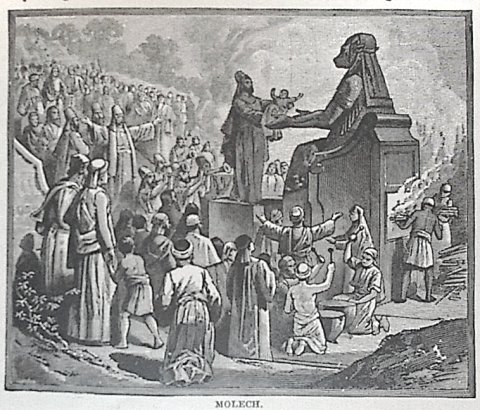
This vulgar deity is also known as Moloch, Molech, Milcom, or Malcam, Baal Hammon and his consort Tanit, and in Greek Kronos because of the parallels of that deity devouring his children. Worshippers of this aberration of human nature built huge bronze statue of a grotesque beast with the head of a bull and the body of a man with outstretched hands. There was a large bronze brazier in front of the image. The image and brazier were heated red hot. Infants and children were placed in Moloch’s hands to be burned alive. Their bodies would fall into the brazier and be burned beyond recognition. The World has developed a less obvious form of the sacrifice of innocents to a more palatable “god.” We kill preborn and newborn infants in the womb and on the operating table for the deity called Self. It is no less evil than what was done in the name of Moloch. Evil like this has become so commonplace that mentioning it in the news, in the Government, and in day-to-day life has – for many – become trite and unnoticeable. It is reminiscent of the book by Hannah Arendt called “The Banality of Evil” about the revelations at Nuremberg. People knew about the atrocities and ignored them. That, too, is evil.

Here are some Scriptures related to sacrificing children:

Acts 7:42-43 42 But God turned away from them and handed them over to worship the host of heaven, as it is written in the book of the prophets: ‘Did you offer to me slain victims and sacrifices forty years in the wilderness, O house of Israel? 43 No; you took along the tent of Moloch, and the star of your god Rephan, the images that you made to worship; so I will remove you beyond Babylon.’

Jeremiah 7:30-32 30 For the people of Judah have done evil in my sight, says the Lord; they have set their abominations in the house that is called by my name, defiling it. 31 And they go on building the high place of Topheth, which is in the valley of the son of Hinnom, to burn their sons and their daughters in the fire – which I did not command, nor did it come into my mind. 32 Therefore, the days are surely coming, says the Lord, when it will no more be called Topheth, or the valley of the son of Hinnom, but the valley of Slaughter: for they will bury in Topheth until there is no more room.

Jeremiah 19:4-6 Because the people have forsaken me, and have profaned this place by making offerings in it to other gods whom neither they nor their ancestors nor the kings of Judah have known, and because they have filled this place with the blood of the innocent, and gone on building the high places of Baal to burn their children in the fire as burnt offerings to Baal, which I did not command or decree, nor did it enter my mind; therefore the days are surely coming, says the Lord, when this place shall no more be called Topheth, or the valley of the son of Hinnom, but the valley of Slaughter.

Leviticus 20:2-5 Say further to the people of Israel:

Any of the people of Israel, or of the aliens who reside in Israel, who give any of their offspring to Molech shall be put to death; the people of the land shall stone them to death. I myself will set my face against them, and will cut them off from the people, because they have given of their offspring to Molech, defiling my sanctuary and profaning my holy name. And if the people of the land should ever close their eyes to them, when they give of their offspring to Molech, and do not put them to death, I myself will set my face against them and against their family, and will cut them off from among their people, them and all who follow them in prostituting themselves to Molech.

Belovéd, our hearts are to be a storehouse of Love and Goodness so that from that storehouse we can bring out great Treasures of more Goodness and Love. My heart, your heart, our hearts ARE truly grieved and sickened by this vile and violent evil; witness Exodus 23:2 You shall not follow a majority in wrongdoing; when you bear witness in a lawsuit, you shall not side with the majority so as to pervert justice. Is the preference for murder truly a majority opinion? If so, we are in jeopardy of the same justice as the perpetrators of such evil. Some of you may, by now, be thinking. “Hey! Stick to Bible lessons and stay out of politics!” Folks, this is not politics – although many, many try to make it about that. This is about morality, ethics, Goodness and Love; it is about Life as God has ordained, not as earthlings have maintained. We know that Good and Evil battle through our days like ravenous beasts. We know God knows that too, and we can see by looking at terrorists, “religious” fanatics, selfish choices that lead to innocent deaths, and obscene acts of fornication and abuse that God has allowed the Tares to grow with the Wheat. (See 1035AFC082710) Even among the Apostles, there was a traitor; he did what he did without interference from Jesus, and it cost him his eternity with God. We are not the deity that created and controls the Universe, nor are we the “deity” created by the hands of men to take innocent lives for selfish reasons. We are not deities at all. It’s time we start being more visibly, vocally, and viscerally outspoken about those who have taken up the mantle of deity for themselves. That is how they have decided to fill their glasses, with sacrilege, blasphemy, and desecration. That is the treasure they have chosen. That is what fills their hearts – Evil. Our hearts are not like their hearts. We can speak out against this evil. You may phone the U.S. Capitol Switchboard at (202) 224-3121. A switchboard operator will connect you directly with the Senate office you request.


We know that the glass is ALWAYS FULL. It might have 120 cc’s of water and 180 cc’s of air, but still, it’s full. If you’re a fish, the water is great. If you’re a butterfly, the water’s not so great. But you know, we usually end up where we’re supposed to be, doing what we’re supposed to do, and living as we’re supposed to live. We may regret some of our choices, but those choices make us who we are and brought us to this point in life. If you think about it, that’s not half bad. We can choose to defend Life – or not. What shall we do, then? Go all radical and protest in the streets? Perhaps that’s not what is required in your life right now, but try this: Give God a little PUSH. Pray Until Something Happens. Take up the FROG – Fully Rely On God. Exercise your FAITH – “Fully Aware I Trust Him.” Are you afraid someone will disagree with you? Remember, FEAR is False Evidence Appearing Real. When you look at your worried face in the mirror, tell yourself “Relax! God’s got this!” BE in him as he is in you. Think of John 16:33 33 I have said this to you, so that in me you may have peace. In the world you face persecution. But take courage; I have conquered the world! Go forth and bear fruit that is Good (See also John 15:16)

Which treasure chest suits us best? The one empty one with the long tongue and ferocious teeth or the one overflowing with All Good things? With which treasure do you choose to be filled?


Please read 2 Peter 2:4-12. Thank you for enduring this L-O-N-G post!

Unless otherwise indicated, all scripture passages are from the New Revised Standard Version Catholic Edition (NRSVCE) New Revised Standard Version Bible: Catholic Edition, copyright © 1989, 1993 the Division of Christian Education of the National Council of the Churches of Christ in the United States of America. Used by permission. All rights reserved.

Biblical languages inserts from Bible Hub (Bible Hub: Search, Read, Study the Bible in Many Languages) Visit at http://biblehub.com

Creative Commons License
Aloha Friday Messages by Charles O. Todd, III is licensed under a Creative Commons Attribution-ShareAlike 3.0 Unported License

     Proverbs31:8 Speak up for those who cannot speak for themselves; ensure justice for those being crushed. Taken from the Holy Bible, New Living Translation, copyright © 1996,      2004, 2015 by Tyndale House Foundation. Used by permission of Tyndale House Publishers, Inc., Carol Stream, Illinois 60188. All rights reserved. New Living Translation (NLT)


Aloha Friday Message – February 22, 2019 – Our Call to Mercy

1908AFC022219 – Our Call to Mercy

Read it online here, please. And please, when you visit there, use one of the social media links at the bottom of the page to share this post. Thank you! And remember, we now have a READER VIEW available, so share this link or this email often.

   Psalm 103:2-3a Bless the Lord, O my soul, and do not forget all his benefits – who forgives all your iniquity …

Psalm 51:10-12 10 Create in me a clean heart, O God, and put a new and right [steadfast] spirit within me. 11 Do not cast me away from your presence, and do not take your holy spirit from me. 12 Restore to me the joy of your salvation, and sustain in me a willing [generous] spirit.

Aloha nui loa, ʻŌmea! We are already preparing for the 8th week in Ordinary Time. Ash Wednesday will be March 6th – just 10 days from now! What kind of series – if any – would you like to see this Lenten Season? Drop me a line via return email, or leave a comment on the blog site at https://aloha-friday.org/ or at the end of this post; just scroll to the very bottom and look for Leave a Reply Your email address will not be published.

OK, enough with the commercials! Let’s get into The Word. A few years back we did a four-part Mercy Series – it was also seen at Catholic 365: Mercy Series. There is a very specific reason I titled this essay Our Call to Mercy. To help explain it, we will share an observation about one of the most successful television franchises – Star Trek. It’s one of those Trekkie Trivia Treasures: What does the Captain of the Enterprise say after s/he gives orders for the course to be laid in and the engines to be activated? It sounds like this – “Lay in a course for heading 275 mark 187.” (Navigator response: Course laid in Sir) “All ahead Warp 6.” (Helm response: Aye, Captain, ahead Warp 6) Q: What does the Captain say to execute that order? A: Engage. That is what we should be doing when it comes to Our Call to Mercy – we are to engage; move forward on a proper heading as directed. To help clarify, let’s look at what we mean by engage:

   In this context, engage is similar to interlock or mesh as when gears or cogs interlock. But it is more like the intransitive verb which means to enter into or to participate. It is to act reciprocally with mutual input and response. This sense of  engage is not just to receive passively, but to actively give and receive with intentionality; to fully involve and include the entire transactional  input and output that influences or affects all participants. Blather. Blather. Blather. Our Call to Mercy is to [1] acknowledge and receive God’s mercy and [2] to  give others mercy unconditionally. “That’s not surprising,” you may say. “Didn’t Jesus tell us to be as merciful as God?”

You remember well, ʻŌmea. Here is the passage: Luke 6:36 36 Be merciful, just as your Father is merciful. And of course there’s this: Matthew 5:7 Blessed are the merciful, for they will receive mercy. We know that our reward from God will be based on how well we followed Jesus’ command: John 13:34 34 I give you a new commandment, that you love one another. Just as I have loved you, you also should love one another. That kind of love – agape love – is also unconditional and characterized by kindness, mercy, and grace. This is all summarized in the passage most-often quoted here: Micah 6:8 He has told you, O mortal, what is good; and what does the Lord require of you but to do justice, and to love kindness, and to walk humbly with your God? There are many words used in Scripture which connote mercy. Among them are: Kindness, lovingkindness, mercy, graciousness, compassion, pity, benevolence, forbearance, forgiving, goodness, lenience, tenderness, favor, goodwill, charity, faithfulness, salvation.

All of these are GIFTS from God. WE cannot earn them, cannot buy them, cannot barter for them, or even really understand these gifts. They are overwhelmingly generous, incredibly opulent, and eternally accessible. We need only accept them in the same way as he gives them, and they are ours. But there’s more to it than that, isn’t there?

To recall something from last week, God rules the Universe, and therefore the Universe is governed by God’s Rules – his commandments and his Perfect Plan. One of those rules states that WE have to share every Gift we are given. It’s so simple it’s obvious, but then sometimes the obvious isn’t so simple. We know what we would be like without God’s Mercy – miserable. We are created in the image and likeness of God; whatever God is we are to be. God is Holy, we must be holy. God is Love, we must be loving. God is Forgiving, we must forgive as he forgives – completely. God is Merciful, we must show others mercy – even our enemies. He has even told us what will happen if we cannot stay engaged in his Plan in James 2:13 13 For judgment will be without mercy to anyone who has shown no mercy; mercy triumphs over judgment [condemnation]. God’s Mercy is available all the time everywhere to everyone; the Psalmist illustrates this by saying things like “I called upon the name of the Lord, and he answered me,” and “Hear, O Lord, the sound of My Call.” (↔ Music Link) WE call to God for mercy, and HE answers that call in accordance with his will. Sometimes his will is that we are granted reprise, relief, or even redemption from our adversity. Sometimes his will is that Mercy is best served by our suffering; this is hard for us to hear, because when we ask for mercy, we expect our pain to end. That’s not the Rule. The Rule is that God decides, we don’t. God is righteous, we are not, and we cannot, therefore, make a righteous choice.

We know we can depend on him and his Mercy because of his Righteousness – his infinitely perfect holiness. Psalm 116:4-5 Then I called on the name of the Lord: “O Lord, I pray, save my life!”  Gracious is the Lord, and righteous; our God is merciful; and Psalm 123:3 Have mercy upon us, O Lord, have mercy upon us, for we have had more than enough of contempt. We can also depend on his Justice – his infinitely perfect integrity. His gracious Mercy and Righteousness pervade all of creation. He created everything, and he alone knows everything (and everyone!) in all of his creation. He made them for us – all the earthlings – and all who will acknowledge that by living for, with, and in him can and will witness and enjoy his goodness and mercy forever. Such is the kindness of God who ejected Adam from Eden lest he stretch out his hand and take from the Tree of Life and thus live forever in Sin. Kindness is an attribute of God that he expects us to have and to use.

Ephesians 2:4-7 But God, who is rich in mercy, out of the great love with which he loved us even when we were dead through our trespasses, made us alive together with Chris — by grace you have been saved — and raised us up with him and seated us with him in the heavenly places in Christ Jesus, so that in the ages to come he might show the immeasurable riches of his grace in kindness* toward us in Christ Jesus.

* kindness – χρηστότητι (chrēstotēti) from χρηστότης (chréstotés) {khray-stot’-ace} goodness, uprightness, kindness, gentleness, kindness that is also serviceable. – See Galatians 5:22-23 where kindness is listed among the Fruit of the Spirit.

When we choose to be unkind, we choose to be ungodly, and that is one very unwise choice! God alone chooses wisely: Romans 9:15-18 15 For he says to Moses, “I will have mercy on whom I have mercy, and I will have compassion on whom I have compassion.” 16 So it depends not on human will or exertion, but on God who shows mercy. 17 For the scripture says to Pharaoh, “I have raised you up for the very purpose of showing my power in you, so that my name may be proclaimed in all the earth.” 18 So then he has mercy on whomever he chooses, and he hardens the heart of whomever he chooses. ( See Exodus 33:19, and Exodus 9:16) We are all in need of Mercy, and inasmuch as we call for Mercy and receive Mercy, we are similarly to possess Mercy and give Mercy. Everyone, every living soul, requires and receives Mercy:  Romans 11:32 32 For God has imprisoned all in disobedience so that he may be merciful to all. It was disobedience that cut us off from the direct Mercy of God – living completely in his presence. It is the Grace of Obedience that restores us to the direct mercy of God. The Grace of Obedience leads us to the requisite for forgiveness: Repentance. From the beginning, God expects repentance as our response to his privilege of Mercy: Joel 2:13 13 rend your hearts and not your clothing. Return to the Lord, your God, for he is gracious and merciful, slow to anger, and abounding in steadfast love, and relents from punishing. This is because 22 The steadfast love of the Lord never ceases, his mercies never come to an end  – Lamentations 3:22. We repent – acknowledge our sins and confess our weakness – and we are restored: Leviticus 26:40, 42 40 But if they confess their iniquity and the iniquity of their ancestors, in that they committed treachery against me and, moreover, that they continued hostile to me – 42 then will I remember my covenant with Jacob; I will remember also my covenant with Isaac and also my covenant with Abraham, and I will remember the land. It is foolishness to avoid repentance: Proverbs 28:13 13 No one who conceals transgressions will prosper, but one who confesses and forsakes them will obtain mercy.

The outcome of this is a total transformation: Philippians 3:21 21 He will transform the body of our humiliation that it may be conformed to the body of his glory, by the power that also enables him to make all things subject to himself. We once again become subject to, and therefore in union with, God. 1 Corinthians 15:49 49 Just as we have borne the image of the man of dust, we will also bear the image of the man of heaven. We have an Earthly family in the Fellowship of the Holy Spirit, and a Heavenly Family in  the Eternal Communion of the Saints: Romans 8:29 29 For those whom he foreknew he also predestined to be conformed to the image of his Son, in order that he might be the firstborn within a large family.

We call upon God for Mercy, and Mercy we must share; this creates in us a clean heart, a heart governed by Mercy and Love. If you acquire A Clean Heart (↔ Music Link), would you lose your heart of stone? (↔ Music Link) Then indeed each of us can say, Bless the Lord, O my soul, and do not forget all his benefits – who forgives all your iniquity …. When it comes to Mercy, our order from the Lord is “ENGAGE!”

Whatever, whenever, wherever, whoever, however, if ever, forever —

at your service, Belovéd!

Unless otherwise indicated, all scripture passages are from the New Revised Standard Version Catholic Edition (NRSVCE) New Revised Standard Version Bible: Catholic Edition, copyright © 1989, 1993 the Division of Christian Education of the National Council of the Churches of Christ in the United States of America. Used by permission. All rights reserved.

Biblical languages inserts from Bible Hub (Bible Hub: Search, Read, Study the Bible in Many Languages) Visit at http://biblehub.com

Creative Commons License
Aloha Friday Messages by Charles O. Todd, III is licensed under a Creative Commons Attribution-ShareAlike 3.0 Unported License

Aloha Friday Message – February 15, 2019 – Come Back Again

1907AFC021519 – Come Back Again

   Jeremiah 17:5-6 Thus says the Lord:
Cursed is the man who trusts in human beings,
who makes flesh his strength,
whose heart turns away from the Lord.
He is like a barren bush in the wasteland
that enjoys no change of season,
But stands in lava beds in the wilderness,
a land, salty and uninhabited.

Read it online here, please. And please, when you visit there, use one of the social media links at the bottom of the page to share this post. Thank you! And remember, we now have a READER VIEW available, so share this link or this email often.

Aloha nui loa, ʻŌmea! Happy Valentine’s Day! How wonderful it is to have someone in your life who loves you enough to put up with you. Do you know why? Because that’s the way God loves every single one of us! No matter how badly we mess up, or how often, whenever we come back to him and say, “I’m sorry. I’ll try to stop that,” he just keeps forgiving us. Oh, it’s true, he’ll let the consequences of our missteps take their course – maybe toned down a bit – but he’s always got his arms open to hug us and his hands filled to bless us. I confess I am amazed at how many people I see in just my narrow sphere of contacts who stalwartly ignore, deny, and even renounce him. Let’s see what The Word holds for this weekend.

In the weekend’s readings, we learn about the hope we have in the Goodness of the LORD. We know God takes care of everything we need, and yet so many times we reject his blessings and choose to do it ourselves. Jeremiah tells us that when we turn away from the Lord like that we are “like a barren bush in the desert that enjoys no change of season, but stands in a lava waste, a salt and empty earth.” In the same way, the Psalmist tells us we are blessed when we do not choose to follow “the counsel of the wicked, or walk in the way of sinners, or sit in the company of the insolent.” Blessed instead are they who hope in the Lord. St. Paul tells the Corinthians that it is unwise to disbelieve that Christ has been raised from the dead because “if Christ has not been raised, your faith is vain; you are still in your sins.” Finally, in “The Sermon on The Plain,” Jesus reprises some of the same themes heard in the Beatitudes found in the Gospel of Matthew: Blessed are the poor, the hungry, the weeping, and the hated. God will give you all that you need to be fulfilled. As good stewards, we willingly serve the Lord and know that he rewards all of his “good and faithful servants” with the best of all he has. It is remarkable to see how often we reject his best and embrace what remains – our mess.

In the daily torrent of information washing over and around us every waking moment, we have little control over what others say and do. Everything we say and do can be a target for angry dispute by just about anybody else – and sometimes the results are ridiculous. Say the sky is blue and someone will argue that it really isn’t blue and we only believe it is because we have a bias against orange. Give a meal to a hungry homeless person, and we are labeled as a racist because we didn’t feed someone of another ethnicity even if no person of other ethnicity is present. There just isn’t any way to be right any more. How can this be? How is it that any person can tell me I am wrong if only because they are right? It sort of reminds me of what parents often tell their kids when the kids challenge them with the eternal “WHY?!” What do we answer moms and dads? “BECAUSE I SAID SO!

We should be in authority over our children, but – honestly – that just doesn’t seem to be happening as it should any more. We have abused and misused the inspiration we are intended to draw from family to the point that our global society is more favorable toward killing unborn – and now even just-born – infants, “euthanizing” sick or dying adults, murdering masses of people because they are “different,” and destroying our planet to amass more wealth and power. We have polluted everything from our air, land, and water to our heart, minds, and souls. It is the latter pollution that threatens us most – and for far too many people, concerns us least. We’ve wrecked just about every ecology there is.

When we talk about ecology, we usually never think of the ecology of the soul in the same terms as God does. There is a book called The Ecology of the Soul – Peace, Power and Personal Growth for Real People in the Real World by a guy named Aidan Walker. Honestly, I can’t recommend reading it – or even looking for it. It’s mostly New Age claptrap about finding all the answers by looking inside yourself. He does have at least one thing in proper perspective – though poorly described – when he says, “any belief is intuitive.” We’ve presented this idea here before, but from a non-humanistic point of view. Walker’s writings preclude the presence of God, so right off the bat he leaves me wondering. “Hey, wait!” you might say. “Aren’t you doing what you were griping about just a moment ago, finding something wrong with another’s point of view just so you can ‘be right’?” You could say that; you could even believe that; however, if we make a start at explaining Life and leave God out of it, there’s no way to “be right.” Without a Divine Creator – which every world culture, every religion, every “spirituality” expresses a belief in some form – there is nothing left but superstition, imagination, and nonsense. Am I saying that Walker and his ilk have muddied their vision of Truth? Absolutely, because they deny that there is A Truth. I usually bring in this quote when discussing Truth, so – even though you may have heard it or read it previously – I ask you to read this quote (emphasis added) from Frank Peretti carefully:

“There is no way for you to know whether what I am telling you is True, unless you know what the Truth is. And there’s no way for you to know what the Truth is unless there is a Truth that you can know! You’ve got to have a Truth that is True, whether you believe it or not, boom! It’s True whether you like it or not, boom! It’s True whether you even know about it or not, boom! It’s just TRUE! Objective, external Truth that stands in and of itself. The bible talks all about that; from cover to cover it talks about the Truth. And the Lord says, “I am the Lord thy God, I declare what is true, I declare what is right.”

Here is The Truth:

Isaiah 45:18-19 – 18 For thus says the Lord, who created the heavens (he is God!), who formed the earth and made it (he established it; he did not create it a chaos, he formed it to be inhabited!): I am the Lord, and there is no other.

19 I did not speak in secret, in a land of darkness; I did not say to the offspring of Jacob, “Seek me in chaos.” I the Lord speak the Truth, I declare what is Right. We as a World Culture have settled on the “Politically Correct” invention of Relativism – “What’s true for me may not be true for you. There is no universal moral standard by which to judge others, we ought to tolerate the behavior of others even when it runs counter to our personal or cultural moral standards. There cannot be any single objective standard for moral judgments on any matter.” Pontius Pilate sort of hit the nail on the head when he asked, “What is Truth?”

As humans, we find it easier, for some reason, to define Truth by listing all the things it isn’t. Unfortunately that perpetuates a lot of “knowledge” that isn’t true. One would think that attaining knowledge is the first step to obtaining Truth, but (watch out now) we know that isn’t True because we know there is knowledge that isn’t true – fake news for example. In human terms Truth has to be supported by objective verifiable facts and in accordance with reality. Well, the fact is that Truth is in trouble because we no longer believe in external objectivity; objectivity has become a personal possession that I, that you, that we take hold of and rearrange in whatever manner pleases us at the moment. In doing so, we deny the Unity of Truth – moral, religious, scientific, philosophical, Truth and so on. Going back to Walker’s idea that religion is “intuitive,” we can once more visit what the Apostle Paul said about the ubiquity of the knowledge of God among and throughout his Creation:

Romans 1:20-25 20 Ever since the creation of the world his eternal power and divine nature, invisible though they are, have been understood and seen through the things he has made. So they are without excuse; 21 for though they knew God, they did not honor him as God or give thanks to him, but they became futile in their thinking, and their senseless minds were darkened. 22 Claiming to be wise, they became fools; 23 and they exchanged the glory of the immortal God for images resembling a mortal human being or birds or four-footed animals or reptiles.

24 Therefore God gave them up in the lusts of their hearts to impurity, to the degrading of their bodies among themselves, 25 because they exchanged the truth about God for a lie and worshiped and served the creature rather than the Creator, who is blessed forever! Amen.

God created the Universe – and he himself is not the Universe – and so whenever we break, defy, deny, ignore, and/or mock the Rules of the Universe, we are WRONG, and everything that is WRONG is not the Truth! In our hearts we know it is wrong to murder children in the womb; to destroy priceless history because it didn’t come from our culture; to blame people for mistakes made 10, 50, 100, or 1,000 years ago despite the objective Truth that the mistake was a learning opportunity that resulted in a better understanding of what IS true. God is always pleased when we admit we are wrong and repent – we turn around and come back to him. God is not pleased when we hammer another person with their own past for the sole purpose of personal aggrandizement by public denigration of others. That’s not standing up for the Truth. That is hindering truth, and that is wrong. You and I can believe whatever we want, but our belief is irrelevant as to whether or not what we believe is True. Everyone has experience in believing a lie; so, too, has everyone experience in believing what is True. One must ask, then, why do we believe in lies?

It is the sinfulness, the pollution if you will, of human nature to try to restructure Truth to fit our own desires. Eve and Adam thought they could be more like God if they knew the difference between good and evil. The Truth is that they became less like God through their disobedience. We can think of truth in many of the same terms we use for Love in 1 Corinthians 13:4-8a: Truth is patient, kind, not envious or boastful or arrogant or rude or selfish or irritable or resentful; it does not rejoice in sinning, but rejoices in the Truth. It bears all, hopes all, endures all; Truth never ends. Truth never changes. Truth always prevails. If we want to know Truth, we have to learn Truth, and to learn Truth, we must consider truth: Philippians 4:8 Finally, beloved, whatever is true, whatever is honorable, whatever is just, whatever is pure, whatever is pleasing, whatever is commendable, if there is any excellence and if there is anything worthy of praise, think about these things.

I am going to close this with a list of references about Truth. It is my hope that you will actually use all these references. In this table, there are many Bible passages that are “worthy of praise” because they are honorable, just, pure, commendable, and excellent. Think on these things and Truth will out. Come back again to God who alone is Truth. Trust God, not humans.


Job 34:12 Psalm 52 Psalm 53 Jeremiah 7:28
Ezekiel 13:3-9a Matthew 22:16 John 1:17 John 4:23-24 *
John 8:31-45 Romans 1:18-25 Romans 2:5-10 2 Thess 2:7-12 *
1 Timothy 6:3-7 2 Timothy 4:3-4 * Hebrews 10:26-31 2 Peter 1:19-2:17 *
James 4:1-10 * Please read at least these four important passages.


Unless otherwise indicated, all scripture passages are from the New Revised Standard Version Catholic Edition (NRSVCE) New Revised Standard Version Bible: Catholic Edition, copyright © 1989, 1993 the Division of Christian Education of the National Council of the Churches of Christ in the United States of America. Used by permission. All rights reserved.

Creative Commons License
Aloha Friday Messages by Charles O. Todd, III is licensed under a Creative Commons Attribution-ShareAlike 3.0 Unported License

Aloha Friday Message – February 8, 2019 – Get Going!

1906AFC020819 – Get Going and Go where I send thee! (↔ Music Link)

Read it online here, please. (And be sure to use that Music Link up there!)

Mark 16:15-16 15 And he said to them, “Go into all the world and proclaim the good news to the whole creation. 16 The one who believes and is baptized will be saved; but the one who does not believe will be condemned.”

E pili mau na pomaika‘i ia ‘oe a me ke akua ho’omaika’i ‘oe, ʻŌmea! (May blessing always be with you and may God bless you, Beloved!) Let me begin by saying how much I look forward to making these little messages for you. I think it’s one of the most satisfying things I do on a regular basis – more fulfilling even than cooking and eating (and that’s saying something!). As I looked ahead to this weekend’s reading, I remembered that not long ago I shared with you my delight in the collection of readings for this week. All four are among my most-cherished scriptural treasures! In addition, as I prepared for this week, our family had a unique experience. In our Parish, we are “making a big deal” about National Catholic Marriage Week. Crucita and I believe it is so important that married couples – and especially couples planning on getting married – understand that sacramental intent and value of Matrimony. We had a wonderful celebration with members of our church community and Crucita and I were selected as one of two long-married couples to address the audience that night. We will be hitting number 50 in April. The other couple will be reaching their 57th in March! I’ve posted our presentation online so you could see how Crucita and I chose to start our marriage as a Christ-centered commitment to each other and to God through the Vocation of Holy Matrimony. You can see that presentation here.

As always, I want to encourage you to use the links I put in (that music link at the top is a classic in Television History). There are several GREAT music links. Use them, please? So, there’s the latest news. Let’s get going with the Good News. I confess a substantial amount of this comes from a previously published message, but I also proclaim that my excitement and joy over the content has only grown and the content is improved!

    This Sunday is one of my favorite Sundays because it has so many of my favorite passages. We start out with Isaiah 6:8 Then I heard the voice of the Lord saying, “Whom shall I send, and who will go for us?” And I said, “Here am I; send me!

I always liked that. It was, in a special way, part of my decision to give my life to “Full Time Christian Service” at age 10 at Camp IdRaHaJe – which is an abbreviation for “I’d Rather Have Jesus.” (↔ Music Link) Later – in high school – I thought I had a calling to the Ministry in the Reformed Church in America. Long story short, one thing led to another, the Draft happened, and that idea faded away in that form, but persisted in a way God had chosen for me before my mother knew me. (Think about last week’s Key Verse.) The message for that calling was “Preach my Word.” Once I was in the Air Force, I was led to my conversion in the Catholic Church. Just two weeks after my first fully Catholic day, I married the love of my life – Crucita – and not long after, the message in the call became “Teach my Word.” I’m still working on that directive.

The Psalm this week is Psalm 138. It is my all-time-favorite Psalm. The first two verses are filled with wonderful praise:

Psalm 138:1 I thank you, Lord, with all my heart;
    in the presence of the angels to you I sing. New American Bible (Revised Edition) (NABRE)

I like that part about singing in the presence of the Angels. It reminds me of Psalm 22:3 which says that God “inhabits the praises of his people.” The rest of the Psalm is so reassuring. God will surely hear the cry of the suffering.

The Epistle for this Sunday is one that steadies me with grateful conviction. It is a continuation of the readings from 1 Corinthians, this time in chapter 15, just a few pages over from where we were last week in 1 Corinthians 13. Paul is describing how he received the Gospel, “as to one born abnormally,” when Jesus met him on the road to Damascus. 1 Corinthians 15:10 10 But by the grace of God I am what I am, and his grace toward me has not been in vain. On the contrary, I worked harder than any of them—though it was not I, but the grace of God that is with me. This verse always reminds me that I have not yet worked as hard as I should, or as hard as I can, on behalf of the Gospel. I am what I am by the grace of God, though, and he constantly challenges me to be a better steward of the many, many gifts he has presented me in my life. There is absolutely no logical reason why he should be so gracious to me; and yet, the Gifts he showers down are beyond my understanding.

    As we move to this week’s Gospel from Luke, we take a look at Luke’s version of the calling of the fishermen – Peter and the Sons of Zebedee, James and John. He’s directed Peter to cast his net in deep water for a catch. Peter gets a little snarky and says, “We’ve been fishing all night, but if you say so, I’ll do it.” And when he hauls the net back, it’s so full he has to call the bar Zebedee brothers to help him bring it in. Peter – and everyone else (except Jesus of course) – is astonished at the size of the catch. Peter is so spooked he says, “Depart from me Lord, for I am a sinful man.” Then we read in Luke 5:10b-11 Then Jesus said to Simon, “Do not be afraid; from now on you will be catching people.” 11 When they had brought their boats to shore, they left everything and followed him. That is the basis for the wonderful Bible chorus “I will make you Fishers of Men.” (↔ Music Link) More importantly, is demonstrates how to best respond to a call from The Master: … they left everything and followed him.

By the time Jesus was ready to ascend back to Heaven, the Apostles were better prepared to follow Jesus’ next instructions. Instead of “follow me,” his new command was what we read in Mark at the top of this post: Mark 16:15-16 15 And he said to them, “Go into all the world and proclaim the good news to the whole creation. 16 The one who believes and is baptized will be saved; but the one who does not believe will be condemned.”  (YOLO-F again) You may remember it as “proclaim the Gospel to every creature.” However you remember it, the important thing is that we are to go “into all the world.” It is also important to remember that it is we who do the going and God who does the sending. Belovéd, we often forget that order of events. We are all sent to proclaim the Good News. That duty is inherent in our response to his call – “Follow me.” Will we? Will we follow him? I will follow him (↔ Music Link) because by the grace of God, I am what I am.” And what am I?

I’m a people-catcher. One of my most joyous avocations is the desire and ability to look for and to find exceptional people and then GLOW on them! I got caught up in his net of Love, and when he asked “whom shall I send,” the Love in me and around me said “Me! Me!  Pick me!  I know!” That’s a more contemporary version of “Here am I; send me!”  It’s plain to me that I’d Rather Have Jesus Than Anything, because he did pick me; and then he sent me. I want you to just take a moment to look at these words that are translated as send:

John 20:21 21 Jesus said to them again, “Peace be with you. As the Father has sent* me, so I send you.”

* Jesus was sent as in ἀποστέλλω (apostelló) {ap-os-tel’-lo} from apó, “away from” and stéllō, “send”) – properly, send away, i.e. commission; (passive) “sent on a defined mission by a superior;” to bid something to be carried to another. Jesus sent the Apostles as in πέμπω (pempō) {pem’-po} – I send, transmit, permit to go, put forth. In Romans 10:15 (see link below), Paul uses apostelló. We are sent – yep, that’s a “we” meaning you and I – we are sent that they might believe. It is vitally important, then, that we know what we believe. How do we learn that? By feasting on the Word. It is my privilege and joy to send along these little “travelers’ snacks” along The Way.

But what about that last phrase in the quote from Mark? Isn’t that kind of a downer? Why would Jesus say, “but the one who does not believe will be condemned.”? Let’s take another look at The Most Famous Bible Verse in context: John 3:16-18 16 “For God so loved the world that he gave his only Son, so that everyone who believes in him may not perish but may have eternal life. 17 Indeed, God did not send the Son into the world to condemn the world, but in order that the world might be saved through him. 18 Those who believe in him are not condemned; but those who do not believe are condemned already, because they have not believed in the name of the only Son of God.” THAT is why we are sent; that is the urgency with which we are charged. The Apostle Paul sums up that responsibility very nicely in his letter to the Romans:

Romans 10:14-17 14 But how are they to call on one in whom they have not believed? And how are they to believe in one of whom they have never heard? And how are they to hear without someone to proclaim him? 15 And how are they to proclaim him unless they are *sent? As it is written, “How beautiful are the feet of those who bring good news!” 16 But not all have obeyed the good news; for Isaiah says, “Lord, who has believed our message?” 17 So faith comes from what is heard, and what is heard comes through the word of Christ. What have we heard? Is it the voice of the Master? Are we worthy of being sent?

All three of the persons in today’s readings felt they were unworthy, argued they were incapable of doing what God required of them. All three of them were willing, however, to “let go and let God.” We are often reminded over social media, in homilies and sermons, and in our own observations of day-to-day life that “God does not call the qualified. He qualifies the called.” As Catholics are reminded daily, we need only accept The Healing Word as we paraphrase Matthew 8:8Lord I am not worthy that you should enter under my roof, but only say the word and my soul shall be healed. I can hear my Savior calling, (↔ Music Link) and I’m asking you to walk along with me through the Garden. Can you hear him? It’s not just me he wants. He wants everyone, especially the unworthy. It’s a LOVE thing! Where in your life is there someone waiting to hear the Word from you, children? Go, children! You are sent! (And as you saw in that video with Tennessee Ernie Ford, going can be a LOT of fun!) Come on, let’s say it together:

Here am I! Send me!” (↔ Music Link) LET’S GET GOING, THEN!

Whatever, whenever, wherever, whoever, however, if ever, forever — at your service, Belovéd!

Please pray with us here at Share-a-Prayer.

Unless otherwise indicated, all scripture passages are from the New Revised Standard Version Catholic Edition (NRSVCE) New Revised Standard Version Bible: Catholic Edition, copyright © 1989, 1993 the Division of Christian Education of the National Council of the Churches of Christ in the United States of America. Used by permission. All rights reserved.

Biblical languages inserts from Bible Hub (Bible Hub: Search, Read, Study the Bible in Many Languages) Visit at http://biblehub.com

Creative Commons License
Aloha Friday Messages by Charles O. Todd, III is licensed under a Creative Commons Attribution-ShareAlike 3.0 Unported License


A Speech for Valentine’s Special Celebration

A Speech for Valentine’s Special Celebration

On Friday, February 1, 2019, Crucita and I were 1 of 2 couples invited to speak to a small gathering of couples who had been married or were planning to marry. This is what we told them:

Good evening. I am Crucita Todd,

          And I am Chick Todd

This April 19th we will have been married 50 years.

          When we got married, the people who knew us thought it would last only 6 weeks.

Actually it’s already been 2,597… long … weeks.

 We met in the Air Force 11/4/1968 I proposed on 1/4/1969. Actually, I proposed three times before she said yes. We were married on April 19, 1969 in Chapel 2 on Lackland AFB.

During that “courtship period,” we agreed that we would have a Christ-centered marriage. Both of us grew up in strongly Christian families. My parents were deeply religious and they shared that with all their children and grandchildren. I was the youngest in their family. I recall as a shild that my dad would go to clean the church, and he took me with him. My job was to dust the pew, so from an early age, I learned to serve. For years – even up through high school – my parents prayed the Rosary every evening, and of course I was part of that too – and so was anyone else who happened to be in the house. We had special traditions like Las Posadas that we shared every year. My parents gave our entire family a great example of committed Christian living.

My parents were also very committed Christians. They were active in many groups in our church and led their 6 children to get involved also. We went to church several days every week – Sunday morning Sunday school at 8:30, then Church Service at 9:30, the Evening Service at 5:30, then Wednesday night prayer group; and as we grew older, there were youth groups, and Bible camps. We knew that every hour of every day belonged to Jesus. Between the two of us as we started our marriage, we already knew the value of Christian living and a Christ-centered life. That would mean that Christ was always going to be part of our relationship.

We knew we had to be fully committed to something outside of us and larger than us.

 We knew that Matrimony is a Covenantal Vow, a sacrament which is a promise to God & to each other & the World, including the Church.

The promise is to give and receive faithfully

 between the three of us – for and with each other. There are always three3 persons in everything we do.

Some people don’t understand that. I once had a student who asked me, “Well doesn’t that get crowded in bed?”

And that’s an example of an important aspect of a long and happy marriage: HUMOR.

He … WE … are always telling the same old

                    BAD JOKES. BUT WE STILL LAUGH AT THEM!

We choose to live our lives as not Confrontational (hands →←), but always Looking upward and going onward (hands↑↑)

We are not “friends.” We are coworkers in the Kingdom because we are OF THE SAME FLESH. And that’s the part where children come in. You have to have some romance and do the work of making babies.

In article 1601 of the Catechism of the Catholic Church it says, “The matrimonial covenant, by which a man and a woman establish between themselves a partnership of the whole of life, is by its nature ordered toward the good of the spouses and the procreation and education of offspring; this covenant between baptized persons has been raised by Christ the Lord to the dignity of a sacrament.”

We make it a point to never forget that Matrimony is a sacrament Established by God as an integral part of his Plan for all humanity. It’s the way the Universe works. It’s the way children become citizens of The Kingdom.

In our house, we were “pregnant for 9 years” Before we adopted our son, Timothy. We prayed for a child, and God answered our prayer just as he answered Hannah’s prayer.

 We got that little boy, and turned around, and THE FOUR OF US – including the Lord – asked for a little sister. God granted that prayer, too.

Because our children came into a Christ-centered MARRIAGE, that means they became part of a Christ-centered FAMILY.

 For the FIVE US OF US then, that became a Christ-centered LIFE.

That kind of life requires consistent – meaning constant and correct – ongoing catechesis.

When we have our children baptized, we must pay attention when the Priest or Deacon tells us that we will be responsible for our child’s catechesis. WE must be the first teachers of our Faith. To do that well, WE will have to know our faith well enough to teach it.  That means more than just fulfilling our Sunday obligation. It means being a *MARRIED *CATHOLIC *Christian *EVERY DAY of your life.

And doing that so well that your kids know your commitment to Holy Matrimony is 100% real.

Yes, sometimes, that’s inconvenient. Sometimes it’s unpleasant, and sometimes even dangerous.

 But if you always have Christ to be part of everything you do, then getting through the tough stuff is certainly worthwhile and doable.

And there are lots of things you can do to make life richer and sweeter for your Sweetie. You need to go out and have fun together – dinner and a movie, or go to a concert or play, or even you kids’ school programs.

You can bring home some flowers. Get a nice present, go for a walk or drive just to be together. And married people can and should have sex “once in a while.”

When we were both working, we did try to help each other with the chores; or when one of us had a tough day we’d listen and share about that. And we never tried to change each other. I would never have minded if he “went out with the guys.” I just needed to know where he was. And he let me do what I wanted to do as well – school activities, for example. I went to Mexico for a whole semester to study. Later, I took care of the house and kids while he worked full time, took call at the hospital 14 miles away, and worked on his Masters Degree all at the same time.

We have always tried to do things in a way that played to our strengths, not our weaknesses – to what we have in common rather than our differences. It would be hard to find two people more different than the two of us. She like to be outside, I like to be inside. She likes the graphic arts, I like the performing arts. She loves the water, I hate being wet. And when it comes to money …

He doesn’t get any. That’s the thing. If one of you is good at finances and the other isn’t, that person – regardless of gender or role – should take charge of the finances.

It’s not a good idea for me to have money because I either spend it or give it away; and the way I spend it it’s like giving it away so NO MONEY FOR YOU! I get a little stipend once every quarter from a long-standing investment. I get to use that to finance my hobby – making earrings. That’s good enough for me – and I usually end up giving them away, too!

We take care to be respectful to each other, too. During our various jobs across the country we’ve know couples whose relationship includes mocking each other. Teasing and joking is one thing, but mockery is some bad ju-ju! We try to help each other rather than compete with each other.

For example, I make it a practice to have her coffee ready every morning when she wakes up, and to turn down the covers every night before we go to bed. There is an aspect of self-preservation in that, too, though, because without her morning coffee …..

Sometimes whether we like it or not, or even plan for it, it’s necessary for married couples to live apart – not because you can’t get along, but just because that’s simply what it takes to take care of your family. It is the little, practical things like that have added to the longevity of our 50-year marriage. Fifty years sounds like {whispered} and seems like a lo-o-o-o-o-o-ng time.

 But remember a day is as a 1000 years For the Lord,
so if he can stick with you through it all,
you should be able to do that also, with HIS help of course.

Be good to each other in ways that help strengthen the bond of Matrimony.

 And all you men, do not underestimate the intrinsic value of the phrase “YES, DEAR.”

Don’t you “yes-dear” me!

Yes dear.

You always have to have the last word don’t you?

           NO DEAR!

Well, this time you don’t.

          (whispered) YES DEAR.

And when things get really annoying – AND THEY WILL

 Remember Ephesians 5:25-27. 25 So then, putting away falsehood, let all of us speak the truth to our neighbors, for we are members of one another. 26 Be angry but do not sin; do not let the sun go down on your anger, 27 and do not make room for the devil.

Keep Christ in the center of your life, and …

 You will have a marriage that is greatly blessed,
and the devil will stay in …
well, you know!

THANK YOU!

Aloha Friday Message – February 1, 2019 – Anchored in Love

1905AFC020119 – Anchored In Love

Read it online here, please. And please, when you visit there, use one of the social media links at the bottom of the page to share this post. Thank you! And remember, we now have a READER VIEW available, so share this link or this email often.

   Jeremiah 1:5 “Before I formed you in the womb I knew you, and before you were born I consecrated you; I appointed you a prophet to the nations.”

   1 Corinthians 13:4-6 Love is patient; love is kind; love is not envious or boastful or arrogant or rude. It does not insist on its own way; it is not irritable or resentful; it does not rejoice in wrongdoing, but rejoices in the truth.

   Hebrews 10:24-25 24 And let us consider how to provoke one another to love and good deeds, 25 not neglecting to meet together, as is the habit of some, but encouraging one another, and all the more as you see the Day approaching.

Aloha nui loa, ʻŌmea! Much LOVE to you, Belovéd! Can you believe it? One month of 2019 is already gone! It’s getting difficult to keep track of things when time is just a blur. We hope that those of you who are enduring extreme weather are finding comfort in the warmth of the love shared among all your loved-ones near and far. Love does indeed warm the heart and soul and at times even the body. Love is … well, let’s look a little more closely at some ideas about Love.

   The key verse today is from the Old Testament reading for this coming Sunday. The Lord is telling Jeremiah that he received from God, before he was even conceived, the blessing of the Gift of Prophecy. God had a plan for Jeremiah and that plan was part of the same plan we looked into last week: A Saviour will restore us into the presence of God. And why did God make such a beautifully Perfect Promise that required such brilliant plan? His plan is Anchored in Love – love for all of his Creation – and he wants to restore the Love we had together with him before sin shattered that perfection. Belovéd, we are also part of that plan, that covenant of Love, and that means God has given us gifts to use to help complete that restoration of Perfect Love.

We sometimes don’t want to know about those gifts because when we acknowledge them we also have to acknowledge that they are given to us to be used.

God made us as part of his plan; we have to do our part. Still, it’s often not easy, especially when working with those who are familiar to us. God sent Elijah to a gentile woman and her son in Zarephath to provide for their future and sent Elisha to instruct Naaman the Syrian, another gentile, on how God wanted him to be healed. Two questions might be asked about these accounts. The first would be “why gentiles?” In retrospect, the answer is easy to discover: God wants everyone to be anchored in his love. In fact, he chose the Nation of Israel to be an exemplar of God’s Love and Blessing. The second question, then, would by “Why Israel?”

Let’s take a look at verse 8 in this passage from Deuteronomy 7:6-11 It was because the Lord loved you and kept the oath that he swore to your ancestors, that the Lord has brought you out with a mighty hand, and redeemed you from the house of slavery, from the hand of Pharaoh king of Egypt. In this passage God tells Israel he did not choose them because they were a large nation, or a strong nation, or a wise nation. He chose them because he loved them. Belovéd that is why God has chosen you and me – all of us; HE LOVES US.

The second question that might come up is, “why not his own people?” Even people who have never really explored the Bible in depth know that Israel had a special relationship with God, so why did God give blessings and advantages to the peoples of other nations? I believe God blessed others to show Israel that they too could be blessed if they would only keep their part of the Covenant: To love and obey the Lord their God. Israel had been given so many advantages – fertile land; physical, military, and spiritual strength; just and clear laws; and – greatest of all – the mercy of Salvation was to come through them. They failed over and over to do that, and God showed them over and over that he could still be merciful if and when they could be obedient. Let’s look at a verse from Sunday’s Gospel to get an idea about how the stories of these gentiles were a lesson to all of God’s people.

Luke 4:25-28 25 But the truth is, there were many widows in Israel in the time of Elijah, when the heaven was shut up three years and six months, and there was a severe famine over all the land; 26 yet Elijah was sent to none of them except to a widow at Zarephath in Sidon. 27 There were also many lepers in Israel in the time of the prophet Elisha, and none of them was cleansed except Naaman the Syrian.” 28 When they heard this, all in the synagogue were filled with rage.*

* Rage in Greek in this verse is θυμοῦ (thymou) {thoo-mo} from θυμός (thymos) {thoo-mos’} → venting of rage, wrath, intense emotional outburst. If we look into these stories with the eyes that Jesus’ audience may have had, we see a common thread. Both the widow and Naaman resisted the instructions given them by the prophets Elijah and Elisha – but – they [1] repented and [2] obeyed and were thereby blessed. Nothing else would work – only repentance and obedience. God’s chosen people did not always choose repentance and obedience; instead, they tried the DIY approach. Rather than relying on God, they believed The Law was all they needed. But without Love, which was the foundation of the Law, the law was useless. Remember what the Apostle Paul said in “The Love Chapter.”

1 Corinthians 13:4-6 Love is patient; love is kind; love is not envious or boastful or arrogant or rude. It does not insist on its own way; it is not irritable or resentful; it does not rejoice in wrongdoing, but rejoices in the truth.

The truth is, we cannot do it on our own. We need God, and that requires Love – love for him and for each other. Consider the following passages about loving God and each other:

Hebrews 10:24-25 24 And let us consider how to provoke one another to love and good deeds, 25 not neglecting to meet together, as is the habit of some, but encouraging one another, and all the more as you see the Day approaching.

We are experiencing such a wave of deliberate discouragement! There is so much conflict, so much rage and fury (θυμοῦ), that loving one another seems nearly impossible; indeed, for some, it seems completely undesirable and objectionable. We are created and commanded to live and love as community. Like Israel, we are not keeping that commandment as well as we should!

James 4:1-5 Those conflicts and disputes among you, where do they come from? Do they not come from your cravings that are at war within you? You want something and do not have it; so you commit murder. And you covet something and cannot obtain it; so you engage in disputes and conflicts. You do not have, because you do not ask. You ask and do not receive, because you ask wrongly, in order to spend what you get on your pleasures. Adulterers! Do you not know that friendship with the world is enmity with God? Therefore whoever wishes to be a friend of the world becomes an enemy of God. Or do you suppose that it is for nothing that the scripture says, “God yearns jealously for the spirit that he has made to dwell in us”?

What is “friendship with the world?” It is espousing whatever is contrary to God. That doesn’t sound like much of a big deal until you really think about it. God designed the Universe to work in one certain way – HIS way. When we decide to do it OUR way, we are telling God he doesn’t know what he’s doing. Is that really what you want to tell God while you struggle through your life on Earth? I should hope NOT! That is not what God’s Law – and the Promise that goes with it – commands. God shall judge, we shall not.

Romans 2:1-5 Therefore you have no excuse, whoever you are, when you judge others; for in passing judgment on another you condemn yourself, because you, the judge, are doing the very same things. You say, “We know that God’s judgment on those who do such things is in accordance with truth.” Do you imagine, whoever you are, that when you judge those who do such things and yet do them yourself, you will escape the judgment of God? Or do you despise the riches of his kindness and forbearance and patience? Do you not realize that God’s kindness is meant to lead you to repentance? But by your hard and impenitent heart you are storing up wrath for yourself on the day of wrath, when God’s righteous judgment will be revealed.

Romans 2:11-15 11 For God shows no partiality. 12 All who have sinned apart from the law will also perish apart from the law, and all who have sinned under the law will be judged by the law. 13 For it is not the hearers of the law who are righteous in God’s sight, but the doers of the law who will be justified. 14 When Gentiles, who do not possess* the law, do instinctively what the law requires, these, though not having the law, are a law to themselves. 15 They show that what the law requires is written on their hearts, to which their own conscience also bears witness; and their conflicting thoughts will accuse or perhaps excuse them

*ἔχοντα (echonta) from ἔχω (echó) {ekh’-o} to have, to possess, to hold e.g., in one’s hand,  grasp.

This is a good definition of “natural law” which everyone has. We all know that wrong is wrong, but we still do it because we feel justified in and of ourselves to do wrong; but, we also know in and of ourselves what is right and still we choose to do wrong. How can we possibly believe – or even imagine – that we, sinful as we are, we can deliver just judgments against our neighbor? Think about it; does our righteousness “exceed that of the Scribes and Pharisees?”

There is a storm in our nation, in our world, and – Belovéd, if we will but confess it – in our own hearts and minds. There is an anchor to hold us in the storm. Make fast the anchor line by joining hands together rather than raising fists against.  Repent of anger and conflict and be obedient to Love.

Whatever, whenever, wherever, whoever, however, if ever, forever — at your service, Belovéd!

Unless otherwise indicated, all scripture passages are from the New Revised Standard Version Catholic Edition (NRSVCE) New Revised Standard Version Bible: Catholic Edition, copyright © 1989, 1993 the Division of Christian Education of the National Council of the Churches of Christ in the United States of America. Used by permission. All rights reserved.

Biblical languages inserts from Bible Hub (Bible Hub: Search, Read, Study the Bible in Many Languages) Visit at http://biblehub.com

Creative Commons License
Aloha Friday Messages by Charles O. Todd, III is licensed under a Creative Commons Attribution-ShareAlike 3.0 Unported License

Be a bridge. (↔ Knowledge Link)

“Love Can Be A Bridge” (↔ Music Link)

Aloha Friday Message – January 25, 2019 – One Perfect Promise

1904AFC012519 – One Perfect Promise

Read it online here, please. And please, when you visit there, use one of the social media links at the bottom of the page to share this post. Thank you! And remember, we now have a READER VIEW available, so share this link or this email often.

Luke 1:37 37 Not one promise from God is empty of power, for nothing is impossible with God! ~~ The Passion Translation®. Copyright © 2017, 2018 by Passion & Fire Ministries, Inc. Used by permission. All rights reserved. ThePassionTranslation.com

Isaiah 61:1-2a 1 The spirit of the Lord God is upon me, because the Lord has anointed me;
he has sent me to bring good news to the oppressed, to bind up the brokenhearted,
to proclaim liberty to the captives, and release to the prisoners;
to proclaim the year of the Lord’s favor

   Luke 4:14-15 14 Then Jesus, filled with the power of the Spirit, returned* to Galilee, and a report about him spread through all the surrounding country. 15 He began to teach in their synagogues and was praised by everyone.

*ὑπέστρεψεν from ὑποστρέφω (hupostrephó) {hoop-os-tref’-o} From hupo and strepho; to turn under (behind), i.e. To return (literally or figuratively) – come again, return (again, back again), turn back (again) return, turn back; go home; turn from, abandon (2 Peter 2:21)

Aloha nui loa, ʻŌmea! Grace and Peace to each of you from God our Father and our Lord, Jesus the Christ, in the Power of the Holy Spirit.

Today’s key verse is from the Gospel reading for the Third Sunday in Ordinary Time. In this passage, we see that – at the beginning of his ministry – Jesus was “knockin’ it outta the park.” He has returned to his home town, Nazareth. He got up to read from the Scroll of the Prophet Isaiah “where he had grown up, and went according to his custom, into the synagogue on the Sabbath day.” Here is that passage for your inspection:

Luke 4:16-21 16 When he came to Nazareth, where he had been brought up, he went to the synagogue on the Sabbath day, as was his custom. He stood up to read, 17 and the scroll of the prophet Isaiah was given to him. He unrolled the scroll and found the place where it was written:

     18 “The Spirit of the Lord is upon me,
because he has anointed me
to bring good news to the poor.
He has sent me to proclaim release to the captives
and recovery of sight to the blind,
to let the oppressed go free,
19 to proclaim the year of the Lord’s favor.”

20 And he rolled up the scroll, gave it back to the attendant, and sat down. The eyes of all in the synagogue were fixed on him. 21 Then he began to say to them, “Today this scripture has been fulfilled in your hearing.”

This is one piece of the fulfillment of God’s covenant promise to Adam and Eve – call it the Adamic Covenant – and it is this One Promise that is the entire focus of everything God has ever done. He always knows what he’s doing, he always knows what we need, and his promise is to always meet that need – to be reunited with him.

From this Adamic Covenant, time passed and God continued to strengthen and “fill in” the end result of his One Promise – restoration of our relationship with him. The pattern looks like this:

     Adamic (salvation will come) →  Noahic (all righteous people can hope in salvation) → Abrahamic (Abraham’s descendants will be the source of salvation) → Mosaic (The Law will be the guide to salvation) → Messianic (fulfillment of the law will be salvation). Only in Christ is the law fulfilled. Salvation comes to us through Jesus because in him, and only in him, is the law fully satisfied. Jesus made this abundantly clear in Matthew 5:17-18 17 “Do not think that I have come to abolish the law or the prophets; I have come not to abolish but to fulfill. 18 For truly I tell you, until heaven and earth pass away, not one letter, not one stroke of a letter, will pass from the law until all is accomplished. Each phase of this progressive revelation of God’s Covenant with humanity introduces more details to help us understand his Plan.

  • In Adam, all share the same end: Death. But there is hope for restoration of Life.
  • In Noah, death is still inevitable but the righteous can expect restored Life.
  • In Abraham, death will continue to prevail, but the source of our expectations will be a descendant of Abraham.
  • In Moses, we are given a process for gauging righteousness which strengthens our expectations for Life: The Law and eventually the Prophet who guide us in The Law
  • In the Messianic Covenant, The New Covenant, The Law is fulfilled in Christ when our righteousness exceeds that of the scribes and Pharisees. (See Matthew 5:20) Salvation is ours through the Grace and Mercy of God in Christ Jesus.

Jeremiah gives us evidence of how God’s Plan to fulfill his Covenant would come about:

Jeremiah 31:31-34 31 The days are surely coming, says the Lord, when I will make a new covenant with the house of Israel and the house of Judah. 32 It will not be like the covenant that I made with their ancestors when I took them by the hand to bring them out of the land of Egypt—a covenant that they broke, though I was their husband, says the Lord. 33 But this is the covenant that I will make with the house of Israel after those days, says the Lord: I will put my law within them, and I will write it on their hearts; and I will be their God, and they shall be my people. 34 No longer shall they teach one another, or say to each other, “Know the Lord,” for they shall all know me, from the least of them to the greatest, says the Lord; for I will forgive their iniquity, and remember their sin no more. The New Covenant makes The Law to be “not too hard,” and “not too far away,” but in our mouth and our heart. (See Deuteronomy 30:11-14). When or how will this all come to pass?

There are successive covenant expansions, but only One Promise supported by every step in the covenantal progression: A Saviour will restore us into the presence of God. Now that I am an Old Man, I find that my patience for many things is either waning or missing altogether. I know and understand that this One Promise is the warp and weave of the whole fabric of my life. You’ve seen this phrase in many of these posts: Maran atha! Marana tha! Our Lord has come! Come Lord! This happens whenever I forget the best lesson I learned in Navajo Country. Wait patiently in patient waiting.           Huh? Here’s what I nean:

Hebrews 6:15 15 And thus Abraham, having patiently endured, obtained the promise.

James 5:7-8 Be patient, therefore, belovéd, until the coming of the Lord. The farmer waits for the precious crop from the earth, being patient with it until it receives the early and the late rains. You also must be patient. Strengthen your hearts, for the coming of the Lord is near.

2 Peter 3:3-9 First of all you must understand this, that in the last days scoffers will come, scoffing and indulging their own lusts and saying, “Where is the promise of his coming? For ever since our ancestors died, all things continue as they were from the beginning of creation!” They deliberately ignore this fact, that by the word of God heavens existed long ago and an earth was formed out of water and by means of water, through which the world of that time was deluged with water and perished. But by the same word the present heavens and earth have been reserved for fire, being kept until the day of judgment and destruction of the godless.
   But do not ignore this one fact, beloved, that with the Lord one day is like a thousand years, and a thousand years are like one day. The Lord is not slow about his promise, as some think of slowness, but is patient with you*, not wanting any to perish, but all to come to repentance. * Some translations read “on your account,” or “for your sake” and YES, he is coming back!

We can find that ability to wait patiently in patient waiting by knowing he is coming back – not just returning – coming back – and bringing judgment with him: They should also be strengthened by the assurance of his foreordained parousia*, and by the fruits of faith that they have already enjoyed (Hebrews 10:19–39).

*This word is παρουσία. The word parousia is found in the following verses: Matthew 24:3, 27, 37, 39; 1 Corinthians 15:23; 1 Thessalonians 2:19; 3:13; 4:15; 5:23; 2 Thessalonians 2:1, 8, 9; James 5:7, 8; 2 Peter 1:16; 3:4, 12; 1 John 2:2, Philippians 1:26

He’s not waiting for someone else. He’s not waiting for everyone else. He may be waiting for anyone else, but the bottom line is, he’s waiting for me, so I’d best get my act together, right? And here’s the thing: I know – really, really know it’s worthwhile and doable because Not one promise from God is empty of power, for nothing is impossible with God! Not even me.

Whatever, whenever, wherever, whoever, however, if ever, forever — at your service, Belovéd!

Please pray with us here at Share-a-Prayer.

Unless otherwise indicated, all scripture passages are from the New Revised Standard Version Catholic Edition (NRSVCE) New Revised Standard Version Bible: Catholic Edition, copyright © 1989, 1993 the Division of Christian Education of the National Council of the Churches of Christ in the United States of America. Used by permission. All rights reserved.

Biblical languages inserts from Bible Hub (Bible Hub: Search, Read, Study the Bible in Many Languages) Visit at http://biblehub.com

Creative Commons License
Aloha Friday Messages by Charles O. Todd, III is licensed under a Creative Commons Attribution-ShareAlike 3.0 Unported License

Pages Email Newsletter Categories Archives Connect
  • Connct to us here