Aloha Friday Message – January 18, 2019 – Do what he says.

1903AFC011819 – Do what he says.

Read it online here, please. And please, when you visit there, use one of the social media links at the bottom of the page to share this post. Thank you! And remember, we now have a READER VIEW available, so share this link or this email often.

   John 2:5 His mother said to the servants, “Do whatever he tells you.”

Aloha nui loa, ʻŌmea! Today we take a few moments to look at Jesus’ first recorded miracle at the Wedding Feast at Cana in Galilee. It is the conversion of water to wine – and not just a glass or two of wine! John tells us “Now there were six stone water jars there for Jewish ceremonial washings, each holding twenty to thirty gallons.

The Greek word used here makes this measure quite impressive. The word is μετρητής (metrétés) {met-ray-tace’} – a measure equivalent to about 39.39 liters or 8.75 gallons. The Authorized (King James) Version (AKJV) describes the jars as “containing two or three firkins apiece.” A “firkin” in terms of size, is equal to 9 imperial gallons, which is 10.8 US gallons; 2-3 firkins then would be 21.6 to 31.8 gallons and average of 26.7 gallons. SIX of those would come to just over 160 gallons of first-class wine!

When Jesus sent the servants to the wine, the headwaiter was amazed at the quality. Not only had Jesus supplied in quantity, but also in quality! That is how he does everything when we do what he tells us. And there’s something else, too. He used just simple things even at a BIG wedding.

Do whatever he tells you.

The wedding was nearby Capernaum where Jesus and his family and disciples had moved after he started his ministry. (See Matthew 9:1 and Mark 2:1) His mom had just said, “They are out of wine.” And Jesus said to her, “Woman, how does your concern affect me? My hour has not yet come.” He called her אִשָּׁה (ishshah) {ish-shaw’} – woman, as the first Adam had called Eve. (See Genesis 2:23 – 23 Then the man said, “This at last is bone of my bones and flesh of my flesh; this one shall be called Woman [אִשָּׁה] for out of Man [אִישׁ] this one was taken.” It was a respectful way to address his Mother. Simple questions are wonderful when followed by simple words and simple actions. “Do whatever he tells you.” The servants did what servants do – they served by obeying. They had simple things around them – stone jars, water nearby, and they fetch it. The top off the stone jars as told in the simple command, “Fill the jars with water.” The filled them to the brim – they did their part to the best of their ability. Then Jesus did his part to the best of his ability – and the miracle happened. He made 160 gallons of water into 160 gallons of wine. (We don’t know if it was Chablis or Merlot – or even what color or taste it had – because that is unimportant.) Ordinary things done in ordinary ways become extraordinary when we do what he tells us. Remember last week and John’s hesitancy to baptize Jesus? Matthew 3:14-15 14 John would have prevented him, saying, “I need to be baptized by you, and do you come to me?” 15 But Jesus answered him, “Let it be so now; for it is proper for us in this way to fulfill all righteousness.” Then he consented. John did what Jesus told him, and John beheld the Trinity and the one about whom he said “Here is the Lamb of God who takes away the sin of the world!” (See John 1:29) Jesus Disciples soon learned that Jesus would show them many signs that testified to his Divine Nature. We could probably draw up a group of 7:

  1. The Wedding Feast Feat, changing water to wine – John 2:1-11 “Fill the jars with water”
  2. Healing the royal official’s son at Capernaum – John 4:46-54“Go. Your son will live.”
  3. Healing the man paralyzed for 38 years at Bethesda – John 5:1-15“Stand up, take your mat and walk.”
  4. The Loaves and Fishes and the 5000 fed – John 6:5-14“Make the people sit down.” and then “Gather up the fragments left over, so that nothing may be lost.”
  5. Jesus walks on water in the Sea of Galilee – John 6:16-24“It is I [I AM]; do not be afraid.”
  6. Healing the man blind from birth at Siloam John 9:1-7“Go, wash in the pool of Siloam”
  7. The raising of Lazarus – John 11:1-45 – “I am the resurrection and the life. Those who believe in me, even though they die, will live, 26 and everyone who lives and believes in me will never die.” and Take away the stone.” and then, “Lazarus, come out!” and finally “Unbind him, and let him go.”

There are other passages we might recall such as

  • “Go your way, and from now on do not sin again.” John 8:11
  • “Stretch out your hand.” Matthew 12:13
  • “Give me a drink.” John 4:7
  • “The time is fulfilled, and the kingdom of God has come near; repent, and believe in the good news.” Mark 1:15
  • You give them something to eat.” Mark 6:37
  • And especially this one: “You faithless generation, how much longer must I be among you? How much longer must I put up with you? Bring him to me.” Mark 9:19

None of these are especially difficult. They are things any of us could do any time on any given day. We seem to want to make it far more complicated – because we are unworthy of Jesus’ love and help. Do you remember the Centurion whose servant was ill? Recall these passages from Matthew 8:5-13The centurion answered, “Lord, I am not worthy to have you come under my roof; but only speak the word, and my servant will be healed. 13 And to the centurion Jesus said, “Go; let it be done for you according to your faith.” And the servant was healed in that hour. (This is the verse that led to my notes on The Healing Word.) Being worthy has nothing to do with doing what Jesus tells us. One need only Trust and Obey (↔ Music Link) – simply do what he tells us. Why? The answer is here in John 14:21  21 They who have my commandments and keep them are those who love me; and those who love me will be loved by my Father, and I will love them and reveal myself to them.” Belovéd, how has he revealed himself to us?

He has spoken to us. First, he speaks to us in our hearts; sometimes we call this “using common sense.” We know what is right, we know what is True, but we don’t listen when our hearts tell us we have gone astray – or as I like to say, we ignore the voice of that little old man in the back of our head, the one who is always so irritatingly reasonable and correct. God has shown us he also speaks to us through Scripture. Here are some examples of the kind of common-sense guidance available there:

  • Ecclesiastes 10:2 The heart of the wise inclines to the right, but the heart of a fool to the left.
  • Isaiah 30:21 21 And when you turn to the right or when you turn to the left, your ears shall hear a word behind you, saying, “This is the way; walk in it.”
  • Jeremiah 6:16 16 Thus says the Lord: Stand at the crossroads, and look, and ask for the ancient paths, where the good way lies; and walk in it, and find rest for your souls.
    But they said, “We will not walk in it.”
  • Matthew 17:5 While he was still speaking, suddenly a bright cloud overshadowed them, and from the cloud a voice said, “This is my Son, the Beloved; with him I am well pleased; listen to him!”

Our “natural heart” carried the intentionality to be good before sin entered the World. Our “human nature” fights that at every turn if we are not listening to The Word. We are called to believe, as the Apostle Paul said: But how are they to call on one in whom they have not believed? And how are they to believe in one of whom they have never heard? And how are they to hear without someone to proclaim him? […]So faith comes from what is heard, and what is heard comes through the word of Christ. (See Romans 10:12-17) That requires listening, and intentional effort to hear and understand. Intentional effort is based on CHOICE. WE CAN CHOOSE TO LISTEN. We even have parables – short, simple allegorical stories that convey deep meanings – which Jesus uses to help us listen: Matthew 13:13 13 The reason I speak to them in parables is that ‘seeing they do not perceive, and hearing they do not listen, nor do they understand.’ Jesus is quoting this passage in his answer:  Jeremiah 5:21 21 Hear this, O foolish and senseless people, who have eyes, but do not see, who have ears, but do not hear.

All of this depends on our willingness – our intentionality – to try HEARING THE VOICE OF GOD. (↔ LEARNING Link) Will we listen? Will we hear The Logos, the Living Word of God? Can we stop yelling at that annoying little old man to shut up and leave us alone? When Jesus speaks The Healing Word, will we accept the miracle he would love to place into our lives? Will we ever learn to “Do whatever he tells you” and not be afraid? What is there to fear in doing that which is good? NOTHING! That is why we remember Jesus saying in Luke 12:32 32 “Do not be afraid, little flock, for it is your Father’s good pleasure to give you the kingdom.” Listen. Trust. Obey. Be blessed! “Do whatever he tells you,” and Philippians 4:7 shall be yours and All Will Be Well (↔ Music Link).

Whatever, whenever, wherever, whoever, however, if ever, forever — at your service, Belovéd!

Share-A-Prayer
Please pray with us here
Ephesians 3:20-2120 Now to him who by the power at work within us is able to accomplish abundantly far more than all we can ask or imagine, 21 to him be glory in the church and in Christ Jesus to all generations, forever and ever. Amen.

Unless otherwise indicated, all scripture passages are from the New Revised Standard Version Catholic Edition (NRSVCE) New Revised Standard Version Bible: Catholic Edition, copyright © 1989, 1993 the Division of Christian Education of the National Council of the Churches of Christ in the United States of America. Used by permission. All rights reserved.

Biblical languages inserts from Bible Hub (Bible Hub: Search, Read, Study the Bible in Many Languages) Visit at http://biblehub.com

Creative Commons License
Aloha Friday Messages by Charles O. Todd, III is licensed under a Creative Commons Attribution-ShareAlike 3.0 Unported License

Aloha Friday Message – January 11, 2019 – Aloha Friday Flock of Doves

1902AFC011119 – Aloha Friday Flock of Doves

Read it online here, please. And please, when you visit there, use one of the social media links at the bottom of the page to share this post. Thank you! And remember, we now have a READER VIEW available, so share this link or this email often.

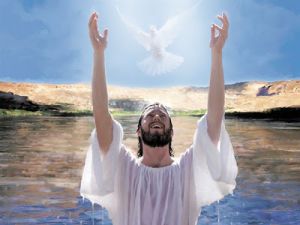
   This coming Sunday, many congregations around the world will be commemorating The Baptism of The Lord. The incident is recorded in all 4 Gospels. It is a significant event for several reasons, but for today I want to focus on that moment when the Holy Spirit goes to Jesus just as he comes up from the water. Our Key Verse for today is from the Gospel of Luke, but it is helpful to see all four versions of this remarkable moment in Jesus’ life. Here is a Gospel-parallel presentation of that moment:
 

Matthew 3:16-17 Mark 1:10 Luke 3:22 John 1:32-34
16 And when Jesus had been baptized, just as he came up from the water, suddenly the heavens were opened to him and he saw the Spirit of God descending like a dove and alighting on him. 17 And a voice from heaven said, “This is my Son, the Beloved, with whom I am well pleased.” 10 And just as he was coming up out of the water, he saw the heavens torn apart and the Spirit descending like a dove on him. 21 Now when all the people were baptized, and when Jesus also had been baptized and was praying, the heaven was opened, 22 and the Holy Spirit descended upon him in bodily form like a dove. And a voice came from heaven, “You are my Son, the Beloved; with you I am well pleased.” 32 And John testified, “I saw the Spirit descending from heaven like a dove, and it remained on him. 33 I myself did not know him, but the one who sent me to baptize with water said to me, ‘He on whom you see the Spirit descend and remain is the one who baptizes with the Holy Spirit.’ 34 And I myself have seen and have testified that this is the Son of God.”

All citations from New Revised Standard Version Catholic Edition (NRSVCE). Links above also display public domain King James Version (KJV).

   There is a dove described in all four Gospels. If you look at each of them separately, it is a little difficult to sort out just who saw the dove. It seems perhaps only Jesus saw it in Mark’s account. In Luke’s account it could have been Jesus only, or Jesus and John, or Jesus and everyone. It’s something to think about. John’s Gospel quotes John the Baptist’s testimony. He had been promised a sign – ‘He on whom you see the Spirit descend and remain is the one who baptizes with the Holy Spirit.’ John states flatly, “I saw the Spirit descending from heaven like a dove, and it remained on him. I myself did not know him …” If we make a construct of the content of all four Gospels, it seems clear that at least John and Jesus saw the Spirit descending like a dove. Now, is it as a dove or like a dove? Honestly, I don’t think we know, because the Greek word used in all four Gospels is ὡσεί hosei {ho-si’} which means as, like, like as, or even as. This word might make a difference if we understand the differences between as and like. I could say, “As your friend, I am sharing my thoughts with you.” (I am your friend.) Or, I could say, “Like your friend, I am sharing my thoughts with you.” (I may or may not be your friend, but your friend and I have something in common). If the Spirit descended like a dove, there was a similarity between the movement of the Spirit and the movement of a Dove. If the Spirit descended as a dove, it was a dove – as Luke testifies. (See Luke 3:22 here for several translations) Does that mean then that the Holy Spirit was momentarily incarnate? One could hardly accept that but, again, it is something to think about. In my heart and mind, a dove landed on Jesus and those who witnessed it (John and Jesus at the very least) understood it to be the Spirit of God which echoed the image of the dove released by Noah in Genesis 8:8-12. Whether we say “as” or “like,” the event itself represents God’s announcement of an imminent change: The beginning of Jesus’ ministry. It’s not the first time a dove showed up as the end of one era and the beginning of another.

In the Flood story, the return of the dove with an olive leaf in its beak is a sign that the Earth has passed its crisis and is being restored. It is the promise of the start of a new world. In Jesus’ Baptism, it is the start of his ministry which is also the start of The Kingdom of Heaven. The dove of the Ark is a messenger of sorts because it shows Noah there is hope that his ordeal is coming to an end. At Jesus’ baptism, the dove is also a messenger of hope for us; but for Jesus the message is that his ordeal is starting. With the start of his ministry came also the start of his persecutions, the accusations against him, the misunderstandings of his mission, and ultimately his passion, death, and resurrection. Immediately after his baptism in water by John, Jesus – in the Power of the Spirit – goes into the desert for an extended trial of fasting, discernment, and ultimately complete submission to the entirety of God’s plan for Salvation – a plan that includes a very violent death for the man called Jesus of Nazareth. That whole series of events began with a dove.

As I reflected on the role of that dove, I wondered where else in Scripture a dove was part of the story. We’ve already recalled the story of Noah and the dove (although we left out the work of the raven Noah sent out). I looked for other places where a dove is mentioned. Here’s a list of those places (not including the quotes from Genesis and the Gospels already presented which are the only New Testament references I could find):

Psalm 55:6

Psalm 68:11-13 (a very interesting read!)

Song of Solomon 2:12-14

Song of Solomon 5:2-3, 12

Song of Solomon 6:9

Isaiah 38:14

Jeremiah 48:28

Hosea 7:11 (not too complimentary for the dove!)

The word dove is a term of endearment in the Song of Solomon (also called Canticles). Doves are thought of as clean and delicate birds that will not nest in damp or dirty places. They often nest in the rock crevices around the mouth of a cave or under the overhang of a cliff. Thus, they rest in safety because where they live it is hard for pursuers to capture them. (See Psalm 55:6) In Psalm 68, the dove is described as having wings of silver and gold. This song, a romanticized description of God’s protections of Israel against her enemies, was meant to be sung as a sort of positive encouragement for Israel. Even before the army forms up and attacks, as they hunker down in their camps and lay low, God foresees their victories and the richness of the plunder which they will take. In Isaiah, three birds are mentioned – a crane, a swallow, and a dove (or a swallow, a thrush, and a dove). The dove’s cry is always taken to be plaintive and mournful whereas the cries of the other two are chattering and noisy. Isaiah’s imagery conveys that he was so demoralized by the circumstances of Israel’s condition that – instead of being vigorously able to defend himself – he can only moan and sigh, groaning with sorrowful mourning like a dove. In Hosea, Israel is again represented as a dove – Hosea uses the name of the largest Tribe in Israel, Ephraim to represent the whole nation – but in this prophecy, the dove flits from one place of danger to another, first to Egypt, then to Assyria, like a dove it has been easily deceived and lacks discernment. He is telling Israel they just don’t make sense. They commit the sin of idolatry knowing full well that it deprives them of God’s protection, but still they brag about being idolaters! Israel was like a dove trying to escape being caught by a hawk and instead flying right into the nets of the bird-catcher, or which goes to the fields to eat the corn spilled there without noticing the net set to capture it.

Of all these images of doves in scripture, I certainly enjoy and appreciate the presence of the dove at Jesus’ baptism. It isn’t the symbol of the Holy Spirit there; it is the Holy Spirit. There are valuable lessons to be learned through understanding the other places where doves are mentioned, especially as representing peace, love, and quiet confidence. For me, though, the image I most relate to is the one in Hosea. Beloved, how often do we go out to gobble up what we perceive to be a bounty of pleasure and wealth only to be caught up in the nets of sin? It is true that, as the song says, “On the wings of a snow white dove he sends his pure, sweet love,” (↔ Very Cute Music Link) it is also true that it is easy to fall prey to evil because we are not as watchful as we should be. Think now of Matthew 10:1616 “See, I am sending you out like sheep into the midst of wolves; so be wise as serpents and innocent as doves.” Also remember Isaiah 59:11. 11 We all growl like bears; like doves we moan mournfully. We wait for justice, but there is none; for salvation, but it is far from us. Let us pray, therefore, that the Holy Spirit will descend on each and every one of us while he seeks a gentle landing place that is welcoming and safe so that he will remain on us, in us, and with us. We may be assured that, clothed and permeated with the Holy Spirit, God will also look on us as his Belovéd child with whom he can be well-pleased.

Whatever, whenever, wherever, whoever, however, if ever, forever — at your service, Beloved

Thank you for all the prayers you have offered for those who asked for your help! You really do make a difference! Please pray with us here at Share-a-Prayer.

Unless otherwise indicated, all scripture passages are from the New Revised Standard Version Catholic Edition (NRSVCE) New Revised Standard Version Bible: Catholic Edition, copyright © 1989, 1993 the Division of Christian Education of the National Council of the Churches of Christ in the United States of America. Used by permission. All rights reserved.

Biblical languages inserts from Bible Hub (Bible Hub: Search, Read, Study the Bible in Many Languages) Visit at http://biblehub.com

Creative Commons License
Aloha Friday Messages by Charles O. Todd, III is licensed under a Creative Commons Attribution-ShareAlike 3.0 Unported License

Aloha Friday Message – January 4, 2019 – A Star is Born

1901AFC010419 – A Star is Born

Read it online here, please. And please, when you visit there, use one of the social media links at the bottom of the page to share this post. Thank you! And remember, we now have a READER VIEW available, so share this link or this email often.

    Matthew 2:2 […]“Where is the child who has been born king of the Jews? For we observed his star at its rising, and have come to pay him homage.”

Aloha nui loa, ʻŌmea! Welcome to a new year of shining a light on The Word. We will begin by taking a look at the back-story of today’s Key Verse which give us an account of the famous Star of Bethlehem. It obviously held meaning for the Magi, for Herod, and that meaning grew from its purpose. Was it merely an arbitrary conjunction of two or more light-sources in the vastness of the universe, or perhaps a phenomenon created by God for one specific moment in time? Was it a comet, an optical illusion, a bending of space and time? We will never truly know until all creation is remade. Is there a plan for everything, a unifying explanation of all the things we do and do not understand about God and his Universe? Many are convinced that there is no such systematization of physical reality and discount all spiritual and metaphysical explanations for the existence of anything – themselves included.

Let’s look back and what inspired these resolute travelers to journey into foreign lands in search of someone whose existence apparently held deep meaning to them.

In our Key Verse, we see the word “magi.” It’s often translated as “wise men.” Traditionally we consider the envoys to be a group of three, mainly because of the list of three gifts they bestow of Jesus and his family: Gold, frankincense, and myrrh. We don’t know their country of origin, the exact reason for their interest in the “newborn king of the Jews,” their names, or their physical characteristics. We have lots of pious ideas about all of that, but the bottom line is we don’t know for sure. We are, however, pretty sure they didn’t show up with the shepherds at the stable by the overflowing inn where Jesus was wrapped tightly in cloth and nestled in a feed trough. The passage that describes them consulting Herod, King of Judea, about how to find this baby is found only in the Gospel of Matthew. Herod, of course, doesn’t know, so he asks the chief priests and the scribes who tell him the prophecies say Bethlehem (house of bread), so he sends them in that direction. Then we read that the star “preceded them, until it came and stopped over the place where the child was.” (See Matthew 2:9) They were thrilled as they entered the house and “saw the child with Mary his mother.” (See Matthew 2:11) There is no mention there of Joseph, shepherds, angels, and a menagerie of animals. It was just Mary and Jesus and some pagans from somewhere east of Judea who were referred to as “the magi,” two or more persons with the moniker Magus. What’s a magus?

They were followers of a very ancient religion called Zoroastrianism. Zoroaster, also known as Zarathustra, was an ancient prophet from the region which is what is now southwestern Afghanistan or northeastern Iran. His writings represent what might be called the first monotheistic religion based on the belief that there is only one God. In his writings there were two distinct persons, very much opposite, that held control over all creation and life. They were called Ahura Mazda – he is omnibenevolent (absolutely good), and Angra Mainyu who is his opposite and therefore “omnimalevolent” (absolutely evil). His writings have influenced several religions (and heresies!), and include the Mazda-Yasna, a system based loosely on the principles of goodness, truth, and fairness. The magi who “discover” Jesus and Mary were probably of a sect of Zoroaster’s followers who believed that the Abrahamic covenant was an integral part of Ahura Mazda’s perfect plan for eliminating evil forever. Their arrival holds a very important and specific meaning, later expressed through the teachings of the Apostle Paul: Salvation was coming to all nations under one God:

Romans 3:29-31 29 Or is God the God of Jews only? Is he not the God of Gentiles also? Yes, of Gentiles also, 30 since God is one; and he will justify the circumcised on the ground of faith and the uncircumcised through that same faith. 31 Do we then overthrow the law by this faith? By no means! On the contrary, we uphold the law. These pagan magi were gentiles – not Jews. They came to do homage to the newborn king of the Jews, and were thus the first representatives of the gentiles to worship God Incarnate, Jesus, the Christ of God.  That is why we call this Feast Day Epiphany – it is the “showing forth,” the manifestation in Time of the Second Person of the Godhead, Jesus. This is the fulfillment of God’s promise to Abraham when Abraham took Isaac to be a sacrifice in Genesis 22:17-18 17 I will indeed bless you, and I will make your offspring as numerous as the stars of heaven and as the sand that is on the seashore. And your offspring shall possess the gate of their enemies, 18 and by your offspring shall all the nations of the earth gain blessing for themselves, because you have obeyed my voice. That blessing for all nations is, of course, Jesus who will be “a Priest forever according to the order of Melchizedek.” Who in the World is that?

We need to go back to the early days of Abraham, when he was still Abram, and a terrible battle in the valley of Siddim. We can look at these passages for more information:

Genesis 14:18-20 18 And King Melchizedek of Salem brought out bread and wine; he was priest of God Most High. 19 He blessed him and said,

“Blessed be Abram by God Most High,
maker of heaven and earth;
20 and blessed be God Most High
who has delivered your enemies into your hand!”
And Abram gave him one-tenth of everything.

That crosses back to Psalm 110:4 The Lord has sworn and will not change his mind,
“You are a priest forever according to the order of Melchizedek.”
 The Apostle Paul writes of this encounter in Hebrews. Hebrews 5:5-10 Christ did not glorify himself in becoming a high priest, but was appointed by the one who said to him,

“You are my Son,
today I have begotten you”;
as he says also in another place,
“You are a priest forever,
according to the order of Melchizedek.”
In the days of his flesh, Jesus offered up prayers and supplications, with loud cries and tears, to the one who was able to save him from death, and he was heard because of his reverent submission. Although he was a Son, he learned obedience through what he suffered; and having been made perfect, he became the source of eternal salvation for all who obey him, 10 having been designated by God a high priest according to the order of Melchizedek.

Paul finishes up in the seventh chapter of Hebrews with an astute analysis of God’s fulfillment of his plan of salvation tying it all to Abram’s encounter with Melchizedek. Truly, that plan was consummated when Jesus pronounced, “It is finished.” But, for us Belovéd, it all began there, in the presence of Abram, Melchizedek, Lot, and El Elyon – God Most High. Bringing the whole story full circle is the fact that Abram and his family came from “Ur of the Chaldeans,” a city in Ancient Mesopotamia which today corresponds to present day southeast Iraq and about 150km NNW of Basra:

Abram and his family originated in the same part of the world that Zoroaster inhabited. Perhaps the Magi who came to see the newborn king of the Jews also traveled from that region following a star that hovered over a location somewhere around Bethlehem – the House of Bread – and gave Jesus’ family things they would need later in life when the World came to realize that the King of Kings is the Bread of Life and The Rising Dawn – the Morning Star, The King of Nations, and Emanuel (See the O Antiphons). Peter calls him the Morning Star: 1 Peter 1:19 19 So we have the prophetic message more fully confirmed. You will do well to be attentive to this as to a lamp shining in a dark place, until the day dawns and the morning star rises in your hearts. Jesus’ birth was heralded by Angels who sang “In the highest heaven, glory to God! And on earth, peace among people of good will!” (See Luke 2:14 CJB), illuminated by a star sent by God to welcome the gentiles and all persons of Good Will, the Lilly of the Valley (↔ Music Link), the Bright and Morning Star, and honored and adored by three Magi from the traditional land of Abraham’s birth. There is certainly meaning in that for all of us. What can we do in this life that will “show forth” that meaning for others and grant them the Epiphany of Faith that will put the Light of the Gospel in their hearts and minds?

Whatever, whenever, wherever, whoever, however, if ever, forever — at your service, Belovéd! (And seriously, go read Hebrews 7.)

Unless otherwise indicated, all scripture passages are from the New Revised Standard Version Catholic Edition (NRSVCE) New Revised Standard Version Bible: Catholic Edition, copyright © 1989, 1993 the Division of Christian Education of the National Council of the Churches of Christ in the United States of America. Used by permission. All rights reserved.

Biblical languages inserts from Bible Hub (Bible Hub: Search, Read, Study the Bible in Many Languages) Visit at http://biblehub.com

Creative Commons License
Aloha Friday Messages by Charles O. Todd, III is licensed under a Creative Commons Attribution-ShareAlike 3.0 Unported License


Aloha Friday Message – December 28, 2018 – Locked Out!

1852AFC122818 – Locked Out!

Read it online here, please. And please, when you visit there, use one of the social media links at the bottom of the page to share this post. Thank you! And remember, we now have a READER VIEW available, so share this link or this email often.

Luke 2:49 49 He said to them, “Why were you searching for me? Did you not know that I must be in my Father’s house?”  The Authorized (King James) Version (AKJV) reads 49 And he said unto them, How is it that ye sought me? wist ye not that I must be about my Father’s business?”

¡Que la bendición esté siempre con ustedes y que Dios los bendiga, Amados! (May blessing always be with you and may God bless you, Belovéd!) Christmas day has come and gone, but it’s still the Christmas Season! Christmas lasts until the Feast of the Presentation of the Lord on February 2, 2019. Between today and then, we have the Octave of Christmas – that ends on January 1, 2019 with the Solemnity of the Blessed Virgin Mary, the Mother of God – and continues through The Epiphany of the Lord. That celebration focuses on the appearance of Jesus before the Magi, and in rare occasions, as well as the Baptism of Jesus as an adult by John in the Jordan River. Normally the Baptism of the Lord is celebrated on January 13, the octave day of Epiphany. In some churches there is also a “Season of Epiphany” which begins on January 6 and continues until Ash Wednesday, the beginning of Lent. All of these events are part of an ongoing open invitation to come together as community and worship together. No matter where you go to church, if you are a Christian of any sort, you are called to be with your fellow Christians to share in the Sacraments and fellowship, the Κοινωνία of The Church. Koinonia {koy-nohn-ee’-ah} means fellowship, association, community, communion, distribution, contribution, or to communicate. This word partially describes the way we share in the life and mission of the Body of Christ, and also hints at how the Holy Trinity is a single community of Three Divine Persons. It is included in our prayers – “graciously grant some share and fellowship with your holy Apostles and Martyrs” and in our Scripture readings from Acts 2:4242 They devoted themselves to the apostles’ teaching and fellowship, to the breaking of bread and the prayers.

We who have been claimed by Christ are called – actually, commanded – to be with and for each other:

John 13:34-35 34 I give you a new commandment, that you love one another. Just as I have loved you, you also should love one another. 35 By this everyone will know that you are my disciples, if you have love for one another.

We are part of the Church:

Acts 11:26b So it was that for an entire year they met with the church and taught a great many people, and it was in Antioch that the disciples were first called “Christians.” Christian means people of Christ.

Jesus was in the habit of going to the synagogue:

Luke 4:16 16 When he came to Nazareth, where he had been brought up, he went to the synagogue on the Sabbath day, as was his custom. This was his training from childhood. Mary and Joseph were surprised that Jesus was not with them. When he asked his parents how they could not know he would be at the Temple, he was surprised they did not understand he couldn’t be anywhere else. The word we have for “did you not know” is οἶδα (eidó) {i’-do} ~~ be aware, behold, consider, perceive as in I know, remember, appreciate. It is used first as a physical statement of perception “I see ____.” Then, it is also used as a metaphorical expression for mental perception. “I see what you mean.” “I see why you say that.” Beyond that it is also applied to a spiritual form of perception which entails comprehension of a principle or manner of conduct, to discern what is actual, or distinguish between proper and improper. That must have been one of those “AH-HA” moments that often comes up in parenting. “Ah. He’s the son of God. Surely he must be at his Father’s house tending to his Father’s interests!”

We come together as a community to share the Love of Christ – the Love he himself gave us to share with others:

Philippians 2:1-2 1 If then there is any encouragement in Christ, any consolation from love, any sharing in the Spirit, any compassion and sympathy, make my joy complete: be of the same mind, having the same love, being in full accord and of one mind. This means we don’t go to church to do our own thing; we go to be part of “Christ’s thing” which is to love God completely and to love each other in the same way Jesus Loves us. We are to do that, we are to live that, and we are to be that all the time everywhere in church or not. In fact, we should be more focused on living a life of charity and fellowship outside the church. Inside the church we get powered-up through fellowship, sacrament, and participation (unlike fencepost Christians who just show up but never offer up). But like the bandleader said, “85% of the gig is showing up.”

We sometimes hear it expressed as, “Ya can’t win if ya don’t play.” So many of us have at times given up opportunities to share in the EXTRAORDINARY benefits and graces of Christian fellowship! It is as if we have locked ourselves out of that communion of the saints by giving all kinds of excuses for not sharing our lives with others. I’m going to give you a list of excuses people use about not going to church; however, instead of saying “church” or “fellowship,” I’m going to use something more common: Eating.

A lot of people always have a good excuse for not attending their church each week. If you take those excuses and apply them to eating, they might look like this list:


  1. I was forced to eat as a child.
  2. People who eat all the time are hypocrites; they aren’t really hungry.
  3. There are so many different kinds of food, I can’t decide what to eat.
  4. I used to eat, but I got bored and stopped.
  5. I only eat on special occasions, like Christmas and Easter.
  6. None of my friends will eat with me.
  7. I’ll start eating when I get older.
  8. I don’t really have time to eat.
  9. I don’t believe that eating does anybody any good. It’s just a crutch.
  10. Restaurants and grocery stores are only after your money.
  11. I eat better when I am alone in the mountains, or on the golf course.
  12. I don’t need to be fed when I eat. I get everything I need without putting myself through that.
  13. Eating is the opiate of the people.
  14. I’ve had so many negative experiences with eating, being fed, and learning to prepare food that I just have lost interest. I mean what’s the point? It all ends up in the same place anyway.
  15. Eating isn’t going to get me any closer to heaven than I already am.
  16. I don’t need to eat with a bunch of people who are frauds about food! They don’t really know what eating is all about, the hypocrites!

Now, if you think about substituting koinónia – fellowship at church – for “eat,” the excuses sound pretty lame, right? Please also recall that God can and will shut the door behind the Saints and against the sinners: Genesis 7:16 16 And those that entered, male and female of all flesh, went in as God had commanded him; and the Lord shut him in. Hollywood’s misinterpretation notwithstanding, no one could open the door thereafter – none could exit and none could enter. Communing with the Saints (i.e., the redeemed of God) is how we can stay on the better side of The Door.

Belovéd, the point here is clear; there are no excuses for missing out on God’s great Gift to us, his Church on Earth. We can come up with all the “reasons” we want, but there are no excuses. When we do make excuse after excuse, we are locking ourselves out and throwing away the key. Matthew 7:21-23 21 “Not everyone who says to me, ‘Lord, Lord,’ will enter the kingdom of heaven, but only the one who does the will of my Father in heaven. 22 On that day many will say to me, ‘Lord, Lord, did we not prophesy in your name, and cast out demons in your name, and do many deeds of power in your name?’ 23 Then I will declare to them, ‘I never knew you; go away from me, you evildoers.’” If you cannot muster the will to go to church, it’s highly unlikely you will ever prophesy, cast out demons, or do other deeds of great power in the name of Jesus. And HE tells us even if you do these things, even if you warm the pew every Sunday, unless you do the will of Our Father, you will not find that key to unlock your passageway to Heaven. And what is the Will of the Father?

To repent and believe the Good News: Mark 1:15 “The time is fulfilled, and the kingdom of God has come near; repent, and believe in the good news.” See Also 2 Peter 3:9.

To be filled with the Holy Spirit: Luke 11:13 13 If you then, who are evil, know how to give good gifts to your children, how much more will the heavenly Father give the Holy Spirit to those who ask him! See also Acts 2:38.

To be pure: Matthew 5:48 48 Be perfect, therefore, as your heavenly Father is perfect. See also Matthew 5:8.

To be thankful: Psalm 118:1 O give thanks to the Lord, for he is good; his steadfast love endures forever! See also Psalm 26:7.

To accept suffering: Matthew 10:22 22 and you will be hated by all because of my name. But the one who endures to the end will be saved. See Also 1 Peter 3:17 and Matthew 5:10-12.

Sounds like a lot, doesn’t it? Actually, it would be a lot if one had to do it alone; but we do not have to be alone – we have each other, and together – when we rely on and fellowship with the Church – we find strength upon strength. The door is unlocked and opened because we went there and knocked; the “key” is being there. All of this requires awareness, perception, and understanding. We need a nearly-continuous flow of “AH-HA moments,” and a great place to access that kind of resource is – you guessed it – The Church.

Don’t lock yourself out. The key in the door is our presence in Church, together. AMEN.

Unless otherwise indicated, all scripture passages are from the New Revised Standard Version Catholic Edition (NRSVCE) New Revised Standard Version Bible: Catholic Edition, copyright © 1989, 1993 the Division of Christian Education of the National Council of the Churches of Christ in the United States of America. Used by permission. All rights reserved.

Biblical languages inserts from Bible Hub (Bible Hub: Search, Read, Study the Bible in Many Languages) Visit at http://biblehub.com

Creative Commons License
Aloha Friday Messages by Charles O. Todd, III is licensed under a Creative Commons Attribution-ShareAlike 3.0 Unported License

Aloha Friday Message – December 21, 2018 – The End of it All … 2018 Advent Series #4

1851AFC122118 – The End of it All, 2018 Advent Series #4

Read it online here, please. And please, when you visit there, use one of the social media links at the bottom of the page to share this post. Thank you! And remember, we now have a READER VIEW available, so share this link or this email often.

Matthew 24:36  36 “But about that day and hour no one knows, neither the angels of heaven, nor the Son, but only the Father.”

Nineteen-month-old Jenna waddled over to Liz, her mom, and raised her chubby arms. “Mama carry me.” Liz scooped her up in one practiced motion, stationed Jenna on her left hip, and went on with fixing breakfast for Jackie, her brother, and John, her husband. Jenna snuggled against Liz, stuck out her left hand, and said, “Um!” “Use your words, sweetie,” her mom said as she transferred a corner of toasted bread from Jackie’s plate to Jenna’s outstretched fingers. “Um! Um!” Jenna mashed the toast into her mouth and held out her hand for more.

*-+-*-+*-+-*-+*-+-*-+*

Frank left the betting counter in the sports bookie lounge grumbling about “not fair,” and “it wouldn’t kill you,” as the bookie shook his head in disgust and disbelief saying, “I can’t believe he actually expected us to carry him until next game! What does he think we are, Chase-Manhattan?” Frank turned and glared at him, and then banged his way through the door and out into the sleet and rain which effectively hid the tears he shed because once again, Christmas for his wife and kids would be pretty stark. He’d make it up to them, though. Yes. He would.

*-+-*-+*-+-*-+*-+-*-+*

James was absolutely worn out. He and his older brother Eddie had been walking for days it seemed. Even though James knew it had only been three, or maybe four, hours, he was barely able to take one step after another. Eddie had said they should stay put and wait for someone to find them, but James started crying and wanted to go look for the rest of the Eddie’s Scout Troop. James had been invited along to explore joining Troop 561 as a Tiger Cub, and now he was sure they wouldn’t accept him. He tripped and fell suddenly, and Eddie reached to pull him up. James, angry because he was embarrassed, growled, “You don’t have to carry me, Eddie. I can make it on my own!”

*-+-*-+*-+-*-+*-+-*-+*

Many years ago, a score of centuries in the past, a Messenger named Gabriel spoke to a teenager named Mary and said – in effect – “God has a request for you. He says, ‘Please, carry me.'” Mary said, “Whatever you ask, I will do. Whatever you do, I will accept.” And so she carried Emanuel in her virginal womb, and all her life she carried God’s Son, and our Brother through adoption, Jesus, in her heart and after his death, she once again carried him in her arms.

*-+-*-+*-+-*-+*-+-*-+*

Do you remember what happened on December 21, 2012 – or rather what didn’t happen? That was supposed to be the end of the world. If you are reading this, and if you are all in one piece, then the world did not end – for you at least. There are hundreds of thousands of people who will die today, and it is the end of the world for them. For you and me, it is perhaps the end of an era, or even something more mundane – the end of the week. Tomorrow we’ll do laundry, clean the garage, maybe have to shovel snow out of the driveway, and try to finish up our Christmas shopping. Sunday, we’ll go to church – you will won’t you? – we’ll listen to the sermon and try to remember that Jesus is the Reason for the Season even if we never did find a music box for Aunt May. But today as we cart our gifts to relatives’ houses or to the post office (too late!), and as we remind ourselves to take the turkey out of the freezer to thaw in the refrigerator, we easily forget; we have another request pending: “Carry me.”

That is the end of it, Beloved; Carry me. WE all remember the masterful work originally written by Mary Stevenson in 1936 called Footprints in the Sand. We remember that when there was only one set of footprints in the sand, that was when Jesus was carrying us. A good and true image of how God works in our lives to protect and sustain us, this story of Footprints in the Sand is often a source of comfort in times of trial.

But, we are also called to be “Christ-Bearers.” Mary came to be known as the Θεοτόκος, Theotokos, {theo-to’-kes} God-Bearer. I am, you are, we are also called to be Theotokos in accordance with the measure of Grace which God has given us to carry the Word, the λόγος – Logos – the Christ, for God’s words are Spirit and Life, and God’s Word of Life is Jesus whom Mary carried in her womb until he was born alive as a human, and then in her heart as he became and remains resurrected and alive. Now he also asks to be carried in our hearts. Can you, can I, can we carry him with the love, the faith, and the eternal commitment and purity Mary had and has when she carried him in her womb and in her heart? Perhaps, if we are very, very blessed (Blesséd are you among women), but even if we cannot match Mary’s fervor or her measure of the Graces of Faith and Obedience, we can make room for Jesus as she did:
Thou didst leave Thy throne and Thy kingly crown, (↔ Music Link)
When Thou camest to earth for me;
But in Bethlehem’s home was there found no room
For Thy holy nativity:
Oh, come to my heart, Lord Jesus!
There is room in my heart for Thee;
Oh, come to my heart, Lord Jesus, come,
There is room in my heart for Thee.

And that is The End of It All, Beloved. Simply say “Yes” when God says to you, “Carry me.” It is not a question. It is not a command. It is sort of a request. Most of all, it is an instruction. It is simply, “carry me.” Everything else, anything else, is suddenly secondary. Will you take a moment now, please, and imagine the moment Mary looked out the window at Jesus rough-housing with Joseph. Mary calls out, “All right you ruffians! It’s time for dinner. Come in and wash up.” Joseph rises and extends both hands to Jesus saying, “Come on, Yeshua, it smells good in there. Let’s see what your mama’s gotten ready for us.” Jesus runs and skips over to Joseph and tackles him around the knees saying, “Aw, Abba, let’s wrestle one more time!” “No, son, we need to get inside. Come on. Let’s go.” “OK, Abba. Carry me?”

And Mary smiles as she turns away from the window. She was the first one ever, in all Eternity, to be asked by God, “Carry me?” She helped carry him to Jerusalem those first six years. Although she did not yet know then, from ages seven through age eleven he would carry himself. At age twelve, he would turn back to the Temple as he began to understand more clearly, “I am here to carry God my Father into the presence of these my brethren.” A little tear touches the corner of Mary’s eye just as Joseph ducks through the low door with Jesus over his right shoulder – the same shoulder upon which Jesus would later carry his cross. But today, for Mary and Joseph, carrying Jesus was just part of living, just part of loving him and loving each other.

There is nothing else to do. If you carry him, you will have room only for him, strength only for his instructions, love only in his Love. He will become in you The Word of God, and that will be Spirit and Life. It is the End of It All because it becomes Eternal in God when the world comes to Judgment.

This is the way the world ends
Not with a bang but a … reward.

But what about the times you need to be carried? Will Jesus still lift you to carry you across the sand? And is that sand by the beach, or is it in the desert? Yes, Jesus will carry you and through the miraculous Mystery of the Incarnation, you will also carry him, Emanuel – God-With-Us. You will be in this World, but not of it. Even if the World does end, you will not, and that is the Truth; remember YOLO-F. You will receive your Eternal Reward, and that is the Truth. As Frank Peretti has said, “There has to be a Truth that is fixed and objective and separate from you, it has to be true whether you believe it or not, it has to be true whether you like it or not, it has to be true whether you have ever heard of it or not… it’s just true.” The truth is that when you carry Christ, you carry Truth.

LIGHT ≡ GOD ≡ LOVE ≡ TRUTH ≡ WAY ≡ LIFE ≡ FOREVER

Whatever, whenever, wherever, whoever, however, if ever, forever — at your service, Beloved.

I’ll be back again just before Epiphany. Meanwhile

May Hope, and Peace, and Joy, and Love
Be yours through the coming of
The Christ Child

Carry Me …

Isaiah 49:15 15 Can a woman forget her nursing child, or show no compassion for the child of her womb? Even these may forget, yet I will not forget you. God will always love us the way he loves Jesus. Romans 8:38-39For I am convinced that neither death nor life, neither angels nor demons, neither the present nor the future, nor any powers, neither height nor depth, nor anything else in all creation, will be able to separate us from the love of God that is in Christ Jesus our Lord.

 When this …

… became this, 


then God remembered every promise he had ever made, and that is definitely worth our remembering and celebrating! It is so important that we also remember that at the end of it all there is an Eternal Celebration, an Everlasting Banquet of Love.

YOLOF → HEHappily Everafter!

Aloha Friday Message – December 14, 2018 – The O Antiphons 2018 Advent Series #3

1850AFC121412 – 2018 Advent Series #3 ~~ The O Antiphons

Read it online here, please. And please, when you visit there; use one of the social media links at the bottom of the page to share this post. Thank you! And remember, we now have a READER VIEW available, so share this link or this email often. This is an improved and updated version of a previous post from 2012. Use the updated links to see Scripture passages and listen to music links. Because the readings are so important this weekend, I have a couple of Key Verses to share before we start:

     Matthew 3:11 11 “I baptize you with water for repentance, but one who is more powerful than I is coming after me; I am not worthy to carry his sandals. He will baptize you with] the Holy Spirit and fire.”

  Philippians 4:4 Rejoice in the Lord always; again I will say, Rejoice.

You may have heard of something called “The O Antiphons.” If not, you’ve probably sung a hymn called “O come, O come Emanuel.” They are related in subject and content, and are sung during this time of year – Advent – during the period called “the Octave of Christmas” which is December 17 through 24 – a period of 8 days, hence octave. The first 7 days of the Octave of Christmas correspond to the 7 O Antiphons; the eighth day of the Octave, December 24, is the Christmas Vigil. The words in these Antiphons are familiar because of the hymn O Come, O Come Emanuel, but the meanings behind them may not be, so we’re going to take a look into the history and meaning of these O Antiphons. Each of the antiphons presents insight into the Divinity of the Messiah by recalling descriptive passages of Scripture. There is evidence that they have been in use in the Church since the Fifth Century. By the Eighth Century, they were in common use in most Rites of Liturgy. They describe for us seven ways by which the Lord “comes to us” in Advent by telling us how he will be revealed to humanity. The Antiphons are in Latin, so that will be presented first, then the English translation, then the date in December when the Antiphon is sung.

Normally they are recited or sung in the evenings as part of an evening prayer service (Vespers). When I listen to them, I am reminded of Christmas 1966. A friend at Metropolitan State College, Mary Jane McBride as I recall, invited me to go to Vespers at a nearby Seminary. I was already contemplating conversion from Baptiterian to Catholic, and that experience moved me miles and miles farther down that road. It was a true Mountain-Top Experience – exhilaration, a feeling of deep spiritual connection, and the glowing-shivers (ya know wuddamean?) … I can still feel that today as I remember it. So this one’s for Mary Jane and everyone who’s taken a friend to the Mountaintop because now, when we say the word GOD, we understand we are naming The Holy Trinity – Father, Son, and Holy Spirit – who have existed together eternally. And it is God who is praised in the O Antiphons:

O SAPIENTIA – O Wisdom December 17: Wisdom was with God at Creation (Proverbs 8:22-31) and God’s Wisdom cannot be surpassed (Isaiah 40:13-14). God have created all things and all times with only the Wisdom of his Word. O Wisdom, who came from the mouth of the Most High, reaching from end to end and ordering all things mightily and sweetly: come, and teach us the way of prudence.


O ADONAI – O SUPREME LORD December 18:  The root ADON means steward-administrator, Master, Lord as a respectful title indicating authority and power. Adding –ai elevated the meaning to a superlative as “Lord of All,” “Supreme Authority,” or “Ultimate Power.” The common expression “Supreme Being,” falls far short of the meaning of Adonai, a name commonly used in Hebrew Scripture to represent the name YHWH. See Exodus 3:1-6.


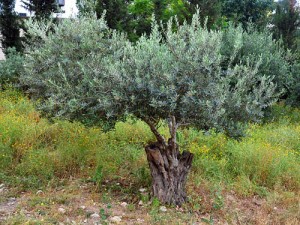
O RADIX JESSE – O ROOT OF JESSE December 19: A shoot shall grow out from the stump of Jesse and a branch shall grow out of his roots.” I love this verse. The image is of an ancient olive tree cut down after many years because it is no longer bearing fruit as it should. The stump is left and irrigated, cared for, and watched over. Then a shoot, a new olive tree, sprouts from the stump and has the support of the ancient roots beneath it. Read Isaiah 11 with this in mind. It’s another Mountaintop Experience. (See the image of such a tree at the end of this post)


O CLAVIS DAVID – O KEY OF DAVID December 20: This is the Key that liberates prisoners, unfetters the chains that bind into death all who walk the Earth. This is the Scepter of Israel. Only this key opens what no human can open, and only this key closes what no human can close. See Isaiah 61:1, Isaiah 42:7, and Luke 4:16-20. This is The Christ of God.


O ORIENS – O RISING DAWN December 21: O Radiant Dawn of the east, brightness of light eternal, and sun of justice: come, and enlighten those who sit in darkness and in the shadow of death. See Isaiah 9:2 and Matthew 4:13-17. God, who are Light, as dawned upon the Earth and dispelled the darkness of death as Light is victorious over the shadows of night. Just as the celestial sun gives warmth, energy, light, and life to the earth, so the Sun of Justice spreads the Light of God over all creatures. And so our eyes and hearts and minds look to the east for the Light of the Nations.


O REX GENTIUM – O KING OF THE NATIONS December 22: O King of the Gentiles and their Desired One you are the Desired of all nations (Haggai 2:7), you are the cornerstone (Isaiah 28:16) that binds the two into one (Ephesians 2:14). Come, and bring wholeness to man whom you fashioned out of clay (Genesis 2:7). In the King of Glory disciple is united to Christ (John 17:01-22), every living soul will acknowledge God’s reign (Isaiah 45:23, Romans 14:9-12, Philippians 2:9-11)


O EMANUEL ­– O EMANUEL, GOD WITH US December 23: O Emmanuel (Isaiah 7:14), God with us, our King and lawgiver (Isaiah 33:22), the expected of the nations and their Savior: come to save us, O Lord our God. The hymn, already mentioned – O come, O Come Emanuel – is a reworking of the O Antiphons: O Come, Emanuel, Rod of Jesse, Day-Spring, Key of David, and Lord of Might for example. The hymn itself appears to have been written in the twelfth century in Latin (Veni, Veni Emanuel) and was based on eighth-century arrangements of the 7 O Antiphons. As you can see, this has been around a long time, and – taken together – these antiphons give us a Biblical encapsulation of the Advent season. In several sites I explored for this post, researchers also mentioned that there is a specific order for these seven antiphons. If start at the seventh and go backwards to the first, and you take the first letter of each title of Christ you get E (Emanuel), R (Rex Gentium), O (Oriens), C (Clavis David), R (Radix Jesse), and S (Sapientia). Looking at the letters you get E R O C R A S. This forms two Latin words: Ero cras. That phrase somewhat freely translated means “Tomorrow, I will be there,” or “I will come tomorrow.” That pretty well matches the whole theme of advent!

And so, Belovéd, there we have it, the Seven O Antiphons. I have many personal reasons for loving the hymn, and I have enjoyed listening to this choral version of O Come, O Come Emmanuel (↔ Music Link). You can listen to them too, if you like, and get a deeper sense of the power of the scriptural insights the Antiphons carry.

This coming Sunday, December 16 is the day before the Octave of Christmas. It is often called “Gaudete Sunday (gow-DEH-teh). The Introit for Gaudete Sunday is taken from Philippians 4:4, 5: “Gaudete in Domino semper” (“Rejoice in the Lord always”). On this Sunday, the Vestments can be rose-colored rather than purple as is usual during a penitential season (Lent and Advent). The rose color reminds us we have passed the midpoint of the season and things are brightening up as is indicated by the entrance (Introit) verse which says, “REJOICE!”

Rejoice with one another, Beloved. Pray for, with, and about one another. Be kind to one another, and be especially kind to strangers. Remember what He said: “Whatever you do to the least of these…” and “I AM coming tomorrow.” Isn’t that a good enough reason to rejoice? There’s a post for that right here, and in that post you will find these biblical terms for REJOICE:

Samah – שָׂמַ֖ח – Jubilant, spontaneous dancing, signing (simhach) – 1 Chronicles 29:9
Alaz – עָלַז – Exult – Burst into leaping with joy – Habakkuk 3:17-18
Nagilah – נָגִ֖ילָה – Let us rejoice – Psalm 118:4
Euphraino – εὐφραίνω – To gladden the mind – Revelation 12:12
Kauchaomai – καυχάομαι – Glory in success and boast against – 1 Corinthians 1:30-31
Sunchairo – a συγχαίρω – Rejoicing together, with others – Luke 15:6
Agalliao – ἀγαλλιάω – Rejoice Greatly, to exult; jump for joy – Revelation 19:6-8
Chairo – χαίρω – Rejoicing over experiencing God’s Grace; be glad in the Lord – Luke 15:32

That is such a great word – REJOICE. When I hear it I hear it as re-joys as in joys again, and again, and again. One of the best JOY words around is Hallelujah and its alternative Alleluia. We are to be an Alleluia People! What does that word mean? It means GOD BE PRAISED. We used to sing a song about that. (↔ Music Link) We’d be divided into two groups – boys and girls, left-side and right-side, children and adults – and on the Hallelujah phrases one group would stand. When Praise ye the Lord came up the Hallelujah group sat down and the second group stood up. There was a lot of “jumping up and down.” Rejoicing is like that. It’s just being so happy that we simply can’t sit still. (↔ Music Link) That’s one of the effects of being baptized with FIRE and the Holy Spirit!

Whatever, whenever, wherever, whoever, however, if ever, forever — at your service, Belovéd!

Unless otherwise indicated, all scripture passages are from the New Revised Standard Version Catholic Edition (NRSVCE) New Revised Standard Version Bible: Catholic Edition, copyright © 1989, 1993 the Division of Christian Education of the National Council of the Churches of Christ in the United States of America. Used by permission. All rights reserved.

Biblical languages inserts from Bible Hub (Bible Hub: Search, Read, Study the Bible in Many Languages) Visit at http://biblehub.com

Creative Commons License
Aloha Friday Messages by Charles O. Todd, III is licensed under a Creative Commons Attribution-ShareAlike 3.0 Unported License

Beloved!

Please pray with us here at Share-a-Prayer.


Aloha Friday Message – December 7, 2018 – 2018 Advent Series #2

1849AFC113018 – 2018 Advent Series #2

Read it online here, please. And please, when you visit there, use one of the social media links at the bottom of the page to share this post. Thank you! And remember, we now have a READER VIEW available, so share this link or this email often.

   Philippians 1:8-11 For God is my witness, how I long for all of you with the compassion of Christ Jesus. And this is my prayer, that your love may overflow more and more with knowledge and full insight 10 to help you to determine what is best, so that in the day of Christ you may be pure and blameless, 11 having produced the harvest of righteousness that comes through Jesus Christ for the glory and praise of God.

Today’s Key Verse comes from the second reading for the Second Sunday of Advent. It expresses my own purpose for sending this to you today. I do so very much wish that your love would overflow more and more with knowledge and insight that flows like a river straight from the Holy Bible and into your hearts and minds! To that end, I have compiled for us a modest reading list. I hope you will use it, and spend some time using the links.

This message could end up being the shortest in a long time or the longest ever. I’m going to give you a list of Messianic Psalms, Psalms that speak prophetically about Jesus’ birth or about his passion, death, and resurrection. With each Psalm, I will give you a link to a verse the shows how that prophecy was fulfilled “in accordance with the Scriptures.” There are several dozen more places in the Old Testament that contain prophecy about Jesus, but I will present mostly texts only from Psalms.

The reason I say this will be short is that I am not going to comment on the texts. The reason I say this will be the longest ever is that I am asking you to go through the table below each day of the coming week and look up the Psalm with the prophecy and the verse describing the fulfillment of the prophecy. The conclusion I hope you will reach by the end of the week is that Jesus has been the Christ since before the Earth began, and will be the Christ forever after the Earth is dissolved. As we did last week, we will be focusing on and confirming the Divinity of Jesus. Even more desirable would be to have you pull out your real, not Internet, Bible and look up these passages! That would be the best thing for this study! I’ve updated all the links, too, and I really encourage you to go to the links for the Psalms and read them from Complete Jewish Bible (CJB) as well. Just use the  I think you will enjoy seeing God’s word expressed in the context of the Hebrew language. Just use the drop-down menu to find it.


Date Psalms about his coming
Friday, 12/7 Psalm 2:6 – He will be a King Matthew 21:5; John 18:36-37
Psalm 2:7 – You are my Son, today I have begotten you Matthew 3:17; Acts 13:33
Psalm 69:9 – It is zeal for your house that has consumed me John 2:16-17
Saturday, 12/8 Psalm 78:2 – He will speak in parables Matthew 13:34-35
Psalm 110:1 – He will be called Lord Matthew 22:43–45; Luke 2:11; Hebrews 1:10
Psalm 118:22 – He will be the stone rejected by the builders. (↕ Music Link) Acts 4:10-11; Romans 9:32-33; 1 Peter 2:7-8
Sunday 12/9 Psalm 118:26 – He will come to the Temple Matthew 21:12; John 2:13-17
Psalm 132:11; Jeremiah 23:5 – He will come from the House of David Matthew 1:1; Luke 3:23, 31
Psalms about his Passion, Death, and Resurrection
Psalm 16:10; Psalm 30:3 – He will die but not decay Acts 2:31; Acts 13:33-35
Psalm 22:1 – He is abandoned Matthew 27:46; Mark 15:34
Monday, 12/10 Psalm 22:7 – People wag their heads and mock him Matthew 27:39; Mark 15:29-30
Psalm 22:16 – He will be counted among sinners Matthew 27:38; Mark 15:27; Luke 23:32; John 19:18
Psalm 22:16 – Hands and feet pierced John 19:22-37 (Please be sure to read this one.)
Tuesday, 12/11 Psalm 22:17 – They will stare and mock Matthew 27:36; Luke 23:35
Psalm 22:18 –Garments are divided and lots are cast Matthew 27:35; Mark 15:24; Luke 23:34; John 19:23-25
Psalm 30:3; Psalm 41:10; Psalm 118:17 – He will be raised to life on the third day Acts 13:33; Matthew 28:6; Mark 16:6; Luke 24:34-46; John 2:18-22
Wednesday, 12/12 Psalm 41:9; Psalm 55:12-14 – Betrayed by a friend Matthew 10:4; Matthew 26:20-25; Mark 14:18-21; John 13:18
Psalm 68:18-20 – He ascends to Heaven and defeats death Mark 16:19; Luke 24:51; John 20:17; Acts 1:9
Psalm 69:21 – Given vinegar to drink (vin egar – sour wine) Matthew 27:34, 48; Mark 15:23, 36; Luke 23:36; John 19:29
Psalm 110:1 – Sits at the right hand of God Hebrews 1:3 (Some translations use the term “refulgence“); Acts 2:34-35
Thursday, 12/13 Psalm 22:26-31There is Victory in Jesus over death and the devil. (↕ Music Link) Hebrews 2:14; 1 Corinthians 15:55-57


Please pray with us here at Share-a-Prayer.

And pray as well for …

  • Missionaries who go out into the world to carry the Good News and the Sacraments to every land and nation, including missionaries, itinerant preachers, and lay people carrying God’s word and God’s gifts to our communities.
  • For families enduring illness, rebellion, addiction, failing marriages, or other grievous trials, we ask God to brighten and lighten their days by planting hope wherever despair sprouts up.
  • Pray for love. Love of family, love of friends, love of life, love of scripture, love of mercy, and love of God in all things and through all things for the endless Glory of God.

Jesus is Lord!

MARAN ATHA! MARANA THA!

Whatever, whenever, wherever, whoever, however, if ever, forever — at your service, Beloved.

You can use this link to see an online version of the PDF file:
https://aloha-friday.org/wp-content/uploads/2018/12/2018-Advent-Series-2.pdf

Unless otherwise indicated, all scripture passages are from the New Revised Standard Version Catholic Edition (NRSVCE) New Revised Standard Version Bible: Catholic Edition, copyright © 1989, 1993 the Division of Christian Education of the National Council of the Churches of Christ in the United States of America. Used by permission. All rights reserved.

Creative Commons License
Aloha Friday Messages by Charles O. Todd, III is licensed under a Creative Commons Attribution-ShareAlike 3.0 Unported License


Aloha Friday Message – November 30, 2018 – Advent Series #1

1848AFC113018 – 2018 Advent Series #1

Read it online here, please. And please, when you visit there, use one of the social media links at the bottom of the page to share this post. Thank you! And remember, we now have a READER VIEW available, so share this link or this email often.

The 2018 Season of Advent begins December 2nd. For you trivia fans out there, with the exception of January and February, the 2018 calendar looks just like the 2012 calendar. That means that this Advent the dates for the Sundays are the same as in 2012. Do you remember what happened in 2012 – or I should say what didn’t happen? The world didn’t end on December 21, 2012. The so-called long-count “Mayan calendar” – which extends over approximately 5,125 years starting in around 3114 B.C. – reached the end of a cycle on December 21, 2012. That was the day it was all going to blow up, or fizzle out, or hit “RESET.” It didn’t happen. Today is 11/30/18. My dad was born on this day in 1971. Twenty-one years ago, my dad went to Heaven on this day at age 81. It was he who inspired me to faith by showing me day-by-day how Good our Father can be by being a good father to me.

Because the dates this month line up with the dates from 2012, I went back and looked at the posts during that Advent. I want to share them with you again, with some additional insights and better links, because these essays discuss “four things we hear about often, but may sometimes say to ourselves, ‘I wonder what that’s all about?'” I’m going to include the liturgical colors this time, too, so that when we get to Gaudete Sunday, we’ll have something new to study. Here is what I have in mind:

Week of Advent / date Preceding Friday AFC # Topics
1 / December 2 November 30 1848AFC113018 The I Am Statements
2 / December 9 December 7 1849AFC120718 The Messianic Psalms
3 / December 16 (Gaudete) December 14 1850AFC121418 The O Antiphons*
4 / December 23 December 21 1851AFC122118 The End of it All

This time I am using only two versions of each text, the NRSVCE and the AKJV in each link. It should make it easier for you to read. All our Key Verses are from the Gospel of John, where there are 7 distinct statements Jesus makes which all begin with “I AM.” These statements are significant for thousands of reasons (at least thousands of sermons and homilies, articles, essays, and tracts have been written about them). One of the most significant reasons is that the structure – in Greek – of the statements is a bit unusual. It is a little like the intensive form we sometimes see in a statement that combines two pronouns for emphasis such as I myself. What we see – in Greek and in Latin translations – is Ἐγώ εἰμι ≡ I am me …. Ego sum (I am) ≡ Me, I am … This intensive/emphatic form carries a very clear message; it leaves no doubt about excluding everyone but Jesus from the claim about to be made. Combining that intensive pronoun with a definitive article “the” makes a very strong statement: “I myself am specifically and only this.” I AM WHO AM or I AM THAT I AM. YHWH.

Here is the list of these seven remarkable statements about Christ’s BEING.

Seven I AM Statements  

          I AM …

  1. The Bread of Life (John 6:35, 48-51)
  2. The Light of the World (John 8:12)
  3. The Gate (John 10:9)
  4. The Good Shepherd (John 10:11)
  5. The Resurrection and the Life (John 11:25)
  6. The Way, The Truth, and The Life (John 14:6)
  7. The True Vine (John 15:1, 5)

1: I AM THE BREAD OF LIFE – Jesus begins his sustaining relationship with the citizens of the Kingdom of God the same way his Father did: With Bread. God revealed the power of his love by providing bread – Manna – in the desert. Manna sustained life, but only in a temporal, ephemeral way. People still got hungry the next day and needed more manna. And even after eating manna for many, many days, people also eventually died. Jesus says that he is the Living Bread come down from Heaven (John 6:51). And this Living Bread sustains eternal life. While Israel had manna in the desert to sustain their corporeal lives, Jesus alone (I AM) can sustain Spiritual Life, Life as known only in God and by God, but now made available to us through Jesus. Through Jesus we are transformed so that we will also know Life in God as God knows Life. Only Jesus can do this because he is the only truly begotten son of I AM. Remember? That was the NAME YHWH, and the use of that style of speaking – this intensive/emphatic form – was (and is) the way God speaks. So not only do we have Jesus demonstrating that he and he alone can rightfully claim to be the Bread of Life, but his statement also asserts his Deity by identifying with YHWH – I AM. The Apostle John is stating something that would have been very clear to Jesus’ listeners, but it would also be very extraordinary. They even say, “How can he say he came down from heaven?” This was a mind-blowing statement, and the ones that followed were even more remarkable.

2: I AM THE LIGHT OF THE WORLD. LIGHT is a strong recurring theme in the Gospel of John. Take a look:

  • John 1:4in him was life, and the life was the light of all people.
  • John 3:1919 And this is the judgment, that the light has come into the world, and people loved darkness rather than light because their deeds were evil.
  • John 8:1212 Again Jesus spoke to them, saying, “I am the light of the world. Whoever follows me will never walk in darkness but will have the light of life.”
  • John 9:5As long as I am in the world, I am the light of the world.
  • John 12:3535 Jesus said to them, “The light is with you for a little longer. Walk while you have the light, so that the darkness may not overtake you. If you walk in the darkness, you do not know where you are going.
  • John 12:3636 While you have the light, believe in the light, so that you may become children of light.
  • John 12:46  – 46 I have come as light into the world, so that everyone who believes in me should not remain in the darkness.

When Jesus said, “I am the light of the world. Whoever follows me will never walk in darkness but will have the light of life” it was addressed to the Pharisees while Jesus is in the part of the Temple where the offerings were put (See John 8:20). In that area there were large candles burning which represented the Pillar of Fire which led and protected Israel in the desert (See Exodus 13:21-22). Surrounded by those who were supposed to be the best of Israel in front of him and the candles glowing behind him, the symbolism is powerful. God has returned as Living Light to lead Israel out of the desert of darkness. The leadership and protection Israel knew as God’s Presence was the Pillar of Fire. Now it is Jesus the Son of Light who is present among us to guide and protect us.

3: I AM THE GATE. In Jesus’ time and place, sheep were the source for precious staples such as wool, milk, and meat. They were not raised for slaughter only, but were counted as a resource, as wealth. They were certainly worth protecting, so they were usually penned in. On the pen, there was only one doorway in the wall. Since the sheep were valuable, often the shepherd slept in the doorway – he was, in fact, THE door! Once again, Jesus is confronting the Pharisees. In the previous chapter (John 9) Jesus had healed a blind man using clay made from dirt had his own spit. They are questioning the blind man and claiming he is a liar and even accuse Jesus of being a sinner. Jesus testifies that the blind man has seen “the Son of Man.” Jesus uses this metaphor of the sheepfold to illustrate that the safety, security, protection, and care given to sheep by a lowly shepherd is possible because the shepherd becomes the barrier between the sheep and the dangers outside the sheepfold.

4: I AM THE GOOD SHEPHERD. Jesus intensifies his metaphor by showing that the Gate or Door) is the Shepherd, and a Good Shepherd at that. He, literally, lays down his life to protect the sheep. In this we see another sharp contrast between Jesus and the Pharisees. They were supposed to be the “Shepherds of Israel” – spiritually that is – and they were anything but good. They are acting like the hired-hand who doesn’t really have anything of himself invested in the sheep or the sheepfold. To him they are just dumb animals, and in a similar way, Jesus accuses the Pharisees of not caring for the people of Israel. The Pharisees would sacrifice nothing of themselves for the people, yet Jesus is preparing to “lay down his life for the sheep.” Not just for the sheep in the sheepfold of Israel does he do this, but he says it is also done for “sheep of another fold” (the gentiles, see John 10:16)

5: I AM THE RESURRECTION AND THE LIFE. Here, Jesus is talking to Martha, the sister of Lazarus. She believes he is talking about the end-of-the-world resurrection. In a matter of minutes Jesus fully validates his statement by calling Lazarus out of the tomb. Jesus gives a very powerful object lesson: I AM The Resurrection. Death is no longer a final obstruction. I AM The Life. The Life in Jesus is not constrained by any temporal bounds; it is eternal. Jesus shows all present that he has a supernatural and divine authority that reigns with unquestionable supremacy over even death. As we later learned, that supremacy covered even his own death.

6: I AM THE WAY, THE TRUTH, AND THE LIFE. Back in December 2011, we touched on the meaning of this statement while discussing the floor plan of the Temple, particularly the Sanctuary and Holy of Holies. Pop back there for a look if you don’t recall it. In this statement, the heaviest emphasis in on the first part, The Way. He is talking about the path to Salvation, for he says, “No man comes to the Father except through me.” Each of these elements is distinctly separate and unique, but all three share this in common: All three refer exclusively to Jesus, and work together to disclose his divinity. Jesus says he is The Truth, not just someone who knows, or teaches, or exemplifies truth. He is The Truth, that is Jesus and Truth are identical. Therefore what he says and does is True because it is what God has ordained for Jesus’ purpose. Then he says he is The Life, and here again we see that it identifies his divinity, his oneness with God the Father who created us and everything around us out to the edges of creation (if such a thing exists and an edge of creation). As The Way and the Truth, he is the point of mediation and expiation the point at which the loops of the infinity symbol cross and these – the Way and The Truth – tie humanity together as recipients of God’s Gracious Mercy. As The Life, Jesus connects us – through and in him – to and for God the Father thus making it possible for God to “be all in all” (1 Corinthians 15:28), because “He is before all things, and in him all things hold together.” (Colossians 1:17)

7: I AM THE TRUE VINE. In Psalm 80:8 we read, “You brought a vine out of Egypt; you drove out the nations and planted it.” The vine, of course, was Israel and it was transplanted into a better soil – a land of milk and honey – from which Israel, with God’s help and direction, had cleared the land of it former noxious and deeply sinful inhabitants. Once transplanted, a vine draws moisture and nutrients from the earth and the sky, in a way uniting them. The stalk of the vine divides in smaller and smaller portions out to all the tips of the tendrils, leaves, and finally the fruit. It gives this nourishment to all without interruption. Any leaf, any tendril, any branch, or twig that is connected to the vine is connected to the roots. Jesus is the Divine vine that unites heaven and earth, and his father is the vinedresser. Jesus is the source of all Life in his disciples (including us), and through him we receive the grace and energy to become fruitful in holiness. And it is God the Father who prunes – cleans and cares for the vine. There’s something important about this I want you to know, and it has to do with pruning grape vines: If a grape vine is not properly pruned, it will “overproduce.” It will make a huge number of buds and leaves, so many in fact that it cannot support the fruit that comes from this explosion of fruition. When purging, the master of the vineyard cuts away all but 2-8% of the remaining growth from the previous year! Only 2-8% is left. Think about that. If the vine is left without pruning a second year, the fruit it produces will be of poor quality, the grape clusters will be sprawling and disheveled, and not much of the fruit will actually ripen. Even if some of the fruit ripens, the vine pours so much energy into producing the fruit that the production of leaves and woody-stalk is diminished.

If you’re going to stay connected to The True Vine, you are going to be expected to “bear fruit that will last,” and for that 90-98% must be pruned away. 90-98%, Beloved. Wouldn’t you love to get rid of 90-98% of the things that keep you from being fruitful?

. All of these statements affirm the identity of Jesus as the Christ of God. They confirm his divinity, his mission, and his eternal role in creation, salvation, and reconciliation. Jesus is Truly the I AM because he is Truly YHWH. In the Aramaic Bible in Plain English this last passage reads “I AM THE LIVING GOD, The True Vine, and my Father is the vine dresser.” Amen, to that. Remember, Belovéd, YOLO-F

Whatever, whenever, wherever, whoever, however, if ever, forever — at your service, Belovéd!

Unless otherwise indicated, all scripture passages are from the New Revised Standard Version Catholic Edition (NRSVCE) New Revised Standard Version Bible: Catholic Edition, copyright © 1989, 1993 the Division of Christian Education of the National Council of the Churches of Christ in the United States of America. Used by permission. All rights reserved.

Biblical languages inserts from Bible Hub (Bible Hub: Search, Read, Study the Bible in Many Languages) Visit at http://biblehub.com

Creative Commons License
Aloha Friday Messages by Charles O. Todd, III is licensed under a Creative Commons Attribution-ShareAlike 3.0 Unported License

Aloha Friday Message – November 23, 2018 – Giving thanks for Black Friday

1847AFC112318 – Giving thanks for Black Friday

Read it online here, please. And please, when you visit there, use one of the social media links at the bottom of the page to share this post. Thank you! And remember, we now have a READER VIEW available, so share this link or this email often.

   John 18:37 37 Pilate asked him, “So you are a king?*” Jesus answered, “You say that I am a king. For this I was born, and for this I came into the world, to testify to the truth. Everyone who belongs to the truth listens to my voice.”
*King in Greek βασιλεύς (basileus) {bas-il-yooce’} – leader of the people, prince, commander, lord of the land, king, in certain contexts Emperor.

Aloha nui loa, ʻŌmea! You may wonder, “What in the World has happened to that geezer?! Thankful for Black Friday, the day we celebrate Avarice and Lust? No way, Old Man!”

But wait! There’s more! Does that sound familiar? We’ll be hearing that phrase thousands of times over the next month as the $19.95 Super Deals are endlessly advertised on TV. However, that’s not the “more” I’m thinking of. There is more to this weekend that recovering from yesterday’s Holiday meal, more to remember than Pilgrims and turkey and football and stampeding shoppers. Look at our Key Verse for today. Does it remind you of anything, another holiday perhaps? Hopefully you recognize that it is part of the Easter Triduum (not Tridium). It is from the Good Friday readings of Christ’s Passion and Death on the Cross. It’s used other times throughout the year as well, and this weekend is one of those times because we are in Cycle B of the Liturgical Calendar. During Cycle A, we read from Matthew 25:31-46, The Judgment of the Nations. During Cycle C, we read from Luke 23:35-43, which gives us the account of Jesus being mocked on the cross and the actions of the repentant criminal.

   This weekend is the end of the Liturgical Year, The Solemnity of Our Lord Jesus Christ, King of the Universe, or more simply The Feast of Christ the King.

Did you know that the Friday of the Triduum – which is called Good Friday in many countries – is also called Black Friday? Good Friday is the middle of the Triduum, the ending of Lent (also a word used only in Western Christianity). The Triduum is a single, albeit long, celebration which starts with the evening service commemorating the Last Supper of Holy Thursday and continues to the evening of Easter Sunday. Though chronologically three days, they are liturgically one day unfolding for us the unity of Christ’s Paschal Mystery.

“Good Friday” has other names in other Rites, languages, and Denominations around the world. Why and how did we get that name? There are no clear explanations for it, and it seems that is only the name in English-speaking countries. In the Eastern Rite churches it is called Great and Holy Friday. In German it is called Karfreitag, Suffering Friday or Sorrowful Friday. In some places it is called Easter Friday. In French it is Le Vendredi Saint – Holy Friday. In Spanish is Viernes Santo – also Holy Friday. According to some catechisms, the term Good Friday is a reflection of Christ’s victory over death through his Passion, Death, and Resurrection. Christ, by His Death, “showed His great love for man, and purchased for him every blessing.” Good, in this sense, means “holy.” But Black Friday has another, more-Worldly meaning, too.

In the United States, Black Friday is historically associated with the massive economic crisis which began on Friday September 24, 1869 (follow the link for historical insights). It was the collapse of the US Gold Market perpetrated by Jay Gould and James Fisk, Jr. At that time, gold was periodically released from government coffers and sold to help stabilize the post-war economy during the recovery after the Civil War. These rascals bought up as much gold as they could by using “insider information.” When the scheme became known, the President, Ulysses Grant, called for the release of four-million dollars in gold. The price plummeted, there was an economic panic because the Gold Exchange Bank could not cover the huge losses. Stock prices fell 20% over several days – which caused many brokerage firms to bankrupt – and commodities across the board took gigantic losses which affected farming for years and years afterwards. There was another Black Friday during the 1929 Stock Market Crash between October 24-29, 1929 which is historically viewed as a forewarning of the 12-year-long Great Depression.

These days, “Black Friday” is also associated with economic episodes. In the sixties retailers started to refer to the Friday after Thanksgiving as Black Friday because they could count on the Holiday Season sales to take them “out of the red” – an accounting ledger-keeping term meaning operating at a loss – and “into the black” which is an accounting ledger-keeping term meaning operating at a profit. To capitalize on that, merchants began using deeply discounted sales to attract more customers. It didn’t take long for Black Friday to sprout monster-feet and take off! Now “Black Friday Specials” can start a week or even a month ahead of the fourth Friday in November and last for days or weeks! That’s where we see the dehumanizing effects of avarice and lust (See the Lenten Series from 2016 for more information.) That is a very, very worldly example of a Black Friday, and something for which I personally cannot be deeply thankful. I’m glad that businesses can sometimes pull out of a financial red-hole and get “back in the black,” but the sight of frenzied shoppers trampling each other so they can spend their money in a vain attempt to “show their love” for friends and family literally makes me ill. The Black Friday in the Triduum can also sometimes make me ill, but for a very different reason.

When I reflect on the Passion and Crucifixion, I cannot escape the horror, the deep sorrow, the pervasive guilt, and the revulsion over what Christ suffered because of me. I have a part in that suffering, and even in the exultations of the greatest joys in life – the birth of a child, the marriage of a couple, the salvation of a soul, the celebration of Jesus’ birth, the magnificence of Jesus’ Resurrection, and so many other joyous occasions – I cannot completely rejoice because the blackness of Black Friday is blackened by me. When I am dealing with a day of pain or heartache or anxiety, my heart will flash upon the image of Christ crucified, and my grumbling and mewling must be silenced; what my body suffers is minuscule by comparison.

Jesus had all the body parts any man has, plus all the feelings, all the susceptibilities, and all the good things in every human life. He just didn’t have sin. But: For you, for me, for us he became sin and died to take all our sins away. And that, perhaps, is what is the most important and most striking about the ways we can identify with him. I did the sin. He did the reparation. Do you remember the song “When He was On the Cross, I Was On His Mind” (↔ Music Link) which was popular around 2007 and earlier? That is another thing we have in common with Jesus. He knows our sins because he paid for every single one of them. He paid-in-full once for all because he loved us that well, well enough for him to lose everything so we could gain everything through his loss. I am grateful for that immeasurable benefit to my life, and – despite the doubts and fears I feel in this present darkness (See Ephesians 6:12) – the realization that he has conquered my death and expiated my sins extinguishes everything negative.

Whenever that happens, the sentiment that follows is Thanksgiving, the brilliantly illuminating understanding that It is Well With My Soul (↔ Music Link) flows into heart, mind, and spirit. How about you, Belovéd? On this Worldly Black Friday, can you take a moment to reflect on the Triduum’s Black Friday and know that this day is only a passing Worldly thing that matters not one whit in comparison to the bliss of “this glorious thought” that we find in Acts 17:28 28 For ‘In him we live and move and have our being’; as even some of your own poets have said, ‘For we too are his offspring.’? For me, though it pains me to see it, I will heed the words (and the caveat) in Jeremiah 6:16 16 Thus says the Lord: Stand at the crossroads, and look, and ask for the ancient paths, where the good way lies; and walk in it, and find rest for your souls.
But they said, “We will not walk in it.”
The caveat is that fewer and fewer souls look for the good way and more and more souls foolishly refuse to walk in it. Remember, Jesus gave us his Peace, and it’s pretty easy to get along in life knowing that. (See Matthew 11:2929 Take my yoke upon you, and learn from me; for I am gentle and humble in heart, and you will find rest for your souls – just as Jeremiah prophesied.) And while we’re sharing that attitude of gratitude, I also want to thank those of you who read this little missives (especially the “not-so-little” ones!) for tuning in whenever you can. That’s another source of Thanksgiving in which we can all rejoice.

Whatever, whenever, wherever, whoever, however, if ever, forever — at your service, Belovéd! (See you at the Triduum!)

Please pray with us here at Share-a-Prayer.

Unless otherwise indicated, all scripture passages are from the New Revised Standard Version Catholic Edition (NRSVCE) New Revised Standard Version Bible: Catholic Edition, copyright © 1989, 1993 the Division of Christian Education of the National Council of the Churches of Christ in the United States of America. Used by permission. All rights reserved.

Biblical languages inserts from Bible Hub (Bible Hub: Search, Read, Study the Bible in Many Languages) Visit at http://biblehub.com

Creative Commons License
Aloha Friday Messages by Charles O. Todd, III is licensed under a Creative Commons Attribution-ShareAlike 3.0 Unported License

Aloha Friday Message – November 16, 2018 – Let’s end this!

1846AFC111618 – Let’s end this!

Read it online here, please. And please, when you visit there, use one of the social media links at the bottom of the page to share this post. Thank you! And remember, we now have a READER VIEW available, so share this link or this email often.

   Daniel 12:2-3 Many of those who sleep in the dust of the earth shall awake, some to everlasting life, and some to shame and everlasting contempt. Those who are wise shall shine like the brightness of the sky, and those who lead many to righteousness, like the stars forever and ever.

Aloha nui loa, ʻŌmea! Do you recognize this key verse? It’s been used twice recently. This week we use it because it is from the Old Testament reading for this Sunday as we continue to follow Jesus on his journey to the Cross and our readings touch on what is called eschatology. That is the “science of” (-ology) and the root word eskhatos. The Greek word used comes from έσχατος {es’-kha-tos} meaning “last.” It is the study of “last times” – the end of the ages, the end of the World, the end of it ALL. I wish I still had the “term paper” I wrote in high school on that topic. I remember it took a long time to type! I hope it included some biblical citations like the one above.

I’d like to live in a bright world like that described in Daniel, a world filled with the light of wisdom and righteousness, wouldn’t you? It seems that is not an option these days. There is so much darkness, so much blatant evil, and so much foolishness that there is no quiet or Peace to be had. We have wars, terrible diseases, wars, terrible famines, wars, violence on every side, and the Earth groans with the sicknesses caused by centuries of abuse. What kind of a World is this anyway?

It is a world predicted by Jesus and all the prophets before him – a world on its way to perdition. I’d like to look at two of the terribly terrible things we hear about in the news every day, and then I want to look at what we can do to end such agony. Bear with me as we go where the pain runs deep.

If there are 1.5 Billion Muslims in the world, let’s say for the purpose of illustration that 2% are militantly violent. Two-percent sounds like a smallish number – it means that 98% are not militantly violent. However, two-percent of 1.5 Billion is THIRTY MILLION. We know from verifiable quantitative evidence that significant losses can be perpetrated by small numbers of jihadists – 1 to a dozen perhaps – and even more can be done in groups of tens to hundreds. We can often stop one actor, or a dozen, or a score, or sometimes even several hundred; but, THIRTY MILLIONS of combatants spread quite literally across the world are clearly unstoppable. Something is going to happen somewhere sometime somehow that reeks of evil. From 2007 to 2016 one source shows that nearly 200,000 people were killed in terrorist attacks (not all of them by Muslim factions). That’s nearly 20,000 deaths per year, and that’s a moderately low estimate because not all deaths are reported.

Another example can be drawn by looking at Catholic Priests. It is estimated that there are currently just over 466,000 ordained persons with ministerial duties, according to one source that is, they are authorized to perform some or all of the Seven Sacraments of the Church. This includes Priests and Deacons. If we apply the same percentage of 2% to that number we come to just over 9,300. Many of the abuses we are hearing about now happened over the past 30-40 years. According to data from the Center for Applied Research in the Apostolate, from 1980 to 2010 the average number of priests was 408,547. Using the same 2% “cut,” that gives a projection of 8,171 who may be under suspicion. That’s an estimated 204 cases – not incidents but cases – of abuse per year. There is strong evidence that non-Catholic Christians have a similar rate of occurrences. If we add those estimates, that comes to nearly 400 cases of clerical abuse per year. As stated above, “Something is going to happen somewhere sometime somehow that reeks of evil.”

   There are so very many other examples of evil gripping at our lives, our planet, our past, present, and future. What can we do? Isn’t this the “End Time,” the Last Days before God finally says, “THAT’S ENOUGH!”?

As we say in our house, “God knows, but he’s not tellin’.” It’s good to remember that not even Jesus knows the answer to that one. You’ll recall what he said in Mark 13:32 32 “But about that day or hour no one knows, neither the angels in heaven, nor the Son, but only the Father.” There are over 150 past predictions that the world will come to an end, and a bunch more future predictions – like the end to the Messianic reign in 3239 (based on studies of the Talmud), or the coming of “Armageddon” in 2020, or The Rapture by 2021. So far, everyone in the past has been wrong; that doesn’t stop people – past or future – from trying to set that date in stone. We are reminded of Ecclesiastes 10:12-14 12 Words spoken by the wise bring them favor, but the lips of fools consume them. 13 The words of their mouths begin in foolishness, and their talk ends in wicked madness; 14 yet fools talk on and on. No one knows what is to happen, and who can tell anyone what the future holds? It’s also good (even wise) to remember Matthew 24:44 44 Therefore you also must be ready, for the Son of Man is coming at an unexpected hour. This, of course, must be preceded by the Gospel reaching all nations as in Matthew 24:14 14 And this good news [Gospel] of the kingdom will be proclaimed throughout the world, as a testimony to all the nations; and then the end will come. As every kid in the back of the car has said, “Are we there yet?” HOW DO WE STOP THIS MESS?!?! Well, let us ask, “What does God say?” You’ll remember seeing this before!

Micah 6:8:
He has told you, O mortal, what is good;
and what does the Lord require of you
but to do justice, and to love kindness,
and to walk humbly with your God?

That is how we end it. Not with a bang, not with a whimper, but with a closer walk (↔ Music Link) with our God. Some may say, “Oh, my! That seems too good to be true!” Really? You will call God a liar? All he really, really wants is for us to return to him. Do you remember this from Acts 3:19-21? 19 Repent therefore, and turn to God so that your sins may be wiped out, 20 so that times of refreshing may come from the presence of the Lord, and that he may send the Messiah appointed for you, that is, Jesus, 21 who must remain in heaven until the time of universal restoration that God announced long ago through his holy prophets.

Belovéd, seek him while he may be found, call him when he is near, go where he is going, and we’ll all get there together. How long will all of this take? In the two “main” apocalyptic books in the Bible – Daniel and Revelation [the Greek word for this is ἀποκάλυψις (apokalupsis) {ap-o-kal’-oop-sis} – a revelation, an unveiling or uncovering, revealing], we have a phrase: “A time, two times, and half a time.” In “Apocalyptic Literature,” this represents an indefinite, evil period of time. Some interpret it as 3½ years (42 months) – or 3.5 centuries, or one-half of seven (i.e., “perfect”) years, and therefore the antithesis of perfection; since seven is the Jewish “perfect” number, half of it signifies great imperfection. (See also Revelation 11:1-2 and Revelation 13:5) In addition to that there are complicated “formulas” that dissect the prophecies in these two books (and portions of the prophecies of Isaiah, Joel, and Zechariah) and come up with a time-table that spells everything out in days, weeks, and months. All well and good, but they still don’t know when it will start! Has it started already? Just when do – or did – the “End Times” get going?

We can turn to Jesus’ own descriptions of that time given to us in Luke 21:10-33. I urge you to select one of the translations shown there and read the whole thing. That will help you make sense of this statement which is based on Luke 21:24d: until the times of the Gentiles are fulfilled. We have seen this kind of “time measurement” before in the past. Look to Genesis 15:16But in the fourth generation [about 400 years according to many scholars] they shall come hither again: for the iniquity of the Amorites is not yet full. The Children of Abraham would not return to the Promised Land until the Amorites (the residents of Canaan) were ripe for punishment, when they had done as much evil without repentance as is possible. When will the Gentiles be ripe for punishment? It seems to me we must be getting close to that day of wrath and those times of tribulation. There certainly have been terrible times in the past, and I can’t say with certainty that today is more terrible than all the other days before it; BUT, things are certainly bad enough that we need to be walking in lock-step with Jesus. Let’s end this by converting every soul we see, by praying for those who refuse repentance and conversion, and by praying, “EVEN SO, COME LORD JESUS!”

Whatever, whenever, wherever, whoever, however, if ever, forever — at your service, Belovéd!

Unless otherwise indicated, all scripture passages are from the New Revised Standard Version Catholic Edition (NRSVCE) New Revised Standard Version Bible: Catholic Edition, copyright © 1989, 1993 the Division of Christian Education of the National Council of the Churches of Christ in the United States of America. Used by permission. All rights reserved.

Biblical languages inserts from Bible Hub (Bible Hub: Search, Read, Study the Bible in Many Languages) Visit at http://biblehub.com

Creative Commons License
Aloha Friday Messages by Charles O. Todd, III is licensed under a Creative Commons Attribution-ShareAlike 3.0 Unported License


Pages Email Newsletter Categories Archives Connect
  • Connct to us here