Aloha Friday Message – August 2, 2019 – The National Idol

1931AFC080219 – The National Idol

Read it online here, please. And please, when you visit there, use one of the social media links at the bottom of the page to share this post. Thank you! And remember, we now have a READER VIEW available, so share this link or this email often.

     Ecclesiastes 1:2Vanity of vanities, says Qoheleth, vanity of vanities! All things are vanity!

Colossians 3:5 Put to death, therefore, whatever in you is earthly: fornication, impurity, passion, evil desire, and greed (which is idolatry).

Luke 12:15 15 And he said to them, “Take care! Be on your guard against all kinds of greed; for one’s life does not consist in the abundance of possessions.”

Aloha nui loa, ʻŌmea! I will be using some blunt statements in this post, more candid than usual, so I ask you to consider them from the vantage-point of an old man who is astonished and appalled by circumstances developing around the World. I’d like to start off with three questions:

  1. What is an idol?
  2. How can I get one?
  3. What does it do?
  • What is an idol? In the most basic sense, an idol is an image, or something set up as an image. It could be a carved piece of wood, or cast metal, or sculpted stone. The idea is that it is an image to which are attributed divine powers. It is not a representation of a deity per se, it is a deity, a worship cult image with physical form. The image itself is endowed with supernatural traits and sovereignty which requires reverential worship from human persons. In the Old Testament, it is a false god, and in modern times it is someone or something that has a higher degree of respect and oblation than is given to Almighty God – Jehovah.
  • How can I get one? Just start out with any inanimate material and transform it in some way into an image. In some cases – pantheism for example – the only transformation required is ascribing supernatural powers to an object like a rock or a stick or an animal or even a natural phenomenon such as wind or lightning or sunlight. Literally anything will do as long as you believe it has divine power which you can manipulate through ingratiation to the deity you have created. It can even be a mythological, nonexistent, irrational creation by a shaman – someone who has traits that make them accessible to a deity’s influence – and is then promulgated among a given population.
  • What does it do? Absolutely nothing. Nonetheless earthlings have for eons created epoch civilizations and attending religions out of nothing but fantasies as an attempt to explain what cannot be explained with common experience. For example, an earthling might believe that the rays of the sun reach into the works of a clock and move the gears and hands to indicate the time. Idols can be used to “unite” a community, or to terrify an enemy, or even to indulge the most sinister of human manipulations, but they cannot cause these sorts of changes.

Believing that an object can be manipulated by ceremonies, incantations, or offerings is called idolatry. The word idolatry comes from the Greek word εἰδωλολατρία (eidololatria) {i-do-lol-at-ri’-ah} which itself is a compound of two words: εἴδωλον (eidolon) {i’-do-lon} “image”) and λατρεία latreia  (“worship”, related to λάτρις (latris) {la-trees’}. It refers to the worship of false gods, biblically of the ceremonial gift-offerings and sacrifices made in honor of false gods. It also carries the connotation of avarice, as a worship of Mammon – wealth – and in the plural, the sinfulness springing from idolatry and particular to it. Idols or sets of idols have formed the basis of countless “civilized cultures,” groups of people that have a common language, a common homeland, and a common government that can be considered “theocentric” in that the importance and significance of all human action are functions associated with service to a deity or favor from a deity. Baʻal, for example, as Melqart, was worshipped as “King of the City” whom Elijah called out in 1 Kings 18:20-40. He asked all 450 of them to pick out 2 bulls, choose one and slaughter it then lay the pieces on their altar for Baʻal, but not to light the altar. Elijah would take the other one and sacrifice it to Jehovah as his God required. Whichever God answered by fire would be acknowledges as the True God. At one point, after hours of “praying,” he told them (v. 27) “Cry aloud! Surely he is a god; either he is meditating, or he has wandered away, or he is on a journey, or perhaps he is asleep and must be awakened.” NOTHING HAPPENED. Then Elijah rebuilt the altar the people had destroyed, dug a trench around it, prepared the sacrifice, had the whole thing drenched three times, and then he prayed. God answered in fire, burning up Elijah’s sacrifice, the sacrifice for Baʻal and “Then the fire of the Lord fell and consumed the burnt offering, the wood, the stones, and the dust, and even licked up the water that was in the trench.” (v. 38). Idols are impotent and idle, but God is diligently powerful.

In our first Key Verse Qoheleth (the word means teacher or preacher and the writings are ascribed to Solomon) says that everything is vanity. The Hebrew word is הֲבֵ֤ל (hebel) {heh’bel} literally meaning a vapor or a breath – something that is worthless, futile, fruitless, ineffectual, utterly meaningless, something so insubstantial that it is blown off by a slight breeze, a puff of air. This is an apt description of the least productive human activity, the creating of an idol. Qoheleth describes all human endeavors as an absurdity (vanity). After exploring every sort of human endeavor, successful or disastrous, he concludes in Ecclesiastes 12:13 13 The end of the matter; all has been heard. Fear God, and keep his commandments; for that is the whole duty of everyone. It is God who is to be reverenced. We cannot prosper through the work of our hands but only of HIS hands. The idols we make cannot preserve us from Death – but El Shaddai-Olam CAN!!

You doubtless know the worldwide television franchise phenomenon IDOL as one of the most successful entertainment formats, customized in nearly 50 regions worldwide, and broadcast to some 150 countries. The idea that a human being has such incredible performance skills the s/he will be “idolized” – made famous and desirable across many cultures and societies – is a tremendously successful endeavor netting billions of dollars and even more billions of viewers. Are these people worshiped as deities? Not exactly, but some people will sacrifice just about anything to watch them perform. More likely candidates for human idols are found in the worlds of professional sports. Every weekend tens of millions of televisions – the new Family Altar for our idols – are tuned to sports broadcasts as viewers abstain from anything that might be remotely be similar to worshipping God. In America, for example, for a large part of the year, football and football players are given more attention than the one hour usually reserved for a church service – and that’s even with the option of making a digital recording of the event to watch later! In this case, football is the god, the players are its “clergy,” and it’s altar for worship is “the tube.” This is most definitely “vanity of vanities.” It is a form of greed – self-gratification to the point of avarice – that takes over one’s inclinations to pursue the divine. Perhaps most fans would not say that they expect a petition to a football player to result in a cure for disease, but it’s pretty darn close to that sometimes. The point is – whether or not these humans are credited with divine powers – they effectively replace the time, intentionality, and purpose of going to church to worship the real God. They have become more important aspects of the fans’ lives than The Creator. That leads us back to the title for this week: The National Idol.

We are in such a tailspin about deciding what and who is right – not just in America, either. Around the world, there is an egocentrism about what gets done, who does it, and who benefits from it. What I am trying to get at is that the name of the National Idol is “ME.” We see so many instances in the day-to-day unfolding of events where what really matters to billions of individuals is WHAT’S IN IT FOR ME? “ME” is bored with church because “THEY” always same the same hymns – Joy To The World and Christ the Lord is Ris’n Today. “ME” is bored at school because “THEY” don’t cover anything that’s really relevant to “ME.” “ME” is offended by “YOU” because “YOU” are not identifying “ME” the way I self-identify. “ME” must get what “ME” wants or else “ME” will cry, or lash out in violence, or even take steps to end the miserable existence of “ME.” “ME” posts hundreds of pictures of “ME” eating, “ME” pouting, “ME” looking cool, “ME” declaring “ME” powerful. “ME” is more important than anyone, anything, any place, or any time, and if you try to go against “ME,” “ME” will hate you because haters hate. Sometimes “ME” finds ways to deliberately push “YOUR” buttons so “ME” can mock “YOU” or “THEM” because “THEY” are oppressing “US!”

When we think of idols, we might think of The Golden Calf, or Moloch, or Athena. We might think that such idols are “out of style” today; not so! There is a bitter controversy here in Hawaiʻi about building a gigantic telescope on Mauna Kea, and the purported basis of that conflict is that it desecrates the sacred place where Hawaiʻian gods are worshipped (by a very, very small number of “native Hawaiʻian persons.”) Here is one of them. (PLEASE USE THESE TWO LINKS TO SEE THE IMAGE.) He is a god of forest and rain, of the raising of animals and crops, fishing in abundance, war, and sorcery. The spokesperson for the organizers of the confrontation – the Hawaiʻi Unity and Liberation Institute (HULI and that just happens to be the Hawaiʻian word for turn, change, reverse) – is sometimes seen wearing a T-shirt within large letters on the front. The “religion” they claim they should be allowed to practice on that mountain is pagan, pantheistic, animistic, with dozens of “named” gods – each with their own image/idol – and hundreds of personal deities which includes ancestor worship of guardian spirits called ʻaumakua. The “protectors of Mauna Kea” make the claim that the telescopes and astronomers there desecrate “their holy mountain.” The source of the desecration is not science, but idolatry. Remember, an idol is not just a representation of a deific (and demonic) power; it is the vector and conduit of that power.

When we consider GREED – Avarice or Cupidity – as one of the 7 Deadly sins (See the 2016 Lenten Series, especially 1612AFC031816 for information on GREED as one of the 7 Deadly Sins) we usually think about the acquisition of many possessions, material things for material people in a material world. Avarice is characterized as pleasing oneself with material acquisitions and possessions instead of pleasing God. In my estimation, idolatry is another form of greed – spiritual greed – that makes me think something material (an idol) can get me whatever I want in the World because “ME” is in charge of it and it has to do what “ME” wants. As Jesus said, “… one’s life does not consist in the abundance of possessions” especially not the possession of godlike powers attributed to a lump of word or stone or a slab of metal.

The National Idol called “ME” has claimed too much of what belongs to God. And which Nation worships “ME?” The Nation of “I,” the nation founded by Satan who said,  “I will ascend to heaven; I will raise my throne above the stars of God; I will sit on the mount of assembly on the heights of Zaphon;14 I will ascend to the tops of the clouds, I will make myself like the Most High.” Satan constantly tempts us to worship “ME.” That is idolatry which is a stubbornness that refuses to make God the Lord of our lives: 1 Samuel 15:23a23 for rebellion is no less a sin than divination, and stubbornness is like iniquity and idolatry. Colossians 3:5 Put to death, therefore, whatever in you is earthly: fornication, impurity, passion, evil desire, and greed (which is idolatry). Psalm 135:15-18 15 The idols of the nations are silver and gold, the work of human hands. 16 They have mouths, but they do not speak; they have eyes, but they do not see; 17 they have ears, but they do not hear, and there is no breath in their mouths. 18 Those who make them and all who trust them shall become like them. Matthew 4:9 and [Satan] said to him, “All these I will give you, if you will fall down and worship ME.”

Unless otherwise indicated, all scripture passages are from the New Revised Standard Version Catholic Edition (NRSVCE) New Revised Standard Version Bible: Catholic Edition, copyright © 1989, 1993 the Division of Christian Education of the National Council of the Churches of Christ in the United States of America. Used by permission. All rights reserved.

Biblical languages inserts from Bible Hub (Bible Hub: Search, Read, Study the Bible in Many Languages) Visit at http://biblehub.com

Creative Commons License
Aloha Friday Messages by Charles O. Todd, III is licensed under a Creative Commons Attribution-ShareAlike 3.0 Unported License

Aloha Friday Message – July 26, 2019 – The Test and the Testament

1930AFC072619 – The Test and the Testament

Read it online here, please. And please, when you visit there, use one of the social media links at the bottom of the page to share this post. Thank you! And remember, we now have a READER VIEW available, so share this link or this email often.

Luke 11:1-4  He was praying in a certain place, and after he had finished, one of his disciples said to him, “Lord, teach us to pray, as John taught his disciples.” He said to them, “When you pray, say: Father, hallowed be your name. Your kingdom come.Give us each day our daily bread.4 And forgive us our sins, for we ourselves forgive everyone indebted to us. And do not bring us to the time of trial.”*

New American Bible (Revised Edition) (NABRE) ~~ Luke 11:4 – … and forgive us our sins for we ourselves forgive everyone in debt to us, and do not subject us to the final test.”*

* πειρασμός, οῦ, ὁ (peirasmos) {pi-ras-mos’} → a trial, probation, testing, being tried; also connotatively, temptation, or a calamity, an affliction. In Hebrew the word is מַסָּה (maccah) {mas-saw’} first seen in Genesis 22:1 – 1 After these things God tested Abraham. He said to him, “Abraham!” And he said, “Here I am.” In Latin, the word in Luke 4 is tentatio which means a trial, an attack, a duration, a proof or proving, a temptation, and also a judgment.

One of the main themes in the readings for the 17th Sunday in Ordinary Time is “persistence in prayer.” Abraham repeatedly asks the Lord to spare the people of Sodom and Gomorrah if only a few righteous people can be found there. God replies that for the sake of those few he would spare everyone; we know how that turned out for those people on the Jordan Plain (“the cities on the plain” included Sodom, Gomorrah, Admah, and Zeboim, and Zoar. Zoar was spared because Lot asked to find refuge there.) The Apostle Paul reminds us that we were buried with him in baptism, in which you were also raised with him through faith in the power of God, who raised him from the dead. This is because he has brought us to life having forgiven us all our transgressions. Jesus’ lesson in Luke 11:1-13 includes The Lord’s Prayer and a lesson in persistence – a man goes to his neighbor after midnight to get food for unexpected guests – and the neighbor gives him bread because he won’t stop asking. It is similar to another parable in Luke 18:1-8 the parable of the Unjust Judge and the Widow. She pesters the judge until he finally relents and grants her petition. This passage in this weekend’s reading in Luke 11 also includes this famous promise in verses 9-10: “So I say to you, Ask, and it will be given you; search, and you will find; knock, and the door will be opened for you. 10 For everyone who asks receives, and everyone who searches finds, and for everyone who knocks, the door will be opened. We are to pray with persistence, with reverence, and with good intent – and that includes meeting the test of granting forgiveness.

If you have an interest in hypercritical study of Scripture, you can find literally hundreds of articles – books even – about The Lord’s Prayer, particularly “forgive us our trespasses/debts as we forgive those who trespass against us/our debtors” and “lead us not into temptation” / “do not put us to the final test.” Let’s look at the “debts and debtors” idea first.

This comes from Matthew 6:12And forgive us our debts, as we also have forgiven our debtors. Only Matthew uses this formula based on ὀφειλήματα (opheilēmata) ← ὀφείλημα (opheiléma) {of-i’-lay-mah} that which is owed, a debt, offense, sin; the result of having a debt, focusing on the after-effect of the obligation. The Lord’s Prayer is not included in the Gospels of Mark and John. In Luke 11:4 (← Check it out!) we read a slightly similar format – And forgive us our sins, for we ourselves forgive everyone indebted to us. In this construct, “indebted” is from that same Greek root opheiléma. In the three synoptic Gospels – Matthew, Mark, and Luke – after Jesus teaches the disciples to pray – he uses the word “trespass” for example in Mark 11:25 25 “Whenever you stand praying, forgive, if you have anything against anyone; so that your Father in heaven may also forgive you your trespasses*.” παραπτώματα (paraptōmata) {par-ap’-to-mah-tah} “Trespass” is found frequently in the Old Testament including even a “trespass offering” i.e., “guilt offering” (e.g., Leviticus 5:15). We won’t go into why some Christians say debtors and other say trespassers here, however. Just know that there is a reason for both, and both are scriptural. Now, let’s look at “lead us not into temptation.”

Here again it is useful to look at the Greek word for this concept.

You have it at the beginning of this post: → πειρασμός (peirasmos) {pi-ras-mos’} → a trial, probation, testing, being tried; also connotatively, temptation; or a calamity, an affliction. Belovéd there is so much debate and consternation over this little word! Let’s just take the simple way through all that flak! I want to include something from a recent lesson:

Today I’m asking for you to look inside of you and answer the question God will ask you every day if you are listening. It is the way God tests us. We often think that when we endure hardships, pain, suffering, temptations, or any number of other negative things, that is God testing us. I think the test is a bit different. God tests us. He uses one of those incredible essay questions:

“Do you love Me? Why or why not?”

That’s THE BIG ONE worth 95 points out of a hundred possible points. But then he gives us lots of 25 point pop-quizzes with hundreds of bonus questions each worth up to 10 points each. Some are T/F, some multiple-choice, and some fill-in-the-blanks. Yes, He does test us, mostly on the essay, but, Good God that He is, he wants us all to get an A+ so they’re all open Book tests. Is being chronically ill with several debilitating conditions a difficult test? Is being mastered by addiction, even multiple addictions, a difficult test? Is giving your life for your child, or your spouse, or your nation, or a total stranger a difficult test? Then what kind of test is it to love God?

God does test us. Today’s reading from Genesis centers on Abraham pleading with God to spare decrepit lives if only there are innocent lives among them. God tested Abraham over, and over, and over – and Abraham always passed (See Genesis 22:1 above.) We know that Israel tested God, too. You will remember the confrontation at Massah in the desert also called Meribah (“strife” or “contention”). In Hebrew this is מַסָּה (maccah) {mas-saw’} which is the word for “temptation” where the Israelites tempted/tested God’s patience with their rebellion and whining. From nacah*; a testing, of men (judicial) or of God (argumentative) — temptation, trial.

See HEBREW *nacah → נָסָה (nasah) {naw-saw’} → to test, try to test, try; test, try, prove, tempt, assay, put to the proof, put to the test. God tests us and that’s all there is to it. He tests us to prove our faith in him as well as our faith in our faith. He wants us to know we know him, so he tests us to remind us he is known and knowable.

I had a dispute recently with someone who insisted that God is “leading us into temptation” with evil intent. Let us not forget James 1:13-15 13 No one, when tempted, should say, “I am being tempted by God”; for God cannot be tempted by evil and he himself tempts no one. 14 But one is tempted by one’s own desire, being lured and enticed by it; 15 then, when that desire has conceived, it gives birth to sin, and that sin, when it is fully grown, gives birth to death. God absolutely DOES NOT TEMPT US to evil. He tests us for faith, in faith, by faith, with faith. Read that again slowly. How are we to know we love God? If we love God, aren’t all of these other circumstances best conquered by knowing that we love God and – more importantly – God loves us? And if we love God, will we not avoid sin and resist the desire to be tempted? John 14:15 15 “If you love me, you will keep my commandments.” As for “the final test,” what could that be? (See “Messianic Woes” in last week’s lesson) I don’t know if there’s a universal answer for that, but for me, the final test would be for me to let doubt and fear cloud my vision of Christ on the Cross looking toward me and saying, “I forgive you” because that is the Testament – the authentication, verification, and absolute proof that my debts are indeed PAID IN FULL.

Please pray with us here at Share-a-Prayer.

Unless otherwise indicated, all scripture passages are from the New Revised Standard Version Catholic Edition (NRSVCE) New Revised Standard Version Bible: Catholic Edition, copyright © 1989, 1993 the Division of Christian Education of the National Council of the Churches of Christ in the United States of America. Used by permission. All rights reserved.

Biblical languages inserts from Bible Hub (Bible Hub: Search, Read, Study the Bible in Many Languages) Visit at http://biblehub.com

Creative Commons License
Aloha Friday Messages by Charles O. Todd, III is licensed under a Creative Commons Attribution-ShareAlike 3.0 Unported License

Aloha Friday Message – July 19, 2019 – Say what?

1929AFC071919 – Say what?

Read it online here, please. And please, when you visit there, use one of the social media links at the bottom of the page to share this post. Thank you! And remember, we now have a READER VIEW available, so share this link or this email often.

Colossians 1:24-26 24 I am now rejoicing in my sufferings for your sake, and in my flesh I am completing what is lacking in Christ’s afflictions for the sake of his body, that is, the church. 25 I became its servant according to God’s commission* that was given to me for you, to make the word of God fully known, 26 the mystery that has been hidden throughout the ages and generations but has now been revealed to his saints.

*οἰκονομίαν (oikonomia) {oy-kon-om-ee’-ah} → management of a household; more accurately, a stewardship,  a position of management (administration) by which a person looks after another’s business and resources.

Aloha nui loa, ʻŌmea! Today we will look at another of those passages that is easily skipped over. What could the Apostle Paul possibly be telling the people of Colossae (Greek: Κολοσσαί), and why? How can he be “completing what is lacking in Christ’s afflictions?” He states he is the servant of the Church, a steward of the Gospel for their benefit. We will study this passage in the tone of the readings for the 16th Sunday in Ordinary Time: Hospitality as one of the four pillars of Stewardship.
The Old Testament reading is from Genesis 18:1-10. It is the story of three visitors – Angels of God (or perhaps even Jesus was there???) – and Abraham invites them to stay awhile and be refreshed by him – he will bathe their feet (are you remembering The Last Supper?) and get them a snack (about 5 gallons of bread dough, a fattened calf, and a batch of cheese!) before they continue their travels. They are on their way to Sodom and Gomorrah to see how bad things really are there. Two angels continue on the road, The Lord tarries with Abraham as Abraham pleads for the lives of the people there. This story is often remembered in Hebrews 13:2 Do not neglect to show hospitality to strangers, for by doing that some have entertained angels without knowing it.

The Gospel is Luke 10:38-42 the story of Mary and Martha. Martha is fussing about in the kitchen – trying to demonstrate her capacity for hospitality – and her sister Mary is just sitting at Jesus’ feet, doting on him and what he is saying. Martha wants Jesus to scold Mary and make her help with the preparations; but Jesus says Mary has made the wiser choice and “will not be deprived of it.” Hospitality is important, and has its place, but there are other things that are more important – listening to The Word for example.

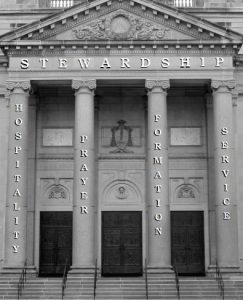
The Apostle Paul mentions hospitality, or the quality of being hospitable, especially in reference to the qualifications for leaders of the Church which he describes as The Body of Christ. As you can see by our illustration here, hospitality is part of the scope of Stewardship; the other parts are Prayer, Formation (learning about God’s plan), and Service (helping the Body of Christ as well as others outside the Church). The Apostle Paul states he has received from the Lord a “commission,” an assignment to spread the Gospel.

In this passage the Apostle Paul is addressing a congregation he has never met, and so he expresses his responsibility and qualifications for the work he is doing on their behalf. As he presents this information, he indicates that the Master in this economy of Faith is God inasmuch as it is God who is providing the resources for our salvation. As part of that economy to be managed, God assigned the responsibility of conveying the Gospel to the gentiles to the Apostle Paul. He describes how that assignment is carried out in 1 Corinthians 9:17 17 If I were volunteering my services of my own free will, then the Lord would give me a special reward; but that is not the situation, for God has picked me out and given me this sacred trust*, and I have no choice. Living Bible (TLB)[i] *This sacred trust is the stewardship of the Gospel – to deliver it freely without expecting a return, to prayerfully lead the community of faith, to contribute to their proper and thorough knowledge of the Truth of the Gospel, and to serve God by serving those whom God has called. It is this service to which the Apostle Paul willing gives his whole life – even the great sufferings (which Jesus had promised him at the time of his conversion) he endured for the sake of the Gospel. Here we see a man who does not count the cost of fellowship and service. He simply gives whatever is needed. In the NIV (New International Version) it is expressed this way: Now I rejoice in what I am suffering for you, and I fill up in my flesh what is still lacking in regard to Christ’s afflictions, for the sake of his body, which is the church.

We’ve all heard – and perhaps even used – the expression “offering it up to the Lord,” or “joining my suffering with the sufferings of Christ.” The Apostle Paul is suffering for those who would not be able to bear the suffering promised to all who follow Jesus. His compassion for the people in Colossae, whom he had never met, is so closely bound to the afflictions of Christ and the Church that he gladly and willingly steps in to suffer on behalf of others. You’ll find a very clear explanation of this kind of suffering in 1 Peter 4:12-19 which ends with this statement: 19 Therefore, let those suffering in accordance with God’s will entrust themselves to a faithful Creator, while continuing to do good. (Please use that link to see this in context.)

The Apostle Paul is NOT saying that Christ’s sacrifice on the Cross was incomplete (as some will try to tell you); he is saying that the Church, the Body of Christ, has much suffering to do, and he is willing to take on more than his share because Jesus commissioned – appointed, authorized, and contractually commanded – that he do so. As a Steward, the Apostle Paul gets my vote for being an exceptional example of the entire concept of Stewardship. When we first read (of skim over?) this passage, our hearts and minds may hear the faint echo of disbelief saying, “Say what?” Now, perhaps, when we hear this we will better understand that being a good Steward means more than just managing and sharing our Time, Capabilities, and Worldly Wealth. It means doing everything in our power, and beyond (for with God all things are possible ← Check it out!) for your sake. The Apostle Paul would have been familiar with the concept of the “Messianic Woes,” the sufferings in the end times that prepare the World for the Advent of the Kingdom of God. He willingly submitted to suffering those preparatory disruptions in his own flesh – marked with the wounds of Christ (certainly at least the scars of multiple scourgings and perhaps even the stigmata) – for the sake of people he never met – you and me, for example.

     So therefore Beloved, Rejoice! God created you with a purpose and is absolutely thrilled when he sees you devoted to Him and to His purpose. This is HIS WORLD (↔ Music Link) after all! That is certainly a cause for great rejoicing. He will surely look with favor on his devoted servants who willing take on the commission to be Stewards of the Gospel.

BONUS MUSIC LINK!

Unless otherwise indicated, all scripture passages are from the New Revised Standard Version Catholic Edition (NRSVCE) New Revised Standard Version Bible: Catholic Edition, copyright © 1989, 1993 the Division of Christian Education of the National Council of the Churches of Christ in the United States of America. Used by permission. All rights reserved.

Biblical languages inserts from Bible Hub (Bible Hub: Search, Read, Study the Bible in Many Languages) Visit at http://biblehub.com

Creative Commons License
Aloha Friday Messages by Charles O. Todd, III is licensed under a Creative Commons Attribution-ShareAlike 3.0 Unported License

[i] Scripture quotations marked NLT are taken from the Holy Bible, New Living Translation, copyright © 1996. Used by permission of Tyndale House Publishers, Inc., Wheaton, Illinois 60189. All rights reserved.


Aloha Friday Message – July 12, 2019 – There you are.

1928AFC071219 – There you are.

Read it online here, please. And please, when you visit there, use one of the social media links at the bottom of the page to share this post. Thank you! And remember, we now have a READER VIEW available, so share this link or this email often.

Psalm 19:14 14 Let the words of my mouth and the meditation of my heart be acceptable to you, O Lord, my rock and my redeemer.

May Peace always be with you and may God bless you, Belovéd!

Philippians 4:5-7 Let your gentleness be known to everyone. The Lord is near. Do not worry about anything, but in everything by prayer and supplication with thanksgiving let your requests be made known to God. And the peace of God, which surpasses all understanding, will guard your hearts and your minds in Christ Jesus.

Sunday’s Gospel is the familiar story of The Good Samaritan. Jesus’ parables help us understand what God intends for us to be, for us to do, and for us to share. At the end of this story, Jesus asks, “Which of these three, in your opinion, was neighbor to the robbers’ victim?” He [scholar of the law] answered, The one who treated him with mercy.’ Jesus said to him, “Go and do likewise.”

We do not know any more about this Samaritan other than his nationality, and we can assume he was wealthy because of the extent of his generosity. He was “taking care of business,” and stopped to help a stranger; then he continued with his work and promised to follow up on his act of charity. Jesus’ point is straightforward: Do that. Recall that Jesus told this story because the lawyer tried to justify himself by asking, “And who is my neighbor?” In my heart and mind, I hope that lawyer blushed a little when he heard Jesus’ answer. It makes me blush, because I know that I, too, try to limit my charity and justify my lack thereof. “He’s just going to use that money to get wine / drugs / gambling / whatever.” “If I send them some money, they’ll keep sending me more and more appeals, and it gets to be nothing more than junk mail.” That’s not what’s supposed to happen. Jesus commands us: Overcome prejudice, overcome fear, overcome violence – and keep working at the tasks God has given you. Everywhere you go, go with God, and God will always be near. How easily we forget that sage advice and stubbornly walk away from God! We cannot expect to be filled with the Spirit if we say, “Not now. I’m busy. I can’t afford to get involved. Maybe some other time.” Not exactly what the Apostle Paul taught: Let your gentleness be known to everyone. The Lord is near. Seek him while – and where – he can be found. This is why it is so important to remember that in everything by prayer and supplication with thanksgiving let your requests be made known to God. The result – both immediate and long-term – is the peace of God, which surpasses all understanding, will guard your hearts and your minds in Christ Jesus. “Guard our hearts and minds in Christ Jesus?” Why are we afraid to help? Is it really because once we “start helping,” others will expect us to continue and even to help them? Is it true that “no good deed goes unpunished?” Even the simplest of things can be good deeds; we don’t have to wait for a “Good Samaritan Opportunity” to be generous, to be faithful, or to be respectful. Let me give you a “good ol’ Catholic” example.

When the Gospel is read during the Liturgy of the Word, there are some common gestures that have come into practice over the centuries. It may surprise some of us to learn that today’s Key Verse – Psalm 19:14 – has something to do with that. When the Priest or Deacon announces the Gospel, he says, “A reading from the Gospel according to St. _________.” Then he traces the sign of the cross over the page. Members of the assembly respond by saying, “Glory to You Oh Lord” and make a small sign of the cross with their thumb over their forehead, lips, and chest. Why? With this silent gesture, we are acknowledging that the Gospel is the Living Word of God so we consciously remember to listen so that the Gospel will make a way into our minds, our speech, and our hearts – that is, if we remember to do that and if we remember WHY we do that.

We trace a cross on our forehead to remind us that the Gospel can illuminate our thoughts and purify our minds. We trace a cross on our lips to remind us our speech should be holy and influence our willingness to share the Gospel with others. Lastly, we cross our hearts as we invite God to increase our love for Him and for others. This short, silent prayer with the accompanying gestures is to remind us that being open to the Gospel will help us to know, to publicly acknowledge, and love Jesus even more. Thus we take steps to fulfill this passage’s meaning: Let the words of my mouth and the meditation of my heart be acceptable to you, O Lord, my rock and my redeemer.

It is such a little thing, but it can make a huge difference if we are not afraid to try it. Fear is such a foolish thing. You may recall we’ve often quoted Brendan Case here who said FEAR is an acronym for False Evidence Appearing Real. There’s an excellent example of this in the book of Wisdom, Chapter 17. The writer is recounting the mind-numbing, heart-wrenching fear that incapacitated the Egyptians as they felt the weight of God’s judgment on them for the wickedness they had committed: Wisdom 17:11-15 11 For wickedness is a cowardly thing, condemned by its own testimony* distressed by conscience, it has always exaggerated the difficulties. 12 For fear is nothing but a giving up of the helps that come from reason; 13 and hope, defeated by this inward weakness, prefers ignorance of what causes the torment. 14 But throughout the night, which was really powerless and which came upon them from the recesses of powerless Hades, they all slept the same sleep, 15 and now were driven by monstrous specters, and now were paralyzed by their souls’ surrender; for sudden and unexpected fear overwhelmed them.          * The word used here for “testimony” is λογισμός (logismos) {log-is-mos’} thought, reasoning; false argument or reasoning, properly, “bottom-line” reasoning that reflects someone’s values, i.e. how they personally assign weight in determining what they find reasonable. (“calculated arguments, thoughts”) emphasizes reaching a personal opinion, i.e. what comes out of a personal reckoning. This is the same fallacious reasoning behind relativism (← Check it out!). “What’s true for you may not be true for me ….” It’s also part of the practice of Satisficing which is a decision-making strategy that aims for an agreeable or tolerable result, rather than the best-possible solution. “Ehh, that’s good enough.” No, it’s not. Let me show you something to think about: A Cross:

What is the first thing that comes to mind? Is it Jesus? With or without the corpus (the crucified body of Christ), does the Cross remind you of anything when you consider The Wondrous Cross (↔ Music Link)? What if that was in your mind as you prepare to listen to the Gospel – even in a non-Catholic setting? Would we remember that Jesus came to die for us every time we see a Cross – even if it’s really just a telephone pole? Do we ever take “half-a-mo'” to remember that the Fullness of God was/is/will be Jesus? Colossians 1:19 19 For in him all the fullness** of God was pleased to dwell …  ** πλήρωμα (plērōma) {play’-ro-mah} sum total, fullness, even (super) abundance; the body of believers, as that which is filled with the presence, power, agency, riches of God and of Christ. And what of us; what will it take to fill even us? Here is what the Apostle Paul said to the Church in Ephesus:

Ephesians 3:16-19 16 I pray that, according to the riches of his glory, he may grant that you may be strengthened in your inner being with power through his Spirit, 17 and that Christ may dwell in your hearts through faith, as you are being rooted and grounded in love. 18 I pray that you may have the power to comprehend, with all the saints, what is the breadth and length and height and depth, 19 and to know the love of Christ that surpasses knowledge, so that you may be filled with all the fullness of God. How does any of this relate to The Good Samaritan and the meditations of our hearts? Simply this:

We can choose to be mindful of the Cross, the Christ, and the crisis of indifference, or we can be like the Priest and the Levite and refuse to make a difference. Too often what we fail to realize is that the choice to ignore the problem is just another way to make a difference – only a negative difference. We can live with and in The Word, or just walk on by as if it doesn’t really matter because we won’t really change anything by acting on our impulse for charity. If instead our minds, our lips, and are hearts are open to the flow of The Word, then we have Spirit and Life because “Your words, Lord, are Spirit and Life” (↔ Music Link). There is one body and one Spirit, just as you were called to the one hope of your calling, one Lord, one faith, one baptism, one God and Father of all, who is above all and through all and in all. Ephesians 4:4-6 – all who know the name of God for His name is HOLY. (↔ Music Link), And whenever we are with him, then he is with us, and together we and he testify to the Truth of Charity, which is Love, empowered by FAITH – being Fully Aware I Trust Him who is my rock and my redeemer. When we are in The Word, we are where Love is, so that with HIM wherever you go There you are. That is certainly nothing to be afraid of. Amen.

Unless otherwise indicated, all scripture passages are from the New Revised Standard Version Catholic Edition (NRSVCE) New Revised Standard Version Bible: Catholic Edition, copyright © 1989, 1993 the Division of Christian Education of the National Council of the Churches of Christ in the United States of America. Used by permission. All rights reserved.

Biblical languages inserts from Bible Hub (Bible Hub: Search, Read, Study the Bible in Many Languages) Visit at http://biblehub.com

Creative Commons License
Aloha Friday Messages by Charles O. Todd, III is licensed under a Creative Commons Attribution-ShareAlike 3.0 Unported License

Aloha Friday Message – July 5, 2019 – A Serious Falling Out

1927AFC070519 – A Serious Falling Out

Read it online here, please. And please, when you visit there, use one of the social media links at the bottom of the page to share this post. Thank you! And remember, we now have a READER VIEW available, so share this link or this email often.

Luke 10:18 18 He said to them, “I watched Satan fall from heaven like a flash of lightning. …”

¡Que la bendición esté siempre con ustedes y que Dios los bendiga, Amados! (May blessing always be with you and may God bless you, Belovéd!) Today I am led to this short – but extraordinary – statement by Jesus. It is one of those passages that references Jesus as “The Ancient of Days;” recall that John the Baptist say “After me comes a man who ranks ahead of me because he existed before me.” Jesus just told everyone he saw Satan get tossed out of Heaven. Did that happen before or after God created the heavens and the Earth? Final answer: We don’t know. What we do know is that Jesus knew who Satan is before earthlings did, because Satan, a.k.a. Lucifer, was there “in the beginning” to louse up the lives of the beings created in God’s image and likeness. Who is this fallen angel, and why is it important to know about him?

Jesus said he saw him fall from Heaven. This is recorded here: 

Isaiah 14:12 12 How you are fallen from heaven,
O Day Star, son of Dawn!
How you are cut down to the ground,
you who laid the nations low!

He was an Angel of God – some make him out to be a “Worship Leader” in the Heavenly realm – and he decided he wanted to be God. We call him Satan or the Devil. We first hear of Satan in 1 Chronicles 21:1 – he “stood up against Israel, and incited David to count the people of Israel.” He is first referred to as the Devil in the New Testament. The terms are roughly equivalent. Satan is a devil and a devil, like Satan, is one who “stands against” – opposes, accuses, contends – against us, the earthlings. Satan, also referred to by his angelic name Lucifer, the “Angel of Light,” is that angel which rebelled against God by desiring to be “greater-than-or-equal-to” God. His rebellion cost him his place in Heaven, and set the course for everything he has done since then. (See 1 Samuel 15:23 for God’s view of rebellion) When he was cast out of heaven (See Isaiah 14:12-15), he took many of his followers with him. He is the prosecutor who charges us with sin and attempts to bend us to his will by twisting the truth; he is a liar. Satan looks like this in Hebrew: שָּׂטָן‎‎ (Satan) {saw-tawn’}, meaning “enemy” or “adversary,” who is always opposed to God’s will, constantly plotting against God and all of humanity. The word Satan is not properly a name, but rather a quality of essence – it describes what he does. Often in the Old Testament the word occurs with the demonstrative article “ha” as in ha-Satan – the accuser, the enemy, the prosecutor, or the persecutor. There are about 10 occurrences of this sort of reference in the first two chapters of Job. Another example is in Zechariah 3:1–2 where God is the “Counsel for the Defense” and Satan is the “Prosecuting Attorney.” One small point I would like to make is that the word is pronounced seɪtən (sayt-n) not seɪntən (saynt-n). There is only 1 (one) N in that word, and it is at the end of the word.

In the Greek version of the Old Testament, he is Σατανᾶν, ς (Satanan or Satanas) {sat-an-as’}; he is also referred to as διάβολος diabolos {dee-ab’-ol-os}, a slanderer who throws misrepresentation of Truth into our path. He is the Prince of Demons, the Old Serpent, Old Scratch, and Prince of the Air. He gained Adam’s right to God’s Garden when Adam gave the Serpent a higher level of trust than he gave God.  Satan’s minions (which are not at all like the cute little yellow creatures so popular these days) are called Fallen Angels – δαιμόνιον (daimonion) {dahee-mon’-ee-on} – evil spirits who are the messengers and ministers of the devil. They serve him by plaguing us with lies and more lies attempting to get us to trust ourselves rather than God; in short, they try to get us to commit their sin of opposing and rebelling against God in all things. Jesus saw Satan fall and I sincerely believe he was expecting him to show up when he went into the desert to fast and pray.

Here are some other passages where this lying snake is identified:

Job 1:6-9 One day the heavenly beings came to present themselves before the Lord, and Satan* also came among them. The Lord said to Satan, “Where have you come from?” Satan answered the Lord, “From going to and fro on the earth, and from walking up and down on it.” The Lord said to Satan, “Have you considered my servant Job? There is no one like him on the earth, a blameless and upright man who fears God and turns away from evil.” Then Satan answered the Lord, “Does Job fear God for nothing? *Or the Accuser; Hebrew: ha-Satan.

Romans 16:20 20 The God of peace will shortly crush Satan under your feet. The grace of our Lord Jesus Christ be with you.

1 Corinthians 5:4b-5 When you are assembled, and my spirit is present with the power of our Lord Jesus, you are to hand this man over to Satan for the destruction of the flesh, so that his spirit may be saved in the day of the Lord.

2 Corinthians 11:12-15 12 And what I do I will also continue to do, in order to deny an opportunity to those who want an opportunity to be recognized as our equals in what they boast about. 13 For such boasters are false apostles, deceitful workers, disguising themselves as apostles of Christ. 14 And no wonder! Even Satan disguises himself as an angel of light. 15 So it is not strange if his ministers also disguise themselves as ministers of righteousness. Their end will match their deeds.

2 Thessalonians 2:9-12 The coming of the lawless one is apparent in the working of Satan, who uses all power, signs, lying wonders, 10 and every kind of wicked deception for those who are perishing, because they refused to love the truth and so be saved. 11 For this reason God sends them a powerful delusion, leading them to believe what is false, 12 so that all who have not believed the truth but took pleasure in unrighteousness will be condemned.

Matthew 25:41 41 Then he will say to those at his left hand, ‘You that are accursed, depart from me into the eternal fire prepared for the devil and his angels;

Revelation 2:9 “I know your affliction and your poverty, even though you are rich. I know the slander on the part of those who say that they are Jews [in Smyrna] and are not, but are a synagogue of Satan. …”

Revelation 2:13 13 “I know where you are living, where Satan’s throne is. Yet you are holding fast to my name, and you did not deny your faith in me even in the days of Antipas my witness, my faithful one, who was killed among you, where Satan lives. …”

Revelation 20:1-10 Read the whole passage for the context of the following:

  • Revelation 20:2-3He seized the dragon, that ancient serpent, who is the Devil and Satan, and bound him for a thousand years, and threw him into the pit, and locked and sealed it over him, so that he would deceive the nations no more, until the thousand years were ended. After that he must be let out for a little while.
  • Revelation 20:7-8 When the thousand years are ended, Satan will be released from his prison and will come out to deceive the nations at the four corners of the earth, Gog and Magog, in order to gather them for battle; they are as numerous as the sands of the sea.
  • Revelation 20:10 10 And the devil who had deceived them was thrown into the lake of fire and sulfur, where the beast and the false prophet were, and they will be tormented day and night forever and ever.

John 6:67-71 67 So Jesus asked the twelve, “Do you also wish to go away?” 68 Simon Peter answered him, “Lord, to whom can we go? You have the words of eternal life. 69 We have come to believe and know that you are the Holy One of God.” 70 Jesus answered them, “Did I not choose you, the twelve? Yet one of you is a devil.” 71 He was speaking of Judas son of Simon Iscariot, for he, though one of the twelve, was going to betray him.

John 8:44 44 You are from your father the devil, and you choose to do your father’s desires. He was a murderer from the beginning and does not stand in the truth, because there is no truth in him. When he lies, he speaks according to his own nature, for he is a liar and the father of lies.

We see quite a lot of this contemptuous maligning – slander and libel, “mud-slinging” – in politics today. The root word for all of this is Διαβάλλω (diaballó) {dee-ab-al’-lo} which gives us διάβολος (diabolos) {dee-ab’-ol-os}. It is someone who is slanderous, making false accusations, and defaming character. Such a one is called a slanderer; a false accuser; it is someone who is unjustly criticizing another to cause hurt (malign) and condemn with the objective of dissolving a valid relationship; the intent is always malicious even if the information is truthful (which is quite often not the case!). The goal of causing division is the preemptory goal in this just as it is in the rebellion against God by Lucifer and his angels, the demons. Of course, God had a plan for this from “In the Beginning.”

We see that first in Genesis 3:15 15 I will put enmity between you and the woman, and between your offspring and hers; he will strike your head, and you will strike his heel. Another example is in Zechariah 3:8Now listen, Joshua, high priest, you and your colleagues who sit before you! For they are an omen of things to come: I am going to bring my servant the Branch. Yes, you are correct! That is the RADIX JESSE, A shoot will come up from the stump of Jesse; from his roots a Branch will bear fruit. The fruit he will bear is the fruit of Truth, and Truth will conquer and destroy both the lie and the liar. This is what the Apostle Peter meant in 1 Peter 5:8 Discipline yourselves, keep alert. Like a roaring lion your adversary the devil prowls around, looking for someone to devour. How do you avoid this prowling, growling, hungry lion? WITH CONSTANT VIGILANCE! Learn to discern in every concern to prevent his return. And how does one discern evil? Is evil something of the natural world, or of the supernatural – the spiritual? See what the Apostle Paul says here:

1 Corinthians 2:11-16 11 For what human being knows what is truly human except the human spirit that is within? So also no one comprehends what is truly God’s except the Spirit of God. 12 Now we have received not the spirit of the world, but the Spirit that is from God, so that we may understand the gifts bestowed on us by God. 13 And we speak of these things in words not taught by human wisdom but taught by the Spirit, interpreting spiritual things to those who are spiritual*. 14 Those who are unspiritual do not receive the gifts of God’s Spirit, for they are foolishness to them, and they are unable to understand them because they are spiritually discerned. 15 Those who are spiritual discern all things, and they are themselves subject to no one else’s scrutiny. 16 “For who has known the mind of the Lord so as to instruct him?” [Refers to Isaiah 40:13] But we have the mind of Christ.

*Having the Spirit of God.

Woe to those who say, “I don’t believe in the Devil. God wouldn’t do that to anyone.” Belovéd, God believes in the Devil enough to warn us about that ancient Evil and to rescue us from his clutches. Maybe it’s best we follow God’s example. Otherwise we could end up in a serious falling out like Lucifer did.

Unless otherwise indicated, all scripture passages are from the New Revised Standard Version Catholic Edition (NRSVCE) New Revised Standard Version Bible: Catholic Edition, copyright © 1989, 1993 the Division of Christian Education of the National Council of the Churches of Christ in the United States of America. Used by permission. All rights reserved.

Biblical languages inserts from Bible Hub (Bible Hub: Search, Read, Study the Bible in Many Languages) Visit at http://biblehub.com

Creative Commons License
Aloha Friday Messages by Charles O. Todd, III is licensed under a Creative Commons Attribution-ShareAlike 3.0 Unported License

Please pray with us here at Share-a-Prayer.


Aloha Friday Message – June 28, 2019 – Serving the Servant

spend1926AFC062819 – Serving the Servant

Read it online here, please. And please, when you visit there, use one of the social media links at the bottom of the page to share this post. Thank you! And remember, we now have a READER VIEW available, so share this link or this email often.

Galatians 5:14 14 For the whole law is summed up in a single commandment, “You shall love your neighbor as yourself.”

May Peace always be with you and may God bless you, Belovéd! Today marks a surprising milestone. This is the 700th post to the MBN at aloha-friday.org. Not quite the same as “The 700 Club,” but still a count not foreseen when we started. Thank you for hanging in as we worked toward this attainment. We hope you’ll stick around for the day we hit 750 – probably sometime in June, 2020.

This coming Sunday we will review the calling of the Prophet Elisha. It’s surprising how many people know about Elijah, but know little about Elisha. Elijah was a Prophet who lived outside worldly comforts and was the enemy of rulers such as Ahab, Jezebel, and Ahazaiah – a desert prophet like John. Elisha was a Prophet who lived in community and was the respected friend of the powerful. Elijah had no earthly means of support other than God. Elisha was seemingly wealthy – he had arable land, livestock and equipment to plow it, and a large family. Both worked diligently to rid Israel of idolatry. Elijah destroyed his enemies with fire and sword (See 1 Kings 18:17-40). Elisha called upon the army of the Lord to dispatch the enemies of Israel (See 2 Kings 6:8-23) In this account, Elisha’s strategy was to pacify the enemy through charity – and it worked! Does that remind you of something Jesus states in Matthew 5:43-47? Jesus commands us to treat our enemies with compassion because in doing so, we are behaving as his servants.

Elijah (“my God is Jehovah”) and Elisha (“God is Salvation”) found favor with God because they served him without distraction. They followed “the straight path” Jesus later described in his ministry. (See Matthew 7:13-14) Going straight toward God sounds like a very reasonable course. Where else would we like to be except in his Grace, in his Will, and in his Presence? Sadly, the answer is, “almost anywhere else.” When it comes to serving God, we are so easily distracted! There’s an interesting pairing of Scriptures in this weekend’s readings. In the Old Testament reading – the calling of Elisha – Elijah drops in on him while he’s plowing with “12 yoke of oxen.” That’s a lot of plow-power! It also indicates Elisha’s wealth as well as his physical strength. He’s plowing straight furrows in the land; that means he was paying attention to what he was doing and in control of himself and his surroundings. Elijah approaches and throws his cloak over him. This is an ancient practice that indicated adoption. Elijah apparently abruptly turns and walks away because Elisha chases after him and asks Elijah if he can go back and kiss his parents (and his whole life!) goodbye. Elijah says, “Go back! Have I done anything to you?” Elisha goes back, slaughters the oxen and uses the materials of the plough to boil their meat and feed his family; then he follows the Prophet. There’s a link to this in Sunday’s Gospel.

Jesus tells one of his Disciples, someone who wants to follow Jesus (↔ Music Link) to Jerusalem for whatever reason, in Luke 9:62 62 Jesus said to him, “No one who puts a hand to the plow and looks back is fit for the kingdom of God.” What? What can this mean? Let’s start with a modern example and then extrapolate to what Jesus’ disciples heard.

   Who among us has spent part of a day mowing the lawn? Many a yard has a rectangular shape, and we mow along the edges of that shape in straight rows, carefully overlapping the rows so that no pesky little strips of uncut grass are left. We have to keep an eye on how those mower-rows go so that we get a nice even cut; it can even be artfully pleasing when well done. The same goes for plowing large areas. Think of the mower paths on a Major League Baseball field, or on a golf green. Now think of those long, incredibly straight rows in corn fields or other crops. How do they do that? You have to be watchful to get it done well. It is the same way in our relationship with Christ. We need to keep a steady hand on the plow, and focus on what’s ahead. If you’re distracted by what’s off to the side, you’re liable to go a little askew. How do you think it would turn out if you turned around and looked back at your furrow while you’re plowing ahead toward the end of the field? Isn’t there a pretty good chance you’ll make even greater errors? Elijah’s half-joking scolding of Elisha hints at the cost of hesitation (he might lose out on God’s call), but Elisha goes plows straight through that objection and closes up that portion of his life immediately, and then unswervingly follows Elijah. In the end, Elisha ends up receiving “a double portion of [Elijah’s] spirit” which lead to performing twice as many miracles as Elijah. He the former master, Elisha, becomes the servant of the Servant of God. Elisha serves God in the same manner as he plowed the field – without distraction or deviation. What then of the Disciple to whom Jesus spoke of as being unfit for the Kingdom of God? Did Jesus “forget” about Elisha?

Of course not; however, the lesson he taught there was a powerful reminder to those present (and to us as well) that we should not be distracted by what we have passed. One of the most important things I learned years ago was “Don’t look back unless you want to go back.” Are memories, families, position and power, physical pleasures – are any of these of greater value that serving the Servant King? What has he asked from us? He simply said, “Follow me.” Where should our eyes be then? (↔ Music Link) what happens if we look back? Just as with mowing the lawn or plowing the field, we go astray. We lose our way and become unfit for the Kingdom of God. Bummer. In this age when multitasking seems to be (seems to be) a virtue, it turns out that might be what could make us unfit servants of the Servant King. Often, when that happens, we just give up – as did some of Jesus’ Disciples (← Check it out!)

Not everyone can afford the extravagance of giving up, and certainly not true and intentional Disciples. You know, many of us think we have this Christianity thing all figured out and we can handle it on our own. The Apostle Paul said in Philippians 3:13-14 13 Beloved, I do not consider that I have made it my own; but this one thing I do: forgetting what lies behind and straining forward to what lies ahead, 14 I press on toward the goal for the prize of the heavenly call of God in Christ Jesus.

The Apostle Paul kept his eyes on the prize, and what a prize! He truly was a servant of the Servant! He never deviated from his mission. He left everything, lost everything several times, and eventually lost his life on the straight and narrow road. That required a singular focus on one thing: Love. Today’s Key Verse is another excerpt from Sunday’s readings: Galatians 5:14 14 For the whole law is summed up in a single commandment, “You shall love your neighbor as yourself.” It sounds so familiar that we think we have already done it. That’s looking back. If we think we’ve completed that, we’ve claimed the extravagance of giving up. We need to look ahead and see how much more we can Love. We’ve looked at this passage several times: Isaiah 30:2 21 And when you turn to the right or when you turn to the left, your ears shall hear a word behind you, saying, “This is the way; walk in it.” What is “the way?” The way is Love. But it is tiring to always focus ahead and struggle along that straight and narrow; we exhaust ourselves fighting against the natural impulse to turn aside from our labors. There’s a cure for that: Hebrews 12:13-14 12 Therefore lift your drooping hands and strengthen your weak knees, 13 and make straight paths for your feet, so that what is lame may not be put out of joint, but rather be healed.14 Pursue peace with everyone, and the holiness without which no one will see the Lord. When it hurts to look back, and you’re scared to look ahead, you can look beside you and your BEST FRIEND will be there. (↔ Music Link) God speaks to us through his Word (the Christ) and his Word (the Scripture). When we are listening, then we are nearer to him because he is near to us. When we see him acting in our lives, he is near. We see him defeat our enemy, and he is near. Whenever we notice he is near – SURPRISE! HE IS NEAR!! The more we know him, the more we love him because we know better how much he Loves us. So look back? Not really, there’s no point in that if we want to move forward. Remember? Yes, especially remember history so we don’t repeat it – which is going back instead of just looking back. Look ahead? Yes, with eyes on the Prize and our the eyes of our heart carefully focused. We just need to be careful how that focus works.

  • If anger is your lens, don’t look forward or back
  • If Peace is your Goal, let loose of everything that is not Peaceful
  • If Joy is your hope, be joyful even in adversity
  • If you cannot be reconciled with the past, it will use up your future

The Disciple to whom Jesus spoke hadn’t settled on his decision to hit the road on the straight and narrow and go to Jerusalem and Calvary. He was unfit then. One wonders if, perhaps later on, he set his eyes toward The Kingdom and has arrived thereby serving the Servant of God. If we are going to follow Jesus, then we have to go where he goes, do what he does, say what he says, and be what he is – a servant of the Servant: John 12:26 26 Whoever serves me must follow me, and where I am, there will my servant be also. Whoever serves me, the Father will honor.

Don’t look back unless you want to go back.

Whatever, whenever, wherever, whoever, however, if ever, forever

— at your service, Belovéd!

Please pray with us here at Share-a-Prayer.

Unless otherwise indicated, all scripture passages are from the New Revised Standard Version Catholic Edition (NRSVCE) New Revised Standard Version Bible: Catholic Edition, copyright © 1989, 1993 the Division of Christian Education of the National Council of the Churches of Christ in the United States of America. Used by permission. All rights reserved.

Creative Commons License
Aloha Friday Messages by Charles O. Todd, III is licensed under a Creative Commons Attribution-ShareAlike 3.0 Unported License


Aloha Friday Message – June 21, 2019 – The Fellowship of The Bread

1925AFC062119 – The Fellowship of The Bread

Aloha nui loa, ʻŌmea! We have new additions to the MBN Intercessory Prayer List. Please visit, and if you can make the time, please add the MBN Daily Prayer to your “daily list.” Thank you VERY much! Read this post online here, please. And please, when you visit there, use one of the social media links at the bottom of the page to share this post. Thank you! And remember, we now have a READER VIEW available, so share this link or this email often.

Luke 9:16-17 16 And taking the five loaves and the two fish, he looked up to heaven, and blessed and broke them, and gave them to the disciples to set before the crowd. 17 And all ate and were filled. What was left over was gathered up, twelve baskets of broken pieces.

Acts 2:42 42 They devoted themselves to the apostles’ teaching and fellowship, to the breaking of bread and the prayers.

1 Corinthians 10:16 16 The cup of blessing that we bless, is it not a sharing in the blood of Christ? The bread that we break, is it not a sharing in the body of Christ?

This Sunday is June 23, 2019 – The Solemnity of the Body and Blood of Christ (Corpus Christi). On this day we remember that Christ told his Disciples, and us as well, that he is the Bread of Life come down from Heaven which was followed by the statement for my flesh is true food and my blood is true drink. Jesus is in the Father, the Father is in Jesus, the Father and the Son live in the Unity / Communion / Fellowship of the Holy Spirit, and the Father and the Son, and the Holy Spirit are in those who believe. St. Thomas Aquinas once wrote: “Material food first of all turns itself into the person who eats it, and as a consequence, restores his losses and increases his vital energies. Spiritual food, on the other hand, turns the person who eats it into Itself, and thus the proper effect of this sacrament is the conversion of man into Christ, so that he may no longer live for himself, but that Christ may live in Him. And as a consequence it has the double effect of restoring the spiritual losses caused by sins and defects and of increasing the power of the virtues.”

In Jesus’ discourse about the Bread of Life, he points out that God gave manna – bread from Heaven – to the Israelites. In the 6th chapter of John (See John 6:47-51), he makes the claim that God is sending true bread from Heaven, himself. Jesus, eternally begotten of the Father, is eternally in the Presence of God. God showed us what this was like in the Bread of Presence, the Showbread (See Exodus 25:30, and Leviticus 24:5-9), which was always in the Holy Place, always before God’s face, and always consumed in a holy way by God’s Holy Priests in that Holy Place. Jesus is the Perfect Bread of Presence, consumed in a Holy Place.

Jesus reminded the Jewish authorities of the manna as well as the Showbread and of the time that King David ate the Bread of Presence as related in 1 Samuel 21:1-6 In this passage, David entered the Tabernacle on a secret mission. He asked the Priest, Abimelech, for five loaves of bread to feed him and his troops. The Priest gave him the Bread of Presence – Showbread – which enabled him to carry out the mission. The passage ends like this: So the priest gave him the holy bread; for there was no bread there except the bread of the Presence, which is removed from before the Lord, to be replaced by hot bread on the day it is taken away. You can see Jesus’ understanding of the significance of this in Mark 2:23-28 In this passage we read, 25 And he said to them, “Have you never read what David did when he and his companions were hungry and in need of food? 26 He entered the house of God, when Abiathar was high priest, and ate the bread of the Presence, which it is not lawful for any but the priests to eat, and he gave some to his companions.” 27 Then he said to them, “The Sabbath was made for humankind, and not humankind for the Sabbath; 28 so the Son of Man is lord even of the Sabbath.”

Yes, we believe it truly is Christ who is present in the Eucharist; we believe His true presence begins from the time of the consecration and then endures so long as the sacramental species are discernible. In that belief, we become what we eat – Holy. Perfect? No, we are not perfect or perfected. We are made WHOLE which is what holiness is. Christ is present, Christ is offered, and Christ offers the Offering.

We refer to this offering as an oblation. This is a solemn gifting of Christ’s sacrifice and ours as we look upon the True Presence with eyes enlightened by faith. (See Ephesians 1:17-19 for opening the eyes of our hearts (↔ Music Link). An Oblation is a “meal” (grain) offering. It is the most fundamental of all offerings. In the Old Testament it is often called a “gift offering,” and the noun used in Hebrew is מִנְחָה (minkhah) {min-khah’}. During every Eucharistic Prayer there are two Oblations. The “lesser oblation” is the Offertory – this happens before the Consecration – in which the bread and wine are presented to God. During this Offertory, the Priest holds both hands over the Gifts on the Altar and blesses them. The “greater oblation,” the Oblation Proper, occurs after the consecration when the Priest, on behalf of Christ, offers God the Precious Body and Blood of Jesus as Jesus himself offers himself to his Father on our behalf. It is a truly amazing moment many people often miss even though we have opportunity to see the Bread of Life and to believe – to be an active participant in The Fellowship of The Bread.

We see the Bread when it is offered. We see the Bread when it is consecrated. We see the Bread when is broken and elevated with the Chalice of Salvation. We see the Bread when it is given for consumption. We become the Bread when we eat the Bread and Drink the Chalice. In all of these instances after the consecration, if we see with the eyes of our hearts, we see The Precious Body and Blood of Christ – not just bread and wine. In the same way that the Bread of Presence was always before the Lord in the Holy Place, we hold the Presence of the Lord in the Tabernacle of our Hearts, and our hearts are always facing the Face of the Lord. That is why we look, that is why we eat, that is why we believe, that is why we go – we become The Fellowship of The Bread.

The TV commercials and shows about losing weight are ubiquitous and all are based on the same premise: Diet and Exercise make change possible. Hm. Diet and exercise can change our lives. A diet that is the “Body, Blood, Soul, and Divinity of Christ” certainly is a healthy diet. The exercise of our Faith is facilitated by the excellence of our diet. Diet and Exercise in this case also makes change possible. Better still, it makes complete change not only possible, but also feasible, and probable. Every Christian who is true to her/his faith is called to fearless and joyous communion with God through Jesus as Jesus’ adopted brothers and sisters.

So if the diet is Christ, then the exercise is, on one hand, our communion with and through him in the Eucharist, and on the other hand, our suffering with and for him (Recall what we studied in Mark 10:30). That doesn’t need to be as dramatic as it sounds. Suffering is not always misery, anguish, torment, and affliction. Sometimes it is just keeping your mouth shut when a stinging retort is poised at your lips. Sometimes it is dropping a dollar into a jar for a street musician or a homeless person. Sometimes it is giving up a bit of our time to volunteer at the Boys and Girls Club. Sometimes it is taking a moment to be kind to the “least of these my brethren.” For me and for my fellow Catholics, that exercise is made possible in a fuller and more satisfying way for us because of our confidence in the wholeness – mature, fully grown, completeness of The Body and Blood of the Eucharist. I gave up accepting the symbol of our faith as expressed in symbolic communion when I accepted the challenge to live in the Mystery of Transubstantiation. It’s a difficult concept for many Catholics to embrace and not all Catholics accept it. I cannot condemn that nor can I judge them for that perspective. Finding Jesus depends on where you put him.

We can’t keep putting Jesus “over there” in the church or “Up There” in Heaven or “back there” in time. He’s always “right here, right now.” Stop. Look. Listen. Feel. Touch. Taste and see the goodness of the Lord. (See Psalm 34:8) He never ever goes away no matter how good things are and no matter how bad things are. He’s always revealing himself to you “every moment of every day.” (↔ Music Link) And on those days when you feel like you have moved so far away from him that he can’t possibly know where you are, he speaks a promise to you:  Isaiah 41:9c-10 “You are my servant, I have chosen you and not cast you off”; 10 do not fear, for I am with you, do not be afraid, for I am your God; I will strengthen you, I will help you, I will uphold you with my victorious right hand.”

Jesus is the Bread from Heaven, the Bread of Life, The Living Bread, and that Bread was blessed and broken for us. Bread is the staff of life, and eating bread is a necessary action of living. Traditionally, bread – as the staff of life – was broken before eating it; it was not cut because, symbolically, that would be slicing Life itself. With that in mind, there is a new layer of context in Acts 2:42 42 They devoted themselves to the apostles’ teaching and fellowship, to the breaking of bread and the prayers. These are spiritual acts – sacred moments devoted to God. The Apostle Paul reminded the Corinthians in 1 Corinthians 10:16 16 The cup of blessing that we bless, is it not a sharing in the blood of Christ? The bread that we break, is it not a sharing in the body of Christ?

That word “sharing” is a very important word in our Liturgy. You will (hopefully) remember hearing this at the beginning of Mass: 2 Corinthians 13:13-14 13 The grace of the Lord Jesus Christ, the love of God, and the communion of the Holy Spirit be with all of you. “Sharing,” “Communion,” “Fellowship,” all of these are κοινωνία (koinōnia) {koy-nohn-ee’-ah} properly, whatever is shared in common as the basis of fellowship (partnership, community) Used secularly, it denotes a business partnership. Used in spiritual contexts, it denotes sharing in, communion, spiritual fellowship in the Body and Blood of Christ, a fellowship in the Holy Spirit which includes apostolic tradition, teaching, prayer, and participation in the Eucharist. That is a public act of worship where our Diversity plus our Unity together form Community – the place where κοινωνία happens in The Living Bread come down from Heaven.

In this Living Bread, we have the Full-Bodied Favor of God (not flavor) who becomes for, with, and in us the Staff of Life; we become what we eat (↔ Music Link). WE become bread blessed and broken and someday we will know that “What was left over was gathered up, twelve baskets of broken pieces.” We will continue the Fellowship of The Bread at the Heavenly Banquet – YOLOF!

Whatever, whenever, wherever, whoever, however, if ever, forever — at your service, Belovéd!

Unless otherwise indicated, all scripture passages are from the New Revised Standard Version Catholic Edition (NRSVCE) New Revised Standard Version Bible: Catholic Edition, copyright © 1989, 1993 the Division of Christian Education of the National Council of the Churches of Christ in the United States of America. Used by permission. All rights reserved.

Biblical languages inserts from Bible Hub (Bible Hub: Search, Read, Study the Bible in Many Languages) Visit at http://biblehub.com

Creative Commons License
Aloha Friday Messages by Charles O. Todd, III is licensed under a Creative Commons Attribution-ShareAlike 3.0 Unported License

We ARE the Body of Christ!

We ARE the body of Christ!

The Body of Christ – the Eucharist – nourishes and forms The Body of Christ – The Church – so that the Body of Christ becomes the Body of Christ!

Aloha Friday Message – June 14, 2019 – Trinity Too

1924AFC061419 –Trinity Too*

Read it online here, please. And please, when you visit there, use one of the social media links at the bottom of the page to share this post. Thank you! And remember, we now have a READER VIEW available, so share this link or this email often.

John 3:16-18 For God so loved the world that he gave his only Son, so that everyone who believes in him may not perish but may have eternal life. Indeed, God did not send the Son into the world to condemn the world, but in order that the world might be saved through him. Those who believe in him are not condemned; but those who do not believe are condemned already, because they have not believed in the name of the only Son of God.

Gospel Readings for Trinity Sunday

Year A – Matthew 28:16-20    This is The Great Commission. It is the command given to all Christians to evangelize the entire world.

Year C – John 16:12-15 – This is from the discourse at the Last Supper. Jesus is telling the Disciples that he will be leaving them soon; they, of course, do not understand, but he assures them that the Holy Spirit will come to them and help them to remember and understand everything he has taught them. This is the reading for this current Cycle.

Year B – John 3:1-17 – One of the best-known, most-quoted passages in the Bible, this passage describes in just a few words the amazing plan God has implemented by sending his Son for the Salvation of the World.  I respectfully ask you to follow that link and read that passage. Here’s a way to reflect on it:

Tom and Margaret went to the same high school from their freshman to senior years. They always “sort of” got along, but both of them were fiercely independent and a bit feisty. Still, they did make a good couple. They were often seen cruising in Tom’s clunky old ’58 Chevy pickup. He’d be driving with one hand, and Margaret would be snuggled up right next to him. Toward the end of their Senior year, they were practically inseparable, and by the week after graduation, each was feeling a yearning emptiness for the other. They were headed for different colleges in the Fall, and it seemed they’d never really get back together. In less than a year, they lost touch with each other. Neither made the effort to reach out, although Margaret still thought about Tom now and then.

At their Five-Year Class reunion they seemed to pick up right where they left off. Within just months they were married. Twenty-two years and four kids later, they were taking a Sunday drive in their 1958 Chevy Apache pickup they’d restored together just as Tommy was graduating from high school. Margaret looked over at Tom and said, “You know, twenty years ago when we were younger, we never sat this far apart.” Tom’s response was quicker than it should have been and he knew it was too late to snatch it back when he said, “Well, I haven’t moved.”

Beloved, how close to your Heavenly Father do you sit as the two of you travel through your life? Have you ever experienced the comfort of snuggling up with Jesus as you travel down the Road of Life? Does the Holy Spirit brighten your way even in the worst of traffic? If you don’t feel as close to God as you used to – or want to – think about the reason for it. Why does God seem so far away?

The three readings at the top are reading from the Solemnity of the Holy Spirit for each of the three cycles of readings – A, B, and C.  I want to focus on the Year B reading for this message.

John 3:16 is probably the most-cited and most-quoted verse in the Bible. Upwards of 80% of the world has seen JOHN 3:16 on television, in print, on the Internet, on billboards, in pamphlets, and heard it on every kind of broadcast media. It is a favorite memory-verse, quoted by millions of Christians worldwide. You might say it’s the basic tune of Christians everywhere. That phrase, “whosever believeth in Him” is brandished with unrelenting fervor as believers confront unbelievers to ask them, “Do you have a personal relationship with Jesus Christ?” If you say no, they may try to move you in that direction – push, pull, or carry you to the foot of the Cross. If you say yes, then perhaps the next question will be, “Do you have a church home?” That’s often followed by an invitation to make their church your church, their Jesus your Jesus, their religion – the only right and true faith – your religion because anything else falls woefully short of God’s plan for your salvation. It’s like, “Join us or go to Hell.” Maybe you feel that is a mischaracterization, a caricature if you will, but when I am confronted by that style of evangelization, I will often ask, “What about John 3:17?”

Most people don’t memorize that one. Some people slide right past it, so sure of being redeemed eternally because they are confident they are in the group called “Whosever Believeth in Him” that they have no qualm whatsoever in roping off their part of the world with the Personal-Relationship Clause of their religion. So, what about John 3:17? 17 “Indeed, God did not send the Son into the world to condemn the world, but in order that the world might be saved through him …” It seems to me that if God sent Jesus for Salvation and not condemnation, I shouldn’t be condemning either. It seems too impersonal to write someone off because they disagree with me about how my relationship with Jesus works. “Of course I have a personal relationship with Jesus,” I tell them. “In fact, I have a close, personal, and deeply satisfying relationship with the whole family – Father, Son, Holy Spirit, our Blessed Mother, and all the Angels and Saints.”

Perhaps it is unkind to respond that way, and I confess I have taken the wind from the sails of an occasional evangelizer by saying, “Yes I’ve accepted Jesus and my personal Savior. Have you accepted Mary as your personal Mother?”  I believe a personal relationship with Jesus is a very good idea, certainly attainable, and I do continuously reassess the relative distance between us (and it’s always me who has moved).  It is the Trinity, however, to whom I gravitate. When I say, “God,” I mean “Father, Son, and Holy Spirit.” When I say, “God bless you,” I am asking the Trinity to bless you. They are, after all, three distinct Persons all in one Being. Because I am created “in the image and likeness of God,” I can see the same patterns in me. (See Genesis 1:26-27) Image and likeness are two different things that mean the same thing. In Hebrew, image is from צֶ֫לֶם – tselem {tseh’-lem}, and likeness is from דְּמוּת demuth {dem-ooth’}. Belovéd,  I looked at all kinds of explanations about the differences and similarities and  it got pretty complicated – it’s like an emphatic way of confirming a given quality (like saying “shape” and “form”) – so maybe I can state it this way:

“You know, Tommy’s just a chip off the old block. He’s got his dad’s good looks but also his stubborn streak and his great compassion.” Tommy looks like and acts like his dad. We were created in such a way that we look like and act like our Heavenly Father – we should be like him. God is Spirit; we are spirit. God creates everything from nothing; we make many things from what God created. God chooses to do his will; we can choose to do his will or choose not to. God is community; we are born into community and are stronger as community. God is infinitely intelligent and wise; we use our God-given gifts of intellect and wisdom to shape our lives and the world around us. God communicates to us through creation, through scripture, and through our gifts; we communicate with God and each other in the same ways.

God gave us himself as a Father and Creator. God gave us himself as a Brother and Savior. God gave us himself as an Advocate and Companion. God is always and everywhere present in our lives as Trinity, the Almighty and Ever-living God, Father, Son, and Spirit. If we move away from his Fatherly care, Jesus’ brotherly love moves closer to us. If we turn away from Jesus, the Holy Spirit speaks the words of our hearts into the heart of God. If we mistrust the Gifts and Fruit of the Holy Spirit, God the Father and God the Son inundate us with even more gifts – so much of a deluge of gifts that the flow of that generosity, like a River of Life, carries us to the Presence of God in and through our ways of looking like and acting like we belong to God.

I once heard something on the TV series The West Wing that never left my mind. It went something like, “If you are not sure you are a righteous man, act as though you were, and you will be.” I believe it’s based on a quote from Aristotle: “Men acquire a particular quality by constantly acting in a particular way.” If you are saved by believing in Jesus rather than condemned by sin, act accordingly. BE a son or daughter of God (John 1:12 again), BE a sister or brother of Jesus, BE a vessel or conduit of the Holy Spirit. You are body, mind, and spirit. So is God. If you want to be nearer to him, be nearer to all of him, our Almighty, Ever-Living, Triune God and we will be closer to The Trinity, too!

And so, Belovéd, now you may better understand what Saint Paul said in 2 Corinthians 13:14 – which I repeat to you here:

Whatever, whenever, wherever, whoever, however, if ever, forever — at your service, Beloved

Unless otherwise indicated, all scripture passages are from the New Revised Standard Version Catholic Edition (NRSVCE) New Revised Standard Version Bible: Catholic Edition, copyright © 1989, 1993 the Division of Christian Education of the National Council of the Churches of Christ in the United States of America. Used by permission. All rights reserved.

Biblical languages inserts from Bible Hub (Bible Hub: Search, Read, Study the Bible in Many Languages) Visit at http://biblehub.com

Creative Commons License
Aloha Friday Messages by Charles O. Todd, III is licensed under a Creative Commons Attribution-ShareAlike 3.0 Unported License

* Parts of this were posted under Aloha Friday Messages at https://aloha-friday.org – The Moon Beam Network as 1424AFC061314 – Blessed Trinity


Aloha Friday Message – June 7, 2019 – Siblings of Fire

1923AFC060719 – Siblings of Fire

Read it online here, please. And please, when you visit there, use one of the social media links at the bottom of the page to share this post. Thank you! And remember, we now have a READER VIEW available, so share this link or this email often.

    Romans 8:15c-17 … you have received a spirit of adoption. When we cry, ‘Abba! Father!’ 16 it is that very Spirit bearing witness with our spirit that we are children of God, 17 and if children, then heirs, heirs of God and joint heirs with Christ – if, in fact, we suffer with him so that we may also be glorified with him.

Aloha nui loa, ʻŌmea! We have arrived at the Birthday of the Church – Pentecost Sunday. This year it seems more important than ever to be aware of the movement and power of the Holy Spirit in each of us, and through us in The Church. Christians everywhere know that the Holy Spirit is actively countering the massive attacks against righteousness all across the world. If ever there was a time for us to exercise our spiritual authority, NOW IS THE TIME! (↔ Music Link)

Several years ago I mentioned another of those songs that shaped my childhood. It was called The Assurance March (↔ Music Link) The message referenced “Chapter 1 verse 12 of John.” That particular line was part of the bridge (the connecting music between verses) and the whole line of the lyric goes “Chapter 1 verse 12 of John is the ground we (firmly) stand upon.” So that verse is a foundational verse, one on which tenets of faith are built – part of the Christian creed. This is a tenet of faith in that it helps us define “the children of God … born … of God. Long story short is that comes about by believing in Him (John 3:16-17) and through baptism. Baptized believers are children of God, joint-heirs with Christ, and recipients of Christ’s participation in Creation which is and was and will be the Light of Life. That Light is, was, and always will be Christ. Everything that is Good comes from that Light – “God from God, Light from Light, True God from True God, Begotten not made, Consubstaantial with the Father, Through Him all things were made.” (From the Nicene Creed; the Profession of Faith). Here is that verse so that you can see how it is foundational to Christian living:

John 1:12 12 But to all who received him, who believed in his name, he gave power to become children of God …

Often reviewing this verse leads to a discussion of how to survive those tests of faith we encounter so often in our lives. Sometimes things happen that we just cannot understand – like the death of a child, the betrayal of innocence, or pointless violence. These things are often difficult to comprehend even within our Christian understanding of life. This too is something about which much has been written – why bad things happen to good people (and the converse of that, why good things happen to bad people). Again, there is a short answer which is inadequate only if you don’t believe that the longer answer isn’t any different from the short answer. The short answer is, “with God all things are possible.” The good and the bad happen, but it all happens within God’s knowing of it. Victims exist and God knows the how and why of that existence. He does not produce the victim or the circumstances that result in victims.

If we look at both of these Scripture passages, we see they are both about the children of God – and that is a very apt description of a Christian. Popular culture wants to tell us that every earthling is a child of God. That’s not necessarily so. What does this passage in John say? It says “ … all who received him, who believed in his name, he gave power to become children of God.” And how is that power exercised? We become his children through adoption as God’s sons and daughters which is why we name ourselves as brothers and sisters of Jesus.  This is such a magnificent Truth that we can scarcely take it in, yet it is so believable that we often overlook its enormity. Jesus – through whom all things were made (See John 1:1-5) – humbled himself to share in our humanity (See Philippians 2:7-8). He, the Creator, became one like his creation – flesh and blood, sinew and bone, body-mind-and-spirit human, in every way like us except in sin. He IS our brother, and we are his siblings; that means, of course, that we who are the children of God are siblings to one another:

Hebrews 2:14-18 14 Since, therefore, the children share flesh and blood, he himself likewise shared the same things, so that through death he might destroy the one who has the power of death, that is, the devil, 15 and free those who all their lives were held in slavery by the fear of death. 16 For it is clear that he did not come to help angels, but the descendants of Abraham. 17 Therefore he had to become like his brothers and sisters in every respect, so that he might be a merciful and faithful high priest in the service of God, to make a sacrifice of atonement for the sins of the people. 18 Because he himself was tested by what he suffered, he is able to help those who are being tested.

He suffered so that we can become the children of God and as such we inherit all of the Life of Christ because as children of God and Jesus’ siblings and if children, then heirs, heirs of God and joint heirs with Christ – if, in fact, we suffer with him so that we may also be glorified with him. Therefore we indeed cry out with Jesus, (Use this Music Link)  “Father, I put my life in your hands.” (See Psalm 31:5) “Abba, into your hands I commend my spirit.” (See Luke 23:46) This reality of familial relationship grows from the Eternal Relationships in the Holy Trinity. It is Spirit and takes on flesh, and flesh enlivened by Spirit (See Genesis 1:2 and Genesis 2:7) Then, in the magnificent perfection and integrity of God’s plan, the Holy Spirit came to us at the Feast of Pentecost – Shavu’ot, (See Leviticus 23:15-16, 21) the giving of First Fruits and the giving of the Torah to Moses at Mount Sinai. On the Pentecost we celebrate this weekend as Christians, we rejoice in reading and hearing the Second Chapter of Acts. (See Acts 2:1-11) THAT SAME Spirit is what unites us as brothers and sisters in Christ. God said it, and thus it was so, and God saw that it was very good.

It was God’s decision to offer us a place in the Kingdom as His children. It was God’s decision to let us live in The Kingdom as a free agent, able to choose good over evil, life over death. It was God’s decision to create us and call us by name to enjoy everything in our lives – even the tough stuff. Believe me; I have seen a lot of the tough stuff in your life and mine. One of the free choices we have is the choice to accept Him and His forgiveness. We are all already forgiven, every single one of us from every single sin. Only one thing is required to make that truth complete in our lives: Become a child of God. Accept Him through whom all things were created. It is the ground we stand upon (See Ephesians 5:10-17 See especially Verses 14-16) and we can stand on that ground only because Jesus showed his love for his Father and for us in ways we cannot begin to understand.

We are the children of God, joint-heirs with Christ in the Fire of the Spirit! The indelible mark of baptism identifies us as such; it animates – brings to Life – each soul called to the Supper of the Lamb. We are the Siblings of Fire ablaze with the vigor of Everlasting Life. How? Why? Look to 1 Corinthians 12:3b no one can say “Jesus is Lord” except by the Holy Spirit. As God’s child, you are his Belovéd and so, as the Apostle John tells us 1 John 3:1-2 See what love the Father has given us, that we should be called children of God; and that is what we are. The reason the world does not know us is that it did not know him. Beloved, we are God’s children now; what we will be has not yet been revealed. What we do know is this: when he is revealed, we will be like him, for we will see him as he is.

And so we close with this benediction:

Ephesians 3:16-22 16 I pray that, according to the riches of his glory, he may grant that you may be strengthened in your inner being with power through his Spirit, 17 and that Christ may dwell in your hearts through faith, as you are being rooted and grounded in love. 18 I pray that you may have the power to comprehend, with all the saints, what is the breadth and length and height and depth, 19 and to know the love of Christ that surpasses knowledge, so that you may be filled with all the fullness of God.

20 Now to him who by the power at work within us is able to accomplish abundantly far more than all we can ask or imagine, 21 to him be glory in the church and in Christ Jesus to all generations, for ever and ever. Amen.

Whatever, whenever, wherever, whoever, however, if ever, forever —

at your service, Belovéd!

Happy Birthday to The Church and a blesséd and most Holy Pentecost to all!  Let there be Fire in the Whole!

Please pray with us here at Share-a-Prayer.

Unless otherwise indicated, all scripture passages are from the New Revised Standard Version Catholic Edition (NRSVCE) New Revised Standard Version Bible: Catholic Edition, copyright © 1989, 1993 the Division of Christian Education of the National Council of the Churches of Christ in the United States of America. Used by permission. All rights reserved.

Creative Commons License
Aloha Friday Messages by Charles O. Todd, III is licensed under a Creative Commons Attribution-ShareAlike 3.0 Unported License


When I Write

Aloha Friday Message – May 31, 2019 – Moving on UP.

1922AFC053119 – Moving on UP

Read it online here, please. And please, when you visit there, use one of the social media links at the bottom of the page to share this post. Thank you! And remember, we now have a READER VIEW available, so share this link or this email often.
Acts 17:28-31 28 For “In him we live and move and have our being”; as even some of your own poets have said, “For we too are his offspring.” 29 Since we are God’s offspring, we ought not to think that the deity is like gold, or silver, or stone, an image formed by the art and imagination of mortals. 30 While God has overlooked the times of human ignorance, now he commands all people everywhere to repent, 31 because he has fixed a day on which he will have the world judged in righteousness by a man whom he has appointed, and of this he has given assurance to all by raising him from the dead.

May blessing always be with you and may God bless you, Belovéd! This Sunday will be celebrated in most American Parishes as Ascension Sunday. The actual Feast of the Ascension was yesterday, May 30th – 40 days after Easter. (It’s also the “Saint Day” for Crucita whose middle name is Ascensión. The reading from the First Chapter of Acts is one of my favorite passages; I mention it often because the Angels tell the flabbergasted Disciples that “this same Jesus” will return again. Regular readers of this blog will recognize that theme, but you can follow the link if you’d like to do a quick refresher. Acts 1 is a wonderful place to deep-dive into Scripture.

Today, however, I want to spend a little time with the Apostle Paul in Athens. What he tells the Athenians is more than meets the eye – in English. We will begin with Acts 17:28a – 28 For “In him we live and move and have our being”. Paul is generalizing a Scripture passage from Job 12:10 10 In his hand is the life of every living thing and the breath of every human being. Paul is using examples from not only Jewish Tradition with Job, but also with Greek tradition. He references a Greek “Mystic” from around 500 BC named Epimenides (epi-men-i-deez) from Knossos (on Crete) who is credited with something that is called “The Liars Paradox.”: All Cretans are liars. Since he was from Crete and therefore a Cretan (krehten) it is a sentence which says of itself that it is false, thus being true if it is false and false if it is true. The Greeks in Athens loved this kind of debate, and Paul certainly had their attention. We, too, want to pay attention to not only what the Apostle Paul said, but also how he said it. For that we need to take a little detour into Grammar.

The verse in the Greek text has a very specific grammatical structure for these words:

kinoumetha kai esmen
Κινούμεθα καὶ ἐσμέν
are moved and exist

What we have here is an expression with the verb “to move” in the passive voice. Usually in American English sentences with an action verb, the subject performs the action denoted by the verb. “I moved the rock.” This is called the active voice. In the passive voice, this becomes, “The rock was moved by me.” The subject in this sentence is “the rock,” and it is acted upon by me. Now, why is this important in this passage?

In this Chapter 17, the Apostle Paul, along with Silas and Barnabas, have really stirred up the Thessalonians – they got kicked out of Thessalonica and ended up in another town some 45 miles west of there in a place called Beroea (also spelled Berea) (beREEah). They found some success there, but when the Thessalonians heard about it, they sent a group of angry Jews there to further displace the Missionaries. Some of the folks from Beroea hustled Paul to Athens – a distance of about 325 miles! – to get him away from danger. (See Acts 17:13-14) Paul used his time to scout out Athens. He was dismayed there were so many idols in that city. Eventually he found one that really caught his attention. He presented the Gospel story to them and his audience even included not only Jews but also noteworthy Gentiles including members of the philosophy schools – Epicureans and Stoics. His approach was through philosophy – the study of the fundamentals of knowledge. This means, of course, that his arguments were philosophical in nature. “So? What’s the Big Deal?” you say. Paul’s statement describes three states of existence studied in philosophy.

  • We live – The physical creature that has the traits of life – nutrition, respiration, excretion, movement, growth, reproduction, and sensitivity.
  • And are moved – This refers to the emotional aspect of being a sentient creature; it is the ability to suffer and feel pain physical and mentally (and I would argue spiritually as well).
  • And have our being – We exist, and this is the elemental and crucial metaphysical component of human life.
  • With these three brief statements, the Apostle Paul illustrates his point that HIS God is so eternally Omnipotent that his creative power is the source of every aspect of human existence.

Thus he says that in God (the Athenians “Unknown god”) everything covered by Philosophy is brought together in one immortal being – physical, emotional, and spiritual. THAT really got their attention! It set them up for his closing statement in Acts 17:30 30 While God has overlooked the times of human ignorance, now he commands all people everywhere to repent, 31 because he has fixed a day on which he will have the world judged in righteousness by a man whom he has appointed, and of this he has given assurance to all by ‘raising him from the dead.’

Now, once they heard that, some of the listeners called the Apostle Paul’s claim ridiculous, but a few engaged with him further and more than just a few became believers there in Athens. In this short passage we can gather much about the sort of man Paul was: He was a Jew of the Pharisees, a Roman Citizen, a scholar of Jewish Scripture and Greek philosophy; he spoke Hebrew, Greek, and Latin (or the common dialects of those languages). He was a pretty sturdy fellow as is evidenced by the number of times he was chased, imprisoned, and beaten with whips or rods. So we have a Jewish Roman who was multilingual and became the foremost Apostle to the Gentiles, and the founder of numerous churches. In my book that’s quite a résumé!

He finishes up this set of brief statements by quoting a famous Greek poet who was also a mystic, and states that “since we are all ‘the offspring of God’ we ought not to think that the deity is like gold, or silver, or stone, an image formed by the art and imagination of mortals.” (See Acts 17:29)

It is my sincere hope that when you hear this passage in the future (hopefully this weekend!), you will remember what a brilliant man the Apostle Paul was (is!), and how hard he worked – and how much he suffered – to spread the Gospel. God grant that each of us can follow his example more closely. Then like Paul, and all the more like Jesus, we will actively move UP to be with them just outside the door of God’s Throne Room.

Whatever, whenever, wherever, whoever, however, if ever, forever —
at your service, Belovéd!

Unless otherwise indicated, all scripture passages are from the New Revised Standard Version Catholic Edition (NRSVCE) New Revised Standard Version Bible: Catholic Edition, copyright © 1989, 1993 the Division of Christian Education of the National Council of the Churches of Christ in the United States of America. Used by permission. All rights reserved.

Biblical languages inserts from Bible Hub (Bible Hub: Search, Read, Study the Bible in Many Languages) Visit at http://biblehub.com

Creative Commons License
Aloha Friday Messages by Charles O. Todd, III is licensed under a Creative Commons Attribution-ShareAlike 3.0 Unported License

Pages Email Newsletter Categories Archives Connect
  • Connct to us here