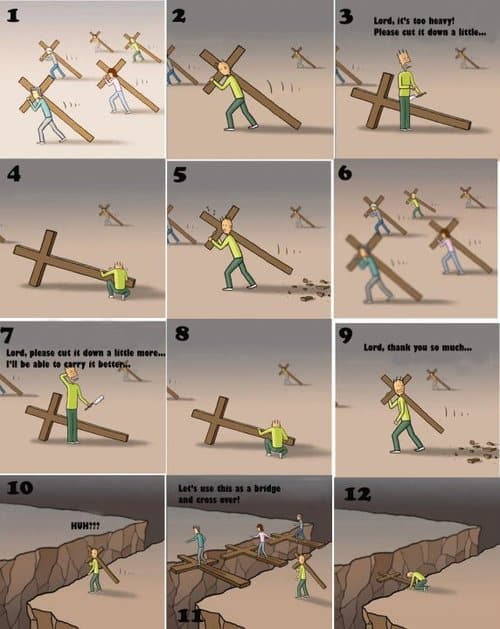
Aloha Friday Message – April 10, 2020 – Our Cross to Bear

2015AFC041020  – Our Cross to Bear

Read it online here, please. And please, when you visit there, use one of the social media links at the bottom of the page to share this post. Thank you! And remember, we now have a READER VIEW available, so share this link or this email often.

    Matthew 10:38 38 and whoever does not take up the cross and follow me is not worthy of me.

Matthew 16:24 24 Then Jesus told his disciples, “If any want to become my followers, let them deny themselves and take up their cross and follow me.” 

    Mark 8:34 34 He called the crowd with his disciples, and said to them, “If any want to become my followers, let them deny themselves and take up their cross and follow me.”

Mark 10:21 21 Jesus, looking at him, loved him and said, “You lack one thing; go, sell what you own, and give [it] to the poor, and you will have treasure in heaven; then come, follow me.”  

   Luke 9:23 23 Then he said to them all, “If any want to become my followers, let them deny themselves and take up their cross daily and follow me.

Luke 14:27 27 Whoever does not carry the cross and follow me cannot be my disciple.

Aloha nui loa, ʻŌmea! The passage from Matthew 16 has been alluded to during the COVID-19 VIRUS crisis. This is indeed a difficult cross to bear – the entire world threatened by something we cannot see, cannot yet conquer, and cannot fully understand. Jesus said we have to take up our cross and follow him.  There are similar statements in all three synoptic Gospels. The passage in Matthew 10 is part of the Gospel where Jesus is telling the disciples that following him must be the preeminent purpose in their lives. In all six of these verses, there is a pattern of three criteria for being a disciple of Jesus: [1] Deny one’s self, [2] take up one’s cross, and [3] follow Jesus. In Mark 10:21, Jesus tells “The Rich Young Man” that he must divest himself of every material and temporal comfort and then return to Jesus ready to follow him. In Mark 8, Peter has just confessed his conviction that Jesus is the Messiah. Immediately thereafter, Jesus begins to describe his arrest, trial, execution, and resurrection. Peter takes him aside and reprimands him for speaking that way. In a flash, Peter goes from being declared the foundation of the Church to being a Satan. Peter later learns he will indeed follow Jesus to the same destination: Death, death on a Cross. Peter’s Cross was waiting for him in the future; or was it? He denied Jesus; how did he deny himself? He literally took up his cross.

When we hear this expression, “Take up your cross,” we often think of some particular trial, difficulty, or long-standing burden. “I have arthritis, but that’s my cross to bear.” “My neighbors are so rude, they irritate me constantly! But, then, that’s my cross to bear.” “There are thousands of refugees living in abject poverty and fear for their lives. What a difficult cross to bear!” “I really don’t mind the suffering in my life because it means I can offer all that up to God. He has blessed me with a difficult cross to bear.” “This terrible scourge is a message from God that we must repent and believe the Gospel, and then take up this cross of affliction and follow Jesus.

These sentiments are common among people of faith. We know how much Christ suffered on our behalf, and we know we will definitely experience suffering in our lives, too. Jesus paid the full price for our sins through his passion, death, and resurrection. It was done once for all of us, and its effectiveness extends to all who accept Christ as Master and Savior. We don’t need to be crucified the way he was, and he does not need to be crucified again; once was exactly enough. Why then does he want us to take up our cross and follow him? Considering the perfection of his sacrifice, what can we add to that? And just what, exactly, is “my” cross.

A few times in the past, I have stated, “I am my cross.” Have you ever felt that way? We look at our sinful – sin-filled – lives and think about how grieved we are that we cannot do better. We feel like we’re letting God down because we never quite get over the border between bad behavior and good behavior. We even feel a little miffed to know that everyone feels like that. In Romans 7:15 The Apostle Paul says, 15 I do not understand my own actions. For I do not do what I want, but I do the very thing I hate. Isn’t that irritating?!? We say, “I try so hard, but I still mess up!” Then our better self, or our friends, or our pastor, or someone we love says, “Well, welcome to the human race. You are only human you know!” And let’s face it; humans are prideful. Humans think we can figure it out on our own and make our lives better conformed to the life of Christ. We just crucify our bad selves with him and resurrect our good selves … with him. But I think there’s something missing in that scenario. Let’s go back and look at today’s texts more closely.

We said the first point was denying one’s self. Why would anyone do that? What does that mean? Again it is the Apostle Paul who gives us a keen insight in Philippians 2:5-11. There is one phrase in that passage – perhaps an early form of a Creed or hymn – that says, but emptied himself, taking the form of a slave, being born in human likeness.” He gave up his own Glory in Heaven to become a helpless human child who lived – and died – among us: Emanuel. Eve’s mistake was to reach out for equality with God (Genesis 3:5for God knows that when you eat of it your eyes will be opened, and you will be like God,[a] knowing good and evil.”) Adam’s sin was to accept that deception as truth. Jesus did not regard equality with God something to be grasped.” Everything Jesus did, he did in obedience to his Father. (John 12:4949 for I have not spoken on my own, but the Father who sent me has himself given me a commandment about what to say and what to speak.) Whatever he did he did first and foremost for God, his Father. That includes the second point, taking up his cross.

As soon as we hear that, most of the time we think about Calvary, the crucifixion, the hours and hours of shame, derision, and intense agony. But that is not where Jesus “took up his cross.” Where did that happen? In Jerusalem, probably in or near the Praetorium. He had already been beaten nearly to death, mocked, insulted, cursed, and denied. Pilate found no guilt in him, but the crowd overruled his decision. Jesus was forced to carry his own cross. In the context of that time, this was not an unusual sight. Criminals were forced to carry their means of execution to the place of execution. Along the way they were taunted, lashed, hit with stones, scoffed at, and treated without mercy. Jesus did that. We have it in all the Gospels – the Way of the Cross. He took up his cross and carried it to the place of his execution, knowing it would be a horrific experience. He went anyway. Why? Why such a terrible, cursed death? He was committed to do what God had asked of him. He completely identified with God’s loving act of bringing into the world “his only begotten Son, so that whosever believes on him shall not perish but have everlasting life.” The whole thing – the trial, the passion, the way of the Cross, the Crucifixion – every moment of that was a moment of Love. When we take up the Cross, we take up his Love and carry it to where that Love is fulfilled. We carry it to follow him.

When we want to follow him, we want to go as he went: We must always be prepared to accept whatever is on our Way of the Cross – pain and suffering, shame and sorrow, even death – and to be eager to endure it, to meet it with an earnest Joy, even to rejoice we are counted worthy for this. Remember, Jesus did this of his own will, so are you, am I, are we willingly shouldering our cross without complaint, histrionics, or thoughts of some saving intervention? There is only one path to Golgotha, only one Way to go; it is the way HE went. It is the Way of Love. Only Love can conquer sin and death – the same sin and death that came upon all of us when first we deemed equality with God something to be grasped at. How often do we do that in our daily lives as we curse our neighbors, threaten our enemies, or cherish our little (or large) vices in the depths of our hearts, suppressing our conscience so that we fail to see our intentional sin? We are commanded to love our neighbors, bless our enemies, and disdain our sins. That is our cross to bear; to always be faithful to the mission of giving up our lives to God in order save them because of his Love. “Life is our greatest treasure because it is given to us expressly for the purpose of losing it, and how well we do that makes all the difference.” It’s our life to lose, our cross to bear. It’s not a cross to wear.

Some folks believe that wearing a cross is the same as carrying one. Sometimes we notice that so-and-so is wearing a necklace with a cross-shaped charm on it, or perhaps even with a crucifix. Sometimes we notice that a person might have a rosary draped around her/his neck like a necklace, or hanging from the mirror in their car. When we do these things, we are making a statement that we can be looked upon as being Christian. That is a wonderful witness, and it is in keeping with St. Francis’ admonition to “Always preach the Gospel. Use words only when necessary.” Wearing the cross is not, however, bearing the cross, at least not to the fullest measure of Christ’s command to take up our cross and follow him.

Our Cross to bear is to live in and through the Love of God no matter what; to get up each day and say, “Good morning, LORD! Thank you for this day! What have you got on your To-Do List for me today?” And so, we are called to love one another by [1] denying one’s self, [2] taking up one’s cross, and [3] following Jesus. That doesn’t mean we glorify ourselves by acknowledging how greatly we are suffering (while hoping others notice how humbly we suffer), nor do we do well to count up all the petty trials and tribulations in life (everyone has those, you know), and most certainly it does not mean that we pay tribute to the merits of pain and suffering as if they were the only things that please God. It is not the pain and suffering of bearing our cross that matters; it is the LOVE that permeates us body, mind, and spirit as we willingly and joyfully live the life we have as the best way to embrace our cross as what it truly is: The Love of God for all living souls. This is how Jesus opens up before us the “way of life.”

We all surely know that there is no Easter without Good Friday. Let’s remember, though, that Good Friday included a walk far more difficult than anything any of us have had to endure, including this COVID-19 VIRUS. But that’s us. Beloved, all around this world, Christians are facing persecution, torture, and death. Here are the  Top 10 Countries persecuting Christians: [1] North Korea [2] Afghanistan, [3] Somalia, [4] Sudan, [5] Pakistan, [6] Eritrea, [7] Libya, [8] Iraq, [9] Yemen, and [10] Iran. Christians are being tortured, hunted, persecuted, and killed for following Christ. Jesus loves them, too; stand with them in your prayers, even in your politics. Make them part of your Way of the Cross. And while we’re at it, I’m going to give you a little something to help you offer up to God your daily walk to Golgotha. It’s a Prayer to Seek God’s Will, a way to offer your whole self to God each day.

Almighty Triune God – Father, Son, and Holy Spirit – I love You. I worship You. I adore You. I praise You. I glorify Your name. I give you thanks for revealing your Glory through Christ Jesus. Enlighten, guide, strengthen, and console me. Teach me Your will and empower and inspire me to fulfill it completely, for it is my heart’s desire to serve You well in all that You ask of me and everything that You allow to happen to me. Only make Your will known, and grant me the graces necessary to faithfully follow You to the place You have prepared for me. I offer You this prayer in the name of Jesus, The Christ, our Lord who lives and reigns with God, The Father Almighty, in the unity of The Holy Spirit, The Lord, the Giver of Life. AMEN.

To restate the three points differently: [1] Always put God first, [2] live in and for his Love, and [3] carry that love to the end of the road and lay it all out for him there. Then you will be his disciple.

Whatever, whenever, wherever, whoever, however, if ever, forever —
at your service, Beloved
Please pray with us here at Share-a-Prayer.

Unless otherwise indicated, all scripture passages are from the New Revised Standard Version Catholic Edition (NRSVCE) New Revised Standard Version Bible: Catholic Edition, copyright © 1989, 1993 the Division of Christian Education of the National Council of the Churches of Christ in the United States of America. Used by permission. All rights reserved.

Creative Commons License
Aloha Friday Messages by Charles O. Todd, III is licensed under a Creative Commons Attribution-ShareAlike 3.0 Unported License

We want to acknowledge and thank Turn Back to God and Jesus Christ Cartoons for this wonderful object lesson on The Cross We Carry. Used with permission from the author at http://www.turnbacktogod.com/wp-content/uploads/2012/02/Jesus-Christ-Cartoon-02.jpg

Please use this link to see the image full-size at that location.


Aloha Friday Message – April 3, 2020 – Palming It Off and On

2014AFC040320 – Palms UP

Read it online here, please. And please, when you visit there, use one of the social media links at the bottom of the page to share this post. Thank you! And remember, we now have a READER VIEW available, so share this link or this email often.

Part of this message is from a lesson in 2014. It’s been updated, but you may have some déjà vu moments. Use the links, feast on the Word, and share with others. I’ve revised it substantially for this difficult time in our lives. More on that later. Also, I am asking that if you have a social media account – Facebook for example – please post this link publicly. I’ve temporarily disabled my Facebook account. PLEASE ALSO COPY AND POST THIS PRAISE REPORT:

AL-G – Diagnosed with breast cancer. SHE HAD NO HEALTH INSURANCE AFTER LOSING HER JOB. PRAISE REPORT: THIS DEAR SERVANT OF GOD IS WELL AND CANCER FREE! SHE, WITH ALL OF THE MBN, THANKS YOU FOR YOUR PRAYERS!

    Zechariah 9:9Rejoice greatly, O daughter Zion! Shout aloud, O daughter Jerusalem! Lo, your king comes to you; triumphant and victorious is he, humble and riding on a donkey, on a colt, the foal of a donkey.

Isaiah 53:1010 Yet it was the will of the Lord to crush him with pain. When you make his life an offering for sin, he shall see his offspring, and shall prolong his days; through him the will of the Lord shall prosper.

Zechariah 13:7“Awake, O sword, against my shepherd, against the man who is my associate,” says the Lord of hosts. Strike the shepherd, that the sheep may be scattered; I will turn my hand against the little ones.

John 16:3232 The hour is coming, indeed it has come, when you will be scattered, each one to his home, and you will leave me alone. Yet I am not alone because the Father is with me.

This is Friday before Palm Sunday, the Sunday that begins Holy Week and the Sunday before Easter. Jesus has become well-known by thousands because of his miraculous deeds – feeding thousands of people at a time, speaking with authority, giving the blind sight, curing lepers, making the lame walk, making the mute speak, and even raising the dead. Now he enters the city of Jerusalem, riding on a baby donkey. The fact that Jesus rode into Jerusalem on a donkey was, in part, a fulfillment of scripture. But wait! There’s more! A king who rides in on a donkey is coming in peace. A king who rides in on a horse is coming in war. It is also significant that the colt Jesus’ disciples borrow is one that has never been ridden. Here the King of Peace is so gentle and so humble that even a young, never-before-ridden colt submits to Jesus’ presence. Instead of bucking him off, the colt meekly carries a full-grown man. It is interesting to me that the disciples who went to fetch it did so without question, and then they put their own cloaks on the back of the colt to make a more comfortable seat. I think it might have also been more comfortable for the colt! And you know, I think that colt’s mama walked next to him on that journey. Read it again (That is in Matthew 21:1-11) and see if you think so, too. (See also Luke 19:29-40) To me, this prefigures Mary walking beside Jesus on the way to Golgotha.

As he rode through Jerusalem, the crowds who recognized him paid him homage: Mark 11:9-10Then those who went ahead and those who followed were shouting, “Hosanna! Blessed is the one who comes in the name of the Lord! 10 Blessed is the coming kingdom of our ancestor David! Hosanna in the highest heaven!”  (See also Luke 19:29-40) That word, Hosanna, is found only in the New Testament, but there are echoes of it in other places in the Old Testament, too. It means to help or to save (See Psalm 118:25 25 Save us, we beseech you, O Lord! O Lord, we beseech you, give us success! The root of the word Hosanna comes from הוֹשִׁ֘יעָ֥ה (howosiah’) {hō-wō-šî-‘āh} from יָשַׁע (yasha) {yaw-shah’} for deliver, save, salvation, victorious; it is expressed as Hoshiya na! or HELP ME! It had meant in the past “Please save,” but eventually came to mean “Salvation is come.” In these passages in the New Testament, it means “Salvation is coming! It’s HERE!” Glory to God on High – ʾĒl ʿElyōn עֶלְיוֹן אל‎ – God Most High as spoken by Melchizedek in Genesis 14:19). In Psalm 118:26, it is followed by “Blessed is he who comes in the name of the Lord!” Over the centuries between David and Jesus, the expression hoshiya na had come to mean Salvation is now! When Jesus got on that baby donkey, he started toward Jerusalem to fulfill what had been prophesied about the Messiah, that his death would take away the veil of sin and death. He started out at a place with which we are already familiar, the home town of Lazarus.

Jesus was in Bethany, close to Bethphage Βηθφαγή, (Béthphagé) {bayth-fag-ay’} which is from an Aramaic word meaning “Place of new – or unripe – figs” near the base of the Mount of Olives. He gets on the colt in Bethany – about 2 miles from Jerusalem, and heads into town. On the way, people who have seen him, who know him – some intimately, some only be reputation – get excited about seeing him, and they begin to remember Zechariah 9:9. They start pulling down palm fronds and laying them on the path in front of him or waving them in the air. The palm was a symbol of victory – even Holy Victory. In addition people were laying their cloaks down in the road and letting the little donkey pass over them. A similar event is reported in 2 Kings 9. [They hurried and took their cloaks and spread them under him on the bare steps. Then they blew the trumpet and shouted, “Jehu is king!”] Elisha had just anointed Jehu {yay-hu’} (“Yahweh is He”) as King of Israel, and had ordered him to go avenge the murders committed by Jezebel’s forces when she had the prophets slaughtered. The king, Ahab, had permitted this, and Jehu was told to destroy Ahab as well. The people were ecstatic about this and acted quickly to honor Jehu. About 875 years later, they did the same thing for Yeshu’a – ישוע – Jesus.

Spreading cloaks or other objects to “pave the way” was a common demonstration of respect for the dignity and power of a person – a King, a military general, even a prophet. So now we have Jesus on a baby donkey and everyone is shouting and happy and cheering and dancing and running ahead and coming back and just going nuts over what Jesus is doing. He was finally defining himself as the Messiah, the Ruler of Israel, The Son of David! And, they surely thought he was about to kick the Romans out of town as the Rightful Ruler.

But, he was on a donkey, not a horse. And the people understood. They identified with him.

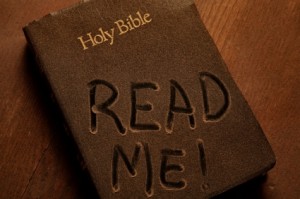
Where is YOUR Bible?

What is it that you might learn about Jesus that would help you identify more with him, feel closer with him? I remember a story I read when I was maybe a fifth-grader. It was about a little girl of about three years who had a wooden doll named Ruth. The Roman soldiers came galloping through her village scattering the villagers. As she ran to get out of the way she fell. Her mom snatched her out of the way just as the cohort reached the place where she fell. The doll slipped out of her arms. An iron-shod hoof stepped squarely on Ruth’s face. Moments later, when the dust had settled, the little girl went back and found the ruined doll. She began to cry.

Then a man’s hand rested on her shoulder and the man’s voice said, “Here, let me have a look at that.” The little girl looked up and saw a young man in his late-twenties. He had long, dark, curly hair in a long, think braid down his back, and gentle, deep-brown eyes. He was smiling. The girl handed Ruth to the man. He sat down and said, “Hmmm, I think I might be able to fix her up a little. Would you like that?” Through dirty tears the girl nodded. The man borrowed a knife from his father who was walking with him. His mother went to sit with the little girl and her mom to comfort them. He started whittling around the hoof mark. Within a few minutes, the evidence of the damage was gone and Ruth had a new face with a beautiful little smile – a smile just like the little girl’s. He handed the little girl the doll, gave her a hug, and returned to the road to continue his journey to Jerusalem with his parents. Around 5-6 years later the little girl saw him again. He was riding into the city on a baby donkey, and people were shouting “Hosanna!” When he passed by her, she held up Ruth for him to see. He winked at her and wiggled his fingers to say hello to Ruth.

Have you met Jesus in a way that made him really accessible to you? Have you heard his quiet whisper on the mountaintop? Did you see him playing with his dog in the park? Have you given him a plate of food at the shelter? Did you buy him a burger and a soft-drink? Did you hear his prophecy in a song on the radio? Did he offer you loving correction and guidance in the heart of your friend? Did he bake you a batch of your favorite cookies? Did he show up at your door with a casserole when your dad died? Did he ride with you through the storm or away from the forest fire? Could you hear the nails piercing his wrists? Did he comfort you when you could not comfort your sick child because of COVID-19 VIRUS? Did someone see Jesus in you when you did these things for others? Then Jesus was present. And you were present with him. (See Contemporaneous Concomitance 5/16/16)

Jesus is with us now as well, and we are with him. How can God allow such a terrible disease to threaten all the Earth? How can God shut the door on humanity and let so many people get sick, many of the sick enough to die? What have we done to deserve this kind of punishment?

We have betrayed our Creator, that’s what. We have clung to false gods and false prophets. We have murdered innocents and celebrated and cheered (← Check these out!) our sinfulness. We have replaced God with human idols, material idols, and spiritual idols. We have been unrepentant. We have refused to humble ourselves, to love justice and mercy, and to serve one another, preferring instead to serve our selves. “Trust your heart,” we say. FALSE!! Trust Jesus!! We might be tempted to think, “Hey! Wait a minute! I didn’t do all that stuff! I’m not a murderer or idolater! God is laying the blame on the wrong person here. I don’t have to be punished because of what everyone else does! I can’t believe in a God like that!” If that is the case, then we believe in made-up gods that conveniently do what we tell them so we can do what they tell us. If we do not want a God who is unchanging, a God who is always with us, then we make up one that can’t do anything to us – or for us. “Is God in charge or not?” That’s what the Israelites said to Moses in the desert. That whole generation died in the desert and never saw the Promised Land! Those who survived that 40 year trek had to fight their way into that land of milk and honey and destroy the thoroughly-evil people who lived there. When they forgot God, they opened themselves up to some pretty bad consequences. Think about it: Have we forgotten God? Let me ask you, have you heard this question lately?

“How can a loving God allow this to happen? That’s not the kind of God I want!” Really? I do. I want a God who is always in control of all things always and all ways. If God is not always in control of all things always and all ways, then that is not “being God.” It is especially not being El Shaddai. Abraham eventually submitted to God’s sovereignty, after several reminders, and El Shaddai did with him as he promised in God’s own time; he was true to his Word. I know so many people whose lives are filled with pain and suffering and yet they can say “God is on his Throne and all is right with the world!” They know the sovereignty of God! In these past couple of weeks with fires, floods, loss of life, treason, persecution, war, martyrdom, COVID-19 VIRUS, being locked in the tombs of our own homes! and all kinds of mayhem around the world, we might ask, “Where is God in all this? How can you say ‘all is right with the world!’?” All is right because God is on his Throne. I would much rather be on my knees before the Throne than standing in the dark kicking a wall. I just have to remember to “Let go and let God be God.” When I do that, I have a much better likelihood of doing what God asked of Abraham: Serve me faithfully and live a blameless life. “I can’t do that. I don’t know how. I am doomed because I cannot live a perfect life. I am human after all!” We forget, sometimes, that Jesus was also fully human.

Jesus had all the body parts any man has, plus all the feelings, all the susceptibilities, and all the good things in every human life. He just didn’t have sin. But: For you, for me, for us he became sin and died to take all our sins away. (See 2 Corinthians 5:21) And that, perhaps, is what is the most important and most striking about the ways we can identify with him. I did the sin. He did the reparation. Do you remember the song “When He was On the Cross, I Was On His Mind” (↔ Music Link) which was popular around 2007 and earlier? That is another thing we have in common with Jesus. He knows our sins because he paid for every single one of them. He, and only he, could do that once for all because he loved us that well, well enough for him to lose everything so we could gain everything through his loss. Knowing that, we no longer have any reason to run from his presence. He willingly became the Perfect Lamb, the offering for our sin! If we have turned away and left him, we are still not alone because God is always with us. How and why is that? When we are with him, God is with us, too, because Jesus is “my Lord and my God” to all who believe in him.

Remember, He loved you this much:

I love you THIS much!!

He still loves you that much and more. Do you need to turn around and go back to him? He’s ready and waiting. Look for him. He is passing through our place on Earth. Go to him. Take some palm branches. Hold them UP high!

Whatever, whenever, wherever, whoever, however, if ever, forever —
at your service, Beloved!

Please pray with us here at Share-a-Prayer.

Unless otherwise indicated, all scripture passages are from the New Revised Standard Version Catholic Edition (NRSVCE) New Revised Standard Version Bible: Catholic Edition, copyright © 1989, 1993 the Division of Christian Education of the National Council of the Churches of Christ in the United States of America. Used by permission. All rights reserved.

Biblical languages inserts from Bible Hub (Bible Hub: Search, Read, Study the Bible in Many Languages) Visit at http://biblehub.com

Creative Commons License
Aloha Friday Messages by Charles O. Todd, III is licensed under a Creative Commons Attribution-ShareAlike 3.0 Unported License

The Full Armor of God — Links

This page will give you links to the four-part series on Catholic365.com to “The Full Armor of God.”

The Armor The Links
Belt of Truth and Breastplate of Righteousness http://www.catholic365.com/article/11349/the-full-armor-of-god-part-1.html
Gospel of Peace and Shield of Faith http://www.catholic365.com/article/11363/the-full-armor-of-god-part-2.html
Helmet of Salvation and Sword of the Spirit http://www.catholic365.com/article/11387/the-full-armor-of-god-part-3.html
Spiritual warfare through prayer http://www.catholic365.com/article/11409/the-full-armor-of-god-part-4.html


Aloha Friday Message – March 27, 2020 – Turn him loose!

2013AFC032720 – Turn him loose!  

    Read it online here, please. And please, when you visit there, use one of the social media links at the bottom of the page to share this post. Thank you! And remember, we now have a READER VIEW available, so share this link or this email often.

    John 11:43-44 43 When he had said this, he cried with a loud voice, “Lazarus, come out!” 44 The dead man came out, his hands and feet bound with strips of cloth, and his face wrapped in a cloth. Jesus said to them, “Unbind him, and let him go.”

May Peace always be with you and may God bless you, Belovéd!  We are already at the fifth Friday of Lent, and this coming Sunday the Gospel is about Lazarus, the brother of Mary and Martha. The account of Lazarus’ death and resurrection is powerfully emotionally and spiritually. This family was one of Jesus’ favorites. You can tell by the intimacy he enjoyed there that Jesus loved this trio of believers. It was Mary who anointed Jesus feet with fragrant spikenard ointment and dried his feet with her hair just six days before his Passion and Crucifixion, and this act prefigured his donning a towel and washing the feet of the apostles on that holy might. Jesus was at their house often, and perhaps they had known each other since before he began his ministry. We can imagine how these three people lived in their home in Bethany. There is no mention of other family or parents. Bethany was close to the Mount of Olives. Jesus passed through there on his way to Jerusalem more than once. It was near Bethany that the Disciples witnessed his Ascension. These three, then, were people Jesus really, really cared about. He loved them in a very special way.

Around the time of this event in Jesus’ life, there was a strong movement among some of the people to capture him and kill him. His Apostles, Disciples, and other friends were very concerned about these constant threats on his life. Jesus knew about the threats, and he also knew how it would all turn out, he knew what would ultimately happen to him near Bethany, in the Garden of Olivet. He knew what had happened to Lazarus, too; despite knowing all the pain associated with that knowledge – Lazarus was dead and Jesus would soon be crucified – Jesus stayed with his mission of teaching and healing. When someone tracked him down to tell him about Lazarus, Jesus told them, “He is only sleeping.” They took that to mean Lazarus was resting and getting better. He told them point-blank that Lazarus had died, but his death would not be the end of the story or his life. Finally he says he will go to his friends’ house so that he can demonstrate God’s power and will. That’s when one of my favorite Bible characters pops into view again. Here’s the passage.

John 11:1-45 16 Then Thomas (also known as Didymus) said to the rest of the disciples, “Let us also go, that we may die with him.”  Thomas fascinates me! He always seems to be a beat behind, or maybe he was just a strong pessimist, “Oh, well, if we’re going to Bethany, we’re all gonna die!” Then again, he might have been the bravest one in the bunch, ready to die with his Master and friend. Later on (John 14:5), Jesus is telling them – in the Last Discourse, “Don’t worry. Everything will be alright. You know where I’m going. I’ll come back and get you.” Thomas pops up again and says, “How can we know where you are going? We don’t know where you are going so how can we know the way?” And of course Thomas is most famous for saying, “I won’t believe he’s back until I see him for myself.” Thomas wasn’t in the Cenacle – the Upper Room – when Jesus first appeared to the 11 after his resurrection, and so he got stuck with the moniker “Doubting Thomas.” Odd that he should doubt Jesus was resurrected because he had been a witness to the resurrection of Lazarus. He stood there with Jesus, Mary and Martha, and all the other mourners as Jesus, his heart stirred emotion and tears in his eyes, and he shocked them all with what he said. You will remember the shortest verse in the Bible – John 11:35 35 Jesus wept.

John 11:38  38 Then Jesus, again greatly disturbed, came to the tomb. It was a cave, and a stone was lying against it.

    John 11:43-44 43 When he had said this, he cried with a loud voice, “Lazarus, come out!” 44 The dead man came out, his hands and feet bound with strips of cloth, and his face wrapped in a cloth. Jesus said to them, “Unbind him, and let him go.”  Lazarus! Be alive! (↔ Music Link)

Everybody there went, “What?!?! It is not a good idea to move that stone. It’s going to smell really bad, and … you don’t really want to do that now. You should have come a week ago when he got sick and you could have healed him, but now, it’s too late. He’s rotting away in his grave.” Jesus must have given them quite a look before he turned toward the tomb where Lazarus had been placed. He told Martha straight out, “Did I not tell you that if you believe, you will see the glory of God?” Somebody, maybe several people, maybe even Thomas (although there’s no way to know for sure who moved the stone) had the courage to lift that stone out of the way. Then The Moment:

Lazarus was resuscitated and came out of the tomb all wrapped up in the trappings of death. He came out to new life. He came out to fresh air, sunshine, solid ground, and within a short time – a few weeks, perhaps more – he and Jesus may have been reclining at the table enjoying a feast prepared by Martha and the household would be rejoicing in the presence of the Risen Lord.

Jesus’ tender sympathy for these friends shows us the very human side of his person. His heart is deeply moved, and he groans inwardly because of their pain. He joins them in shedding tears, but he is also hearing the cries of the mourners and sees the impact the loss of Lazarus has on this tiny community of Bethany. Together they had shared in the joys of life, in the happiness of Jesus’ visits, and now they shared in the mourning, weeping, and immense sorrow of these two sisters who had lost their beloved brother, a brother who had entertained Jesus in his home. In fact, these sisters hoped and prayed that they would be reunited with their brother. They just did not expect it to happen that day!

Some of the bystanders had insinuated that if Jesus could make the blind see, he could sure have gotten here in time to save Lazarus’ life. Jesus actions deliberately counter that idea. He gave the something much more powerful that a healing to talk about. He gave them a resurrection in broad daylight in front of many witnesses.

So let’s get to the two main points here. For whatever reason we doubt God’s love or Jesus saving power, he is always ready and able to exceed all our expectations. Whether we go to our death with him is from bravery or loyalty or from a sincere fatalism that recognizes our frailty, if we die with him we shall rise with him. And when we rise with him he will take us where has prepared a place for us. But we need to respond when he calls.

First, take away the stone! The stone in front of your tomb. Move it! Yes, you probably need help getting that thing out of your way. That’s the purpose of an Examination of Conscience – you understand that rock that’s imprisoning you in darkness. Let God and his helpers take away whatever it is you are hiding behind, whatever it is that keeps you in your tomb of death, and step out to meet your Lord in the Light of his Word. He calls you to come away from the death of flesh to be alive in Spirit, alive in your Creator, your King, your Saviour, or as Thomas put it so well, “My Lord and my God!” Come away from the death of sin and come alive, renewed, revived, and resurrected from your former self. Shed the wrappings of death, and the stench of decay.  Listen with your ears and listen with your heart. Strip away the things that bind you to your death. Take away the stone! He is calling you.

Second, loosen that funeral garb, throw it away, and be free. Loosen and discard the things that stop you from walking into his Light, his Everlasting Life. Be freed of the trappings of death. Here again, you can get help from others, especially through the Sacraments of Reconciliation and Penance. We can all help each other get loosed from our sins. Turn on that little movie theater screen in your mind and watch Lazarus and his friends and relatives pulling away those bonds of death. Can you envision how totally joyous and totally blown away they all were in that moment? In which would you rather be wrapped: The shroud of death or the arms of Life? In which would you rather reside: In the darkness of death or the brilliant Light of Life? Jesus is commanding you, commanding me, commanding us to turn loose of sin and death and embrace Life and Light. Why would we want anything less than that?

“Beloved, come forth!”

Get past the stone. Shed the trappings of death (your sins). Rise up. Go to him. Live. YOLOF!!

PUUUHLEEZ! Remember that your local church still has to pay the bills too.

Donate regularly online if you can.

Write your checks and put them in donation envelope(s)

to take with you when churches reopen.

Be kind to your Pastor and their family members.

Share-A-Prayer

Pray for each other, Beloved. Your sweet prayers have changed many a life.

  • Pray for all the oppressed, and those suffering from all the disasters that have swept the world. Do everything you can to help them in every way you can.
  • Pray for an end to this COVID-19 VIRUS epidemic, and especially pray for everyone who is infected that they will recover, and pray for those that have died that they will taste God’s Mercy.
  • Pray for the poor, the homeless, the marginalized, the addicted – then go help them!
  • Pray for peace, and let it begin with you.

Whatever, whenever, wherever, whoever, however, if ever, forever —

at your service, Belovéd!

Please pray with us here at Share-a-Prayer.

Unless otherwise indicated, all scripture passages are from the New Revised Standard Version Catholic Edition (NRSVCE) New Revised Standard Version Bible: Catholic Edition, copyright © 1989, 1993 the Division of Christian Education of the National Council of the Churches of Christ in the United States of America. Used by permission. All rights reserved.

Creative Commons License
Aloha Friday Messages by Charles O. Todd, III is licensed under a Creative Commons Attribution-ShareAlike 3.0 Unported License


Aloha Friday Message – March 20, 2020 – Anointed for Good

2012AFC032020 – Anointed for Good

Read it online here, please. And please, when you visit there, use one of the social media links at the bottom of the page to share this post. Thank you! And remember, we now have a READER VIEW available, so share this link or this email often. 

    1 Samuel 16:12b-13a The Lord said, “Rise and anoint him; for this is the one.” 13 Then Samuel took the horn of oil, and anointed him in the presence of his brothers; and the spirit of the Lord came mightily upon David from that day forward.

John 9:30-34 – 30 The man answered, “Here is an astonishing thing! You do not know where he comes from, and yet he opened my eyes. 31 We know that God does not listen to sinners, but he does listen to one who worships him and obeys his will. 32 Never since the world began has it been heard that anyone opened the eyes of a person born blind. 33 If this man were not from God, he could do nothing.” 34 They answered him, “You were born entirely in sins, and are you trying to teach us?” And they drove him out.

Aloha pumehana, a me ke akua ho’omaika‘i ‘oe, ʻŌmea! Warmest Aloha, and may God bless you, Belovéd! Thank you for your response to the COVID-19 VIRUS mailing earlier this week. It is our belief that we should do everything within our power to help contain, control, and eliminate this disease as quickly as humanly possible – and the only way we can do that is to count on God to guide and direct, bless and protect everyone who is working on defeating it as well as everyone who has become ill because of it. We are anointed as Priest, Prophet, and King, and it is our role to honor that anointing by serving God and each other every day. That is why today we are going to look at the meaning of being anointed.

You know that I like to look for “first type” passages in the Bible. The first time we hear of anointing is in Genesis 31:13 13 I am the God of Bethel, where you anointed a pillar and made a vow to me. Now leave this land at once and return to the land of your birth. What is the Lord saying to whom in this passage? Open your Bible and flip back to Genesis 28, especially verses 10-22. Now you remember, right? “Jacob’s Ladder,” the dream – vision, really – that Jacob had where God revealed himself to Jacob. A few pages farther on, Jacob wrestles with a man – perhaps an angel? – and he is given the name Israel. What did the Lord mean when he said, “you anointed a pillar and made a vow to me.”? The answer is in verses 18 – Jacob poured oil on top of the rock on which he had first slept and subsequently set up as a pillar – a stone of remembrance. The vow Jacob made follows in verses 19-22; he promised a tithe of everything he received from God in return for God’s protections. The first thing that was anointed was a stone, and altar of remembrance. Who is allowed to make an altar, and to leave a blessing on a place or person? Who is allowed to make an offering of a vow? The answer is … a Priest. Abraham, Melchizedek, Noah, Moses, Israel – all set up an altar – a stone of remembrance – to honor God’s gifts and blessings. This is one form of anointing that we still see today – the anointing of a thing or place as when an altar in a Church is anointed with oil – the oil is poured and smeared on the altar. We have the anointing of a person when a catechumen is anointed multiple times with oil during the catechumenate – it is smeared (epichrióon) {ep-ee-khree’-on} the forehead or chest. We also have the anointing of the sick – also known as “Extreme Unction,” and “Last Rites” Where the oil is smeared on the hands (palms) and forehead.  What does anointing accomplish?

Anointing is a consecration to God of a person, place, or thing; consecration means to bless, set aside as holy, sanctify, ordain, hallow, and it is an honorific act that bestows on the anointed the Offices of Service mentioned above: Priest, Prophet, and King. Anointing is also a prayerful rite to bring healing. In the history of Israel, anointing was made with olive oil – think of Psalm 23:5 You prepare a table before me in the presence of my enemies; you anoint my head with oil; my cup overflows. The notes on that passage describe anointing with a perfumed oil – perhaps scented with balsam or spices (See Exodus 25:6) – that is used to honor guests at an important celebration. Oil was poured on wounds, sometimes with wine or “sour wine” i.e., vinegar – to promote healing. The Rite referred to as the Anointing of the Sick is done with pure olive oil. Recall that in James 5:14 we read 14 Are any among you sick? They should call for the elders [=presbyters*, Priests] of the church and have them pray over them, anointing them with oil in the name of the Lord. * πρεσβύτερος presbuteros {pres-boo’-ter-os}. By the time Samuel got to the home of Jesse when following God’s command to anoint a King to replace Saul, oil was also used to consecrate a King, and even though David was only the second King of Israel, he was anointed there in the presence of his father and his brothers. One surprising thing I found as I studied the history of anointing is this passage describing the Emperor, Cyrus.

In Hebrew there is a word “Mashiach.” The root is masach which means to smear, anoint, spread a liquid. The meaning of Mashiach is “Messiah,” which means “the one anointed with oil.” The custom of anointing with oil is a ritual act designed to consecrate  those chosen by God to be Priest, Prophet, and King  such as the prophet Elisha, or the leader of the Achaemenid Empire, Cyrus. That is why we read in Isaiah 45:1 – 1 Thus says the Lord to his anointed, to Cyrus, whose right hand I have grasped to subdue nations before him and strip kings of their robes, to open doors before him — and the gates shall not be closed. ALL the kings of Israel were anointed, and Cyrus was a Gentile whom God himself anointed with his Spirit. Now, it’s time to switch gears and think about another material that has been used for anointing – CLAY!  

Our Key Verse from Sunday’s Gospel is part of the story of The Man Born Blind in John 9. I want to take you back to verse 6 – Having said these things, he spit on the ground and made mud with the saliva. Then he anointed the man’s eyes with the mud. English Standard Version (ESV) Other translations will read “smeared,” or “applied.” It’s all the same word for anoint. This unnamed blind man became Mashiach because he was anointed with clay by God’s Anointed. This man, who is unnamed, is blind from birth – as was the world in which he lived. He took a leap of faith and asked Jesus to make him see. Jesus’ actions were … well, to me they seem a little unusual. He spits in the dirt, makes some clay, smears the clay on the guy’s eyes anointing him so that he is also “Mashiach,” and sends him to go wash off the mud at a pool in Siloam – a word that means “sent.” The man is sent by the Son of God who was sent to heal the world by washing clean the “clay” from which we are made, by cleaning the World off of us and out of us so the Light – Jesus – can be seen. The Man Who Was Born Blind became a Disciple who did Good because he believed completely and Loved well. At the same time, the people who were supposed to be filled with the Light, to be the servants of I AM, were remaining blind by looking only at the worldly aspect of this healing – the “how” – and totally overlooking the spiritual meaning of the healing – the “who.” Who? A man in darkness all his life saved by the Light because he did as God asked. He went on to follow Jesus and to do what was good and right in the sight of God.

You see, Belovéd, we are anointed Priest, Prophet, and King for Good. We are inspired and empowered to bring Goodness into the world by being Light. “We know that God does not listen to sinners, but he does listen to one who worships him and obeys his will.” As we go through the rest of Lent, and as we do what must be done to endure this time of trial, let us always remember to believe, to follow, to pray, and to anoint because we are Disciples of Jesus the Messiah, and as the Blind Man said, “If this man were not from God, he could do nothing.” We are anointed for Good by God. We can do much that is Good because we once were blind, but now we can see (↔ Music Link) The Light of The World (↔ Music Link).

Whatever, whenever, wherever, whoever, however, if ever, forever —

at your service, Belovéd!

Please pray with us here at Share-a-Prayer.

Unless otherwise indicated, all scripture passages are from the New Revised Standard Version Catholic Edition (NRSVCE) New Revised Standard Version Bible: Catholic Edition, copyright © 1989, 1993 the Division of Christian Education of the National Council of the Churches of Christ in the United States of America. Used by permission. All rights reserved.

Biblical languages inserts from Bible Hub (Bible Hub: Search, Read, Study the Bible in Many Languages) Visit at http://biblehub.com

Creative Commons License
Aloha Friday Messages by Charles O. Todd, III is licensed under a Creative Commons Attribution-ShareAlike 3.0 Unported License


SPECIAL COVID-19 ALERT: Spiritual Communion

Spiritual Communion in This Hour of Need

All across the world, bishops are suspending Mass as Catholics join in the campaign to help “flatten the curve” of the spread of COVID-19 VIRUS. There are still ways for the faithful to participate in the spiritual benefits of Communion. One way that was strongly endorsed by St. Pope John Paul II is Spiritual Communion. This practice is said to have originated with St. Alphonsus Liguori. In addition, St. Josemaria Escriva used this practice beginning in childhood as a way to be in fellowship with Jesus and the Church. St. Thomas Aquinas said “Spiritual Communion is “an ardent desire to receive Jesus in the Most Holy Sacrament [in Communion at Mass] and in lovingly embracing Him as if we had actually received Him.” Spiritual Communion is a wonderful way to focus on the Divine Presence and spend a bit of our time with the Lord.  It is a pious desire to receive the Holy Eucharist when it is not possible to receive it Sacramentally. Since that is the situation that millions of Catholics are now experiencing, Spiritual Communion offers all of us a way to continue to love, honor, and embrace Jesus.

Spiritual Communion should include an Act of Faith. We renew and affirm our confidence in the Real Presence of Christ. It can be a wonderful way to dispose our soul to receive Communion in the Sacrament of the Eucharist or as preparation for Spiritual Communion.

A second component is to recognize a deep desire to receive Christ Sacramentally whenever possible, and to cherish this moment to be intimately united with Jesus.

We also include a loving petition to ask Almighty God to spiritually gift us with the benefits and graces we receive through Sacramental Communion.

There are several forms of this prayer. Although there is no specific format recommended by the church, St. Pope John Paul II described this practice in his April 2003 encyclical, Ecclesia de Eucharistia, Chapter IV – The Eucharist and Ecclesial Communion. He stated that making a prayer for Spiritual Communion “was a wonderful part of the Catholic life for centuries and recommended by saints, who were masters of the spiritual life”.

A very common traditional version reads like this:

O my Jesus, I love You, I adore You, I hope in You, my God so good. I believe that You are truly present in the Most Holy Sacrament of the altar. Although I cannot now receive You sacramentally, I desire to receive you into my soul, and ask that You may at least come spiritually into my heart. Lord, keep me always in communion with You, and never permit me to be separated from You. Amen.

A form used by St. Josemaria Escriva goes like this:

“I wish, Lord, to receive you with the purity, humility and devotion with which your most holy Mother received you, with the spirit and fervor of the saints.”

Another version that I use daily says:

O my Jesus, I believe with all my heart, with all my soul, with all my strength, and with all my being that You are truly present in the most blessed Sacrament of the Altar. Jesus, I love You above all things and persons, and I desire to receive You into my soul. Since I am unable now to receive You sacramentally, I ask to be united with You spiritually. I reach out to embrace You, knowing that You are always there, always coming back to me in the Eucharist, and I unite myself entirely to You. Come, then, and inhabit the tabernacle of my heart and make my body a temple for Your Holy Spirit; and then, through the Power of that Spirit, grant me the faith, the discernment, the patience and perseverance, and especially the humility to successfully resist desecrating this temple. I beg You to do this in Your Most Precious Name and for Your eternal glory. Amen. 

St. Padre Pio also recommended this practice, and practiced it often during his day as a way to stay intimately united with Jesus

As with Sacramental Communion, there is additional benefit in using a Prayer Before a Crucifix. The traditional version is often found in hymnals, Missalettes, and prayer books:

Look down upon me, good and gentle Jesus while before Your face I humbly kneel and, with burning soul, pray and beseech You to fix deep in my heart lively sentiments of faith, hope, and charity; true contrition for my sins, and a firm purpose of amendment. While I contemplate, with great love and tender pity, Your five most precious wounds, pondering over them within me and calling to mind the words which David, Your prophet, said to You, my Jesus: “They have pierced My hands and My feet, they have numbered all My bones.”  Amen.

Another version reads like this:

Look down upon me, good and gentle Jesus, while beneath Your cross I humbly pray, sincerely pleading with You to create throughout my whole existence holy and living virtues – all the gifts and fruits of the Holy Spirit – while leading my soul to sincere contrition and effective repentance as I contemplate with great love and tender pity Your five wounds, pondering upon them within me while calling to mind the words which David Your prophet said of You my Jesus: “They have pierced my hands and my feet. I can count all my bones.”* Glory be to the Father, … Amen.

Psalm 22:16b-17a They pierced my hands and my feet. I can count all my bones.

As part of our Spiritual Union with Jesus and His Church, we can also follow the Daily Readings. There are many publications available by subscription that contain all the readings and prayers for every daily Mass. These include, but are not limited to, Magnificat Magazine, The Word Among Us, and Living with Christ. Did you know you can read the daily readings online? In our house, we use the USCCB website. The entire Bible is available here – and it includes introductions to each book of the Bible and notes on the readings. In the upper right section of the page, there is a calendar which you can use to find the readings for any day o f the year – past, current, or future. Toward the bottom of the page there is a subscription option so you can have the Daily Readings sent via email directly to your inbox. On the left side of the page, there are links to audio presentations of the readings, video reflections on the daily Scripture, and guidelines on suitable versions of the Bible that Catholics use around the world. With so many ways to “feast on the Word,” we have an invaluable way to deepen and strengthen our daily walk with Jesus and his Church.

As you know, the COVID-19 VIRUS is seriously disrupting everything everywhere. It can be a very stressful, even worrisome thing for every earthling in God’s Great World. As a People of Faith anointed as Priest, Prophet, and King, we can – and must – carry out the mission Jesus himself gave us. We must be willing to be actively involved moment-by-moment, day-by-day, prayer-by-prayer in making Jesus present “in the World.” The Great Commission tells us, his Disciples, what to do:

In Matthew 24:14 we read 14 And this good news [Gospel] of the kingdom will be proclaimed throughout the world, as a testimony to all the nations; and then the end will come. In addition we read in the “Great Commission” (See Matthew 28:16–20), 19 Go therefore and make disciples of all nations, baptizing them in the name of the Father and of the Son and of the Holy Spirit, 20 and teaching them to obey everything that I have commanded you. Being made Disciples means learning about Jesus’ life and learning about the Gospel. It means praying in Love with, for, and about our neighbors. It means walking with Jesus “Every step of this Pilgrim Way.”

While we certainly want to always be in our best state of being – in the Grace of God – it is important to know that we can commit to a Spiritual Communion even if we are not in a state of Grace. If we are interiorly disposed to actually receive the Eucharist, by which, if done with a contrite and a pure and loving heart, you receive at least a part of the great benefits you would receive from actual communion. I fervently encourage you to make it a daily practice to

  • Read Scripture – especially the daily readings as described above
  • Offer prayers for Peace, Hope, Healing, and Health in your community and all around the world
  • Follow the advice of St. Francis: “Preach the Gospel at all times. When necessary, use words.” Make the catholicity of your life demonstrably obvious.
  • Make an Act of Spiritual Communion at least daily – as described above.
  • Consider sharing this devotion together with family or other small groups so that, as Christ commanded, we will pray in the community of his Church.

Whatever, whenever, wherever, whoever, however, if ever, forever —

at your service, Belovéd!

Chick Todd

Aloha Friday Message – March 13, 2020 – We still have work to do.

2011AFC031320 – We still have work to do.

Read it online here, please. And please, when you visit there, use one of the social media links at the bottom of the page to share this post. Thank you! And remember, we now have a READER VIEW available, so share this link or this email often.

     John 4:3434 Jesus said to them, “My food is to do the will of him who sent me and to complete* [finish – τελειώσω teleiōsō] his work.
*This word is closely related to the word for “paid in full” – Τετέλεσται, (Tetélestai) {teh-TEH-les-tie} consummated, completely fulfilled; or to complete a process all the way through the final step which means everything that needed to be done has been done.

May Peace always be with you and may God bless you, Belovéd! It’s already going to be the 3rd Sunday of Lent! My goodness, time flies! Today we will sift through the Gospel of John and find a few of those skip-it verses – you know, the ones we think we know, we know we’ve read, but we never really registered what was going on. Our Key Verse is an example for me. That second half – and to complete his work – is one of those things that I usually slide past because I’m focused on the “important part” that says Jesus said to them, “My food is to do the will of him who sent me. Today I invite you to look at the “other important part.” This one particularly caught my attention because of a very dear friend. We worked together ah Hu Hu Kam Memorial Hospital in Sacaton, AZ. We always call her “Mary Bee.” She’s always busy helping other people, was a night-tech in the lab there, and taught everyone in the lab how to do ceramics. Both of us are getting up there, and staying healthy and mobile is important; it’s something we have to work at. We have hobbies, and friends, and music, and family, and faith to work on. Instead of saying, “Oh, I’m so tired! I just don’t even feel like moving,” we are constantly telling each other “Be well. Stay mobile. We still have work to do. Luv ya!” So here’s the thing. You (hopefully) remember me quoting this aphorism: It’s always good in the end. If it isn’t good yet, it isn’t the end yet! If it isn’t the end, then that also means we still have work to do, stuff that God expects us to clean up before we disembark on that Long Slow Train Coming. God assigned us work – just like Jesus – and we need to keep chugging away at it until it is completed.

It was a big surprise to me to see how many times Jesus said he was doing the Work of God, the Work his Father – our Father – assigned to him. Take a look at these:

John 5:17 17 But Jesus answered them, “My Father is still working, and I also am working.”

John 5:30 30 I can do nothing on my own. As I hear, I judge; and my judgment is just, because I seek to do not my own will but the will of him who sent me.

John 5:36 36 But I have a testimony greater than John’s. The works that the Father has given me to complete, the very works that I am doing, testify on my behalf that the Father has sent me.

John 6:38 38 for I have come down from heaven, not to do my own will, but the will of him who sent me.

John 9:4-5 We must work the works of him who sent us while it is day; night is coming when no one can work. As long as I am in the world, I am the light of the world.”

John 17:1b-10 1b “Father, the hour has come; glorify your Son so that the Son may glorify you, since you have given him authority over all people, to give eternal life to all whom you have given him. And this is eternal life, that they may know you, the only true God, and Jesus Christ whom you have sent. I glorified you on earth by finishing the work that you gave me to do. So now, Father, glorify me in your own presence with the glory that I had in your presence before the world existed.

 “I have made your name known to those whom you gave me from the world. They were yours, and you gave them to me, and they have kept your word. Now they know that everything you have given me is from you; for the words that you gave to me I have given to them, and they have received them and know in truth that I came from you; and they have believed that you sent me. I am asking on their behalf; I am not asking on behalf of the world, but on behalf of those whom you gave me, because they are yours. 10 All mine are yours, and yours are mine; and I have been glorified in them.

What do you think of that? One thing is for certain, that completely blows away all those arguments about “Jesus never really knew who he was or why he was here.” Sometimes we try to apply that argument to our own lives – you know, the people who go out to find themselves and look in all the wrong places. God created us. God gave us gifts and talents, and they lead us to skills (things we do that we can learn and improve), knowledge (information we can acquire by study and reason), and abilities (natural traits that make what we do and what we know useful to ourselves and others.)

Jesus never gave up then, and he never gives up now. Can we say the same? We know he is with us, right? It’s sometimes easy to forget that if he is with us, we are with him. I’ve mentioned this numerous times – please, please, take a look at my essay on Contemporaneous Concomitance. It comes up just about every time I mention the Ascension. If you read that short essay you’ll know why my mind, and my heart and spirit, connect it to that extraordinary event in the earthly life of Jesus.

Jesus knew he had work to do. It was the work of his father. If I am with Jesus, I and also doing the work of my Father. I am Jesus brother. God is my Father. Mary is my Mother. The Apostle Paul is another brother from another era, an era which I have experienced with him spiritually in Jesus. God the Father, God the Son, God the Holy Spirit are El Shaddai-Olam who have come into this World to give us HIS Body which was given up for us (See Luke 22:19) and HIS Blood of the [New] covenant, which is poured out for many for the forgiveness of sins (See Matthew 26:28). At that First Eucharist, Jesus did the work God the Father asked him to do. What happened next? Was that the end of it?

Of course not! What came next was Gethsemane, the betrayal, the rigged trial, the false accusations, mockery, scourging, crowning with thorns, the wretched journey up Golgotha, the nails, the pain, the suffocating death, and the moment when Salvation became our reality. Jesus told us it would happen. After he finished describing the Judgment of the Nations in Matthew 25, we read – Matthew 26:1-2 1 When Jesus had finished saying all these things, he said to his disciples, “You know that after two days the Passover is coming, and the Son of Man will be handed over to be crucified.” It happened, just like that, just like he said he would, and we were on his mind because HE did it for us. As he hung there on the Cross in tremendous suffering, fastened by not only nails but also by incomparable eternal Love, he loved and loves us until he has paid the last scintilla of the punishment for our sin. Do you remember?

John 19:28-30 28 After this, when Jesus knew that all was now finished, he said (in order to fulfill the scripture), “I am thirsty.” 29 A jar full of sour wine was standing there. So they put a sponge full of the wine on a branch of hyssop and held it to his mouth. 30 When Jesus had received the wine, he said, “It is finished.” Then he bowed his head and gave up his spirit.

What have we already seen in this essay about the word “finished?” Let’s repeat it from the Key Verse and put it here as a reminder: to complete* [finish – τελειώσω teleiōsō] his work.
*This word is closely related to the word for “paid in full” – Τετέλεσται, (Tetélestai) {teh-TEH-les-tie} consummated, completely fulfilled; or to complete a process all the way through the final step which means everything that needed to be done has been done. THAT is what he came to do. THAT is the work God the Father gave him to complete. But wait! There’s MORE! God – Father, Son, and Holy Spirit – gave us work to do. Good work, Holy work, earthly work, important work, necessary work. If we are in Jesus and Jesus is in us, our food is to do the will of Him who gathers us and to complete our work. What is the work that is the will of God for us to do?

Matthew 28:16-20 16 Now the eleven disciples went to Galilee, to the mountain to which Jesus had directed them. 17 When they saw him, they worshiped him; but some doubted. 18 And Jesus came and said to them, “All authority in heaven and on earth has been given to me. 19 Go therefore and make disciples of all nations, baptizing them in the name of the Father and of the Son and of the Holy Spirit, 20 and teaching them to obey everything that I have commanded you. And remember, I am with you always, to the end of the age.”

We have plenty to do! “Be well. DO GOOD. Stay mobile. We still have work to do. Luv ya!”

Whatever, whenever, wherever, whoever, however, if ever, forever — at your service, Belovéd! Let me be your servant (↔ Music Link) by serving HIM who Loved us to his Death. (↔ Music Link)

Unless otherwise indicated, all scripture passages are from the New Revised Standard Version Catholic Edition (NRSVCE) New Revised Standard Version Bible: Catholic Edition, copyright © 1989, 1993 the Division of Christian Education of the National Council of the Churches of Christ in the United States of America. Used by permission. All rights reserved.

Biblical languages inserts from Bible Hub (Bible Hub: Search, Read, Study the Bible in Many Languages) Visit at http://biblehub.com

Creative Commons License
Aloha Friday Messages by Charles O. Todd, III is licensed under a Creative Commons Attribution-ShareAlike 3.0 Unported License

Aloha Friday Message – March 6, 2020 – Do you hear what I hear?

2010AFC030620 – Do you hear what I hear?

Read it online here, please. And please, when you visit there, use one of the social media links at the bottom of the page to share this post. Thank you! And remember, we now have a READER VIEW available, so share this link or this email often.

     Matthew 17:5 While he was still speaking, suddenly a bright cloud overshadowed them, and from the cloud a voice said, “This is my Belovéd Son; with him I am well pleased; listen to him!

Aloha pumehana, a me ke akua ho’omaika‘i ‘oe, ʻŌmea! Warmest Aloha, and may God bless you, Belovéd! Today we anticipate the Second Sunday in lent, and the emphasis this week is on listening to God and trusting what he says. Abram listened and ultimately became the Progenitor of Nations. David attests in his Psalm 33 that great Joy is found in acknowledging and obeying the Lord. Those who trust and obey him have hope in him, hope in his kindness, and hope for deliverance from death. The Apostle Paul testifies to Timothy that God has given us such Grace through Jesus Christ that it “abolished death and brought life and immortality to light through the gospel.” When Jesus is transfigured on the mountaintop (Perhaps Mt Hermon or Mt Tabor?), three of his Apostles are with him and they see Moses and Elijah – representing the Law and the Prophets, conversing with Jesus who has become radiant with Light (some translations say his face “shone like the sun”). It is the time of year for the Festival of the Booths – Sukkot or The Feast of Tabernacles – which begins on the 15th day of Tishrei and ends on the 21st of Tishrei (usually occurs during the month of October). During this Pilgrimage Feast, celebrated by all Jews, the faithful build small booths, and spend time there praying and rejoicing over the harvest as well as the 40-year pilgrimage of Israel in the desert. Peter is so excited and confused about seeing Jesus, Moses, and Elijah that he suggests the three Apostles build a booth for the three resplendent persons they see. Then something happens that literally “puts the fear of God” in them. Let’s go back to the top, then, and see how all of this fits together starting with Moses in Genesis 12:4a So Abram went, as the Lord had told him.

Notice first that this is Abram. God has not yet appeared to Abram and changed his name to Abraham. (See Genesis 15 ff) Notice also that God spoke to Abram, and Abram listened, and then obeyed what God said. Abram set out on a very long, very ambiguous journey which was more than a “leap of faith.” It was a journey of hundreds and hundreds of miles. God spoke. Abram acted. God Loved. Abram reverenced that love. By the time Abram was leaving Haran, he was committed to obedience whenever God spoke. He was absolutely convinced of the omnipotence of The LORD God. Another biblical person convinced of the Power of God was King David.

David tells his people (including us) in Psalm 33:20 20 Our soul waits for the Lord; he is our help and shield. Belovéd, you know how hard it is to wait – for anything! In this era of instant gratification, instant communication, instant everything – from instant coffee to instant potatoes to instant addiction even to premature (assisted) death – there are so many things for which we refuse to wait because these are things we want. In this verse, however, the Psalmist is saying “wait” as in “longing for.” There is tremendous value in lingering during our journey for a while so that we can be in God’s presence. We tarry awhile, deescalating our lives so busied by wanting, and look to him for succor – support, relief, rescue, comfort – and we trust he will provide this because he is known to be our protector. One of God’s “titles” is Shield of Israel, and the Hebrew word “Magen” is identified with “Magen David” the familiar six-point star that serves as a traditional symbol of Judaism. We know if we just “be still and wait upon the LORD,” his tender love will save us from the coveting of things so that our heart’s desire is only HIM.

I understand love well enough to know how important it is in my life, in your life, in our lives, and even in The World. God’s love is what stirs us to compassion, lifts our spirits, and multiplies our strength every time we give away the love we have received. I do not understand Love, agape love, God-Power Love, well enough to comprehend Golgotha. I can only shudder in awe and dread as I contemplate crucifixus etiam pro nobis – crucified even for us.

Beloved, that is the LOVE to which we are called, that is the cross we are asked to carry. But first, we get to stand on the mountaintop with Jesus, Peter, James and John, Moses and Elijah and listen to God’s voice telling us in tones only a loving father can make, “This is my beloved son with whom I am well-pleased. Listen to him.” Later on we are again asked to listen, not by the Father but by Jesus’ Mother when she says, Do whatever he tells you.” Are we listening?

When God speaks to us, do we obey? Does our obedience lead to action? Is our action based on our response to God’s Love? Are you interested in learning more about Hearing the Voice of God? I’m going to invite you to visit Brendan Case’s dynamic course on just that topic – HEARING THE VOICE OF GOD. It is there for you, thanks to God’s generosity and Brendan’s cooperation, FREE. In Matthew 10:8b, Jesus says, “Freely you have received; freely give.” God wants to make it that easy for you; take a free course and learn how to discern God’s voice out of the thousands of voices contrary to his Word. In 1 Corinthians 2:12, Paul says, “Now we have received, not the spirit of the world, but the Spirit who is of God; that we might know the things that are freely given to us of God.” Belovéd, all the benefits assured to David (See Acts 13:32-39 and Isaiah 55:3) are YOURS, freely given to us by God.

I challenge you to hear, accept, and act on The Word. The first challenge is: Do you know someone or someplace where The Word is unheard? Help pump up the volume by delivering it. Do it contemplatively through fervent prayer or actively through fervent evangelization. The second challenge is this: Do you know someone that has heard the Word of Christ but rejected the Grace of Faith? Evangelize them. Give him or her the reward, the gift, the Grace of the Good News. Share your Testimony. If you hear the Word, but ignore or scoff at what you heard, please try again. If someone is telling you, “I want you to know Jesus,” please try to meet Jesus. If someone you love is resisting the opportunity to find faith by hearing the Word, love them enough to keep witnessing, asking, encouraging, edifying – and praying for, with, and about them. Whoever has listened but has not heard has not come to Faith.

Christian Fundamentalist, Christian Evangelical, Orthodox Christian, Catholic, Jewish, Muslim, Hindu, Buddhist, Protestant, Universalist, Mormon, or even just “Religion-Curious,” whatever your particular persuasion, you have been called to hear, and by hearing you are called to faith, and by faith you are called to accept the Gift of Love in Christ Jesus. Did you know you can be the voice through which The Word is heard? It is often said, “Our lives are the only Bible some people will ever read.” Beloved, consider making your life an audio-book as well as a pop-up action book. Whatever your calling in Christ, honor the Giver by accepting – and sharing – the Gift of The Living Word. “Now hear ye the Word of the Lord.” He is calling! If you listen, you will hear; if you hear, Faith is just a “yes” away.

Do you have a child, a parent, a friend, a relative, a neighbor, or an acquaintance that needs to hear the Word for the first time, or hear it again? Do it now. Both of you might not have another chance later. God himself is telling you to listen to his Son, and upon hearing, do as he says. What benefit is that to us? Ponder these words in Luke 8:21 21 But he said to them, “My mother and my brothers are those who hear the word of God and do it.” If he speaks and gives us direction, will we obey? If his Word can bring us comfort, will we accept it? If Jesus asks us to follow him, will we leave all behind and go where he goes? I Hear Jesus Calling. (↔ Music Link) Do you hear what I hear? (↔ Music Link) Then let’s get up and go where he sends us. (↔ Music Link)

Whatever, whenever, wherever, whoever, however, if ever, forever —

at your service, Belovéd!

Please pray with us here at Share-a-Prayer.


“Listen to Him.”

Aloha Friday Message – February 28, 2020 – First Friday of Lent

2009AFC022820 – First Friday of Lent 2020

Read it online here, please. And please, when you visit there, use one of the social media links at the bottom of the page to share this post. Thank you! And remember, we now have a READER VIEW available, so share this link or this email often.

    Genesis 3:1-5Now the serpent was more crafty than any other wild animal that the Lord God had made. He said to the woman, “Did God say, ‘You shall not eat from any tree in the garden’?” The woman said to the serpent, “We may eat of the fruit of the trees in the garden; but God said, ‘You shall not eat of the fruit of the tree that is in the middle of the garden, nor shall you touch it, or you shall die.’” But the serpent said to the woman, “You will not die; for God knows that when you eat of it your eyes will be opened, and you will be like God, knowing good and evil.”

Matthew 4:11 11 Then the devil left him, and suddenly angels came and waited on him.

Aloha nui loa, ʻŌmea! Grace and Peace to each of you from God our Father and our Lord, Jesus the Christ, in the Power of the Holy Spirit. Today we will take a little journey back to 2014 as we consider what it takes to be a liar. Hopefully no one reading this post will think of that as an objective toward achieving a goal! Let’s start with the first prevarications in the Bible. I chose that word because the episode we’re going to explore is more than just a fancy way to describe a lie. Prevarication includes, or goes beyond lying. It is fabrication, distortion, deception, deceitfulness, falsification, equivocation, misrepresentation, and/or exaggeration. It usually involves a mixture of fact and fiction, truth and treachery. A skillful liar can accomplish remarkable things that benefit the liar and harm the deceived. At times in our society, we might begrudgingly admire a really good liar – the salesperson, for example, who “could sell ice to Eskimos;” or the politician, who can “bamboozle a baboon into voting for him.”  In a way we expect those behaviors, and because we do, we tolerate them. Besides, all of us know that “everyone tells a lie sometimes.” After all we’re human, not perfect, and maybe lying isn’t so bad after all. And that’s a lie right there.

There are two lies in the opening Key Verse. The devil starts out by a twisty turn of words when he says “Did God say, ‘You shall not eat from any tree in the garden’?” That’s a twisted form of this question: “Is there any tree from which God said you cannot eat?” Or it could also be read “Did God really say you shall not eat of every tree in the garden?” Eve knew – perhaps second-hand knowledge if Adam told her – that they could eat from any tree in the garden – EXCEPT the two trees God forbade. The way the devil said it, it sounds like God forbade eating from every tree – including two that were forbidden and all the others that were permitted.

Eve catches his drift and corrects him by saying, “We may eat of the fruit of the trees in the garden;” and then EVE tells a lie – she exaggerates with a little fabrication of her own as she says, but God said, ‘You shall not eat of the fruit of the tree that is in the middle of the garden, nor shall you touch it, or you shall die.’” You see where the lie came in, right? God said nothing about touching the trees in the middle of the garden. Hmmm, uh-huh, and who was standing right next to her? Adam was there – probably saying, “Yes, Dear” – and he didn’t correct her. So the devil jumps right back in and tells another incredible whopper of a lie: “You certainly will not die!” He uses a double negative to express this – another clever way to lie – and then appeals to the “benefits” of disobedience – “God knows that when you eat of it your eyes will be opened, and you will be like God, knowing good and evil.” They were already like God – having been made in the image and likeness of the Creator. Their eyes saw only Good because in the Garden, the abode of God and Humanity – only Good existed. The evil they would soon discern was the evil of these lies which were worsened by passing the buck – the devil said it was God’s fault to leave them out, Eve said the devil tricked her, Adam blamed God and said “The woman whom you gave to be with me, she gave me fruit from the tree, and I ate.” (See Genesis 3:12) Then they realized the presence of conscience, the presence of fear, and the absence of innocence. Human reasoning informed their decision – this tree is beautiful, and the fruit is pleasant to see just like all the other trees, so it must be “just another tree for food.” We’ve been trying to get out of that mess ever since. Let’s look at some Scripture passages that testify to God’s guidance in that quest.

Isaiah 5:20-2120 Ah, you who call evil good and good evil, who put darkness for light and light for darkness, who put bitter for sweet and sweet for bitter! 21 Ah, you who are wise in your own eyes, and shrewd in your own sight!

Wisdom 2:23-24 23 for God created us for incorruption, and made us in the image of his own eternity,24 but through the devil’s envy death entered the world, and those who belong to his company experience it.

John 8:44 44 You are from your father the devil, and you choose to do your father’s desires. He was a murderer from the beginning and does not stand in the truth, because there is no truth in him. When he lies, he speaks according to his own nature, for he is a liar and the father of lies.

2 Corinthians 11:3 But I am afraid that as the serpent deceived Eve by its cunning, your thoughts will be led astray from a sincere and pure devotion to Christ.

Ephesians 4:17-24 17 Now this I affirm and insist on in the Lord: you must no longer live as the Gentiles live, in the futility of their minds. 18 They are darkened in their understanding, alienated from the life of God because of their ignorance and hardness of heart. 19 They have lost all sensitivity and have abandoned themselves to licentiousness, greedy to practice every kind of impurity. 20 That is not the way you learned Christ! 21 For surely you have heard about him and were taught in him, as truth is in Jesus. 22 You were taught to put away your former way of life, your old self, corrupt and deluded by its lusts, 23 and to be renewed in the spirit of your minds, 24 and to clothe yourselves with the new self, created according to the likeness of God in true righteousness and holiness.

Please consider the following (Originally posted under Aloha Friday Messages at https://aloha-friday.org – The Moon Beam Network 1410AFC070714 ) A socioeconomic consensual partnership between two or more persons of the same gender is not a marriage. A marriage is only one man sacramentally united to one woman. You can name it a marriage, but it is not. A family is a mother and a father and their children either by natural conception or adoption. Faith is more than just a personal spirituality. It must be based on something outside of us that is greater than us, truer than us, and eternal. Does that make all non-Christian faiths invalid? Personally, I don’t think so, but only because I believe that God knows everyone who seeks him with a sincere heart; the ability to do that comes to every living soul because of the Power of the Son of God. Does it make a difference at the Resurrection? God knows, but right now he’s not telling. But I do know this: You can’t grow watermelons on a persimmon tree. You will know them by their fruit. The fruit of the Tree of the Knowledge of Good and Evil turned out to be Death. The devil lied about that; don’t you think he’d be willing to lie about anything and everything else?

He’s lied so that bad things like communism, socialism, hedonism, immorality, addiction, terrorism, and situational ethics look like virtues. We know people who sincerely believe it’s OK to blatantly and elaborately lie if it is for a good reason. Many of them are in politics. We know people who are wise in their own esteemed opinion and claim to be an agnostic or atheist. They try to intellectualize and rationalize their place “in the Universe” but their arguments cannot begin to approach the perspective of infinite wisdom and knowledge, infinite power and glory. God’s way was to transcend his omnipotence by laying it aside to become one of us. That would be a little like one of us laying aside our nature to become an amino acid chain. Even that comparison is inadequate, but it is not a lie. There is only one way out of this pile of lies: Repent.

Therefore, this Lent, do what God calls upon us to do: Repent. Believe. Sacrifice. Do the right thing. Rejoice with him at Easter. Bring others to the celebration. Together, we can have a sincere and pure devotion to Christ. And here’s a wee lit’le challenge for ye:  Instead of concentrating on what you’re going to give up for Lent (Be clear on whether it is a sacrifice – something to which you plan to return to after Easter – or a repentance – something which you choose to eliminate from your life as a means to come closer to God.), and concentrate of something positive and good you can ADD to your life! It is a wonderful way to discover the unlimited abundance of God’s boundless Grace. That is our Christian responsibility. Neither Adam nor Eve would take responsibility for what they had done; the first sin was disobedience with a nice dollop of lies for a topping. Also note that this first sin for earthlings was strikingly similar to Satan’s first sin – attempting to place himself equal to or above the God who had created him. Oh, Beloved! We still fall for this trick. And we still try to make excuses. What can we say about people who are supposed to be stewards of the earth and all its contents who will not take their stewardship responsibilities seriously? They have generated their own lies, believed their own lies, and resisted Truth. THAT’S NOT WHAT WE’RE SUPPOSED TO RESIST!

James 4:7 Submit yourselves therefore to God. Resist the devil, and he will flee from you.

That, of course, is the reason to include the verse we read at the end of Jesus’ temptation: Matthew 4:11 11 Then the devil left him, and suddenly angels came and waited on him. In the Gospel of Luke we read in Luke 4:13 13 When the devil had finished every test, he departed from him until an opportune time. ([kairou] {kah-ee-rou} fitting season, season, opportunity, occasion, opportune time, the right moment). Resist the devil, and he will flee; but he’ll be back! What are we supposed to do when he comes back? Resist the devil, and he will flee. Do we not believe that? Then can we believe that “the wages of sin is death? Look around. What do you see? Is there sin anywhere? “In this day and age,” is there really such a thing as SIN? I recently came across a review of John Corin’s book The Hope of Perfection: Unveiling the Book of Hebrews. The reviewer, Gavin W. Finley MD, gave me permission to use this quote from that review:

“These are days of theological relativism and moral decline. So there is a great need for sound doctrine, clear guidance, and the exhortation to go on with God that is to be found in Holy Scripture. We are also blessed to have the real-time personal guidance that comes from the abiding Presence of the Holy Spirit. This hope of perfection and promise that God to be with us right through to the completion of our pilgrimage in Christ is the very message we need right now. This Word of exhortation is so necessary in the dark days we are now entering. It is the word of the hour.”

The World belongs to the Prince of the Air, and The World lies as he lies.

Every time we sin, we are in the grip of Death; every time we repent, we are in the arms of Grace, born again through repentance and faith in the efficacy of the Life, Death, and Resurrection of Christ the Lord. We are alive again, we have faith again, and we are ready for Christ again. We have faith; we need only to use it. Ask for it, seek after it, open the door to it – keep doing that until Jesus comes, and he will find faith on the Earth. Look to him; he is your keeper; the Lord is your shade at your right hand. The sun shall not strike you by day, nor the moon by night. (See Psalm 121) If “seeing is believing,” LOOK!” If you see sin, resist! Then, LOOK AGAIN!! You just might see angels coming to minister to you!

Whatever, whenever, wherever, whoever, however, if ever, forever —

at your service, Belovéd!

Please pray with us here at Share-a-Prayer.

Unless otherwise indicated, all scripture passages are from the New Revised Standard Version Catholic Edition (NRSVCE) New Revised Standard Version Bible: Catholic Edition, copyright © 1989, 1993 the Division of Christian Education of the National Council of the Churches of Christ in the United States of America. Used by permission. All rights reserved.

Biblical languages inserts from Bible Hub (Bible Hub: Search, Read, Study the Bible in Many Languages) Visit at http://biblehub.com

Creative Commons License
Aloha Friday Messages by Charles O. Todd, III is licensed under a Creative Commons Attribution-ShareAlike 3.0 Unported License


Aloha Friday Message – February 21, 20020 – Our Hope is Perfect

2008AFC022120 – Our Hope is Perfect

Read it online here, please. And please, when you visit there, use one of the social media links at the bottom of the page to share this post. Thank you! And remember, we now have a READER VIEW available, so share this link or this email often.

   Matthew 5:48 48 Be perfect, therefore, as your heavenly Father is perfect.

Aloha nui loa, ʻŌmea! Today’s Key Verse is really short, but it leads to many additional verses that are also Key Verses. In Matthew 5:48, we have a command that is easily skimmed over because [1] it is short, and [2] it is – in practical terms – pretty much impossible. Who do you know that can be perfect? I’m not asking “who do you know who thinks they’re perfect,” I’m asking if you know any human alive today who is or could be perfect right this very moment. For most of us, the only way to perfection is through the saving Power of the Blood of the Lamb, and even that power is something we ourselves cannot generate, so how in the World does Jesus expect us to be Perfect? To answer that, we need to look at what “perfect” meant to Jesus, to the Apostle Paul, and to us today.

What do you think of when you try to imagine someone – any person who is not part of the Trinity – who is perfect? One of the words that might come to mind is kind of “old-fashioned”: Blameless. That would be someone who is holy, without faults, righteous – someone like we might find in the Bible. Here are a couple of examples we could consider:

Genesis 6:9 These are the descendants of Noah. Noah was a righteous man, blameless in his generation; Noah walked with God. צַדִּ֛יק (ṣad-dîq) { tsad-deek’} just, righteous, blameless, innocent

Genesis 17:1 1 When Abram was ninety-nine years old, the Lord appeared to Abram, and said to him, “I am God Almighty [El Shaddai]; walk before me, and be blameless. תָּמִים (tamim) {taw-meem’} complete, whole, entire, intact, unblemished, known for integrity, mature

Another characteristic we might think of is the ability to live-through being in the presence of God. In the Old Testament, such a person is Moses. He and his brother, Aaron, gave old Pharaoh quite a lot to think about, and even more gave the Nation of Israel a future. Here’s an example: Exodus 33:9-11 When Moses entered the tent, the pillar of cloud would descend and stand at the entrance of the tent, and the Lord would speak with Moses. 10 When all the people saw the pillar of cloud standing at the entrance of the tent, all the people would rise and bow down, all of them, at the entrance of their tent. 11 Thus the Lord used to speak to Moses face to face, as one speaks to a friend. Then he would return to the camp; but his young assistant, Joshua son of Nun, would not leave the tent. We know we can talk to God in prayer, but who of us can speak to him “ face to face, as one speaks to a friend“? Who but Moses spoke with God face-to-face? That takes some towering Faith – Faith that is filled with everlasting Grace.

These men acted on the basis of Faith. What is it about Faith, what characteristic do we see in people of Faith, that makes such things possible? It is Hope. Let’s take a look at the Apostle Paul’s take of Faith and Hope: Hebrews 11:1-3 1 Now faith is the assurance of things hoped for, the conviction of things not seen. Indeed, by faith our ancestors received approval. By faith we understand that the worlds were prepared by the word of God, so that what is seen was made from things that are not visible. And there is even more about hope in these passages:

Romans 8:24-25 24 For in hope we were saved. Now hope that is seen is not hope. For who hopes for what is seen? 25 But if we hope for what we do not see, we wait for it with patience.

Romans 12:12 Rejoice in hope, be patient in suffering, persevere in prayer.

Romans 15:4 For whatever was written in former days was written for our instruction, so that by steadfastness and by the encouragement of the scriptures we might have hope.

1 Thessalonians 1:2-3 We always give thanks to God for all of you and mention you in our prayers, constantly remembering before our God and Father your work of faith and labor of love and steadfastness of hope in our Lord Jesus Christ. These two aspects of life – hope and patience – seem to me to be wholly connected. Like that old song “Love and Marriage” says, “Ya can’t have one without the other.” Here’s what I mean.

Romans 5:1-5 Therefore, since we are justified by faith, we have peace with God through our Lord Jesus Christ, through whom we have obtained access to this grace in which we stand; and we boast in our hope of sharing the glory of God. And not only that, but we also boast in our sufferings, knowing that suffering produces endurance, and endurance produces character, and character produces hope, and hope does not disappoint us, because God’s love has been poured into our hearts through the Holy Spirit that has been given to us. The term “endurance” here is hupomone {hoop-om-on-ay’} which is patient continuance, steadfastness, constancy; not swerving from our deliberate purpose and loyalty to faith and piety; perseverance despite opposition because there is hope to sustain one’s faith that the future holds a better outcome for us. In fact, I have often seen that without hope one cannot be patient, because there is nothing to wait for, no expectation of relief from suffering.

Conversely, one cannot sustain hope if one is not patient. Hope is for those things we cannot see, but can expect because of Faith. Hope and Patience are inextricably bound together. And Belovéd, we have often seen that when we lose one, the other often fails as well. We lose hope because our patience is exhausted when we wait for a long time. We lose patience because our perception of hope fades when we see less and less hope that change will bring favorable outcomes. If we are to be capable of waiting for a very long time, we must be capable of extraordinary patience. Think of the Hebrews in Egypt. They went down to Egypt during a famine while Joseph was the Vizier and named as Governor of Egypt. They waited for a very long time for God to take them out of Egypt and restore them to their ancestral lands. Do you remember marveling at this passage in Exodus 12:40-4? – 40 The time that the Israelites had lived in Egypt was four hundred thirty years. 41 At the end of four hundred thirty years, on that very day, all the companies of the Lord went out from the land of Egypt. That is an outcome of patience borne out by hope and hope that bears the spiritual fruit of patience. There must have been a HUGE hope sustaining and nurturing their patience! FOUR-HUNDRED-AND-THIRTY YEARS LATER, So Moses and Aaron went to Pharaoh, and said to him, “Thus says the Lord, the God of the Hebrews, ‘How long will you refuse to humble yourself before me? Let my people go, so that they may worship me. (See Exodus 10:3 and 5 other passages in Exodus 5 – Exodus 13 – the story of the Plagues in Egypt) What could be so inspiring that a nation would wait 430 years for it to happen? How about returning to God; returning to the land God had given them; to holiness in life, and blessings from their Creator? That would be a perfect outcome.

Aha! Finally the connection between being perfect, hope, and patience! God had given them the Land of Milk and Honey, Canaan. God had been the source of their military victories. God had sent them to Egypt to mature into a Chosen and Holy Nation:

Exodus 19:5-6a Now therefore, if you obey my voice and keep my covenant, you shall be my treasured possession out of all the peoples. Indeed, the whole earth is mine, but you shall be for me a priestly kingdom and a holy nation. This is later confirmed by the Apostle Peter in 1 Peter 2:9 But you are a chosen race, a royal priesthood, a holy nation, God’s own people, in order that you may proclaim the mighty acts of him who called you out of darkness into his marvelous light. God has called to Perfection everyone who has become his child: John 1:12-13 12 But to all who received him, who believed in his name, he gave power to become children of God, 13 who were born, not of blood or of the will of the flesh or of the will of man, but of God. Because of this, the Apostle John later says in 1 John 3:1-3 See what love the Father has given us, that we should be called children of God; and that is what we are. The reason the world does not know us is that it did not know him. Beloved, we are God’s children now; what we will be has not yet been revealed. What we do know is this: when he is revealed, we will be like him, for we will see him as he is. And all who have this hope in him purify themselves, just as he is pure. Those who are pure are blameless, holy, without faults, righteous – someone like we might find in the Bible. We could imagine – or even better recall – that God has given us foreshadowings of this perfection by showing us people who are complete, whole, entire, intact, unblemished, known for integrity, and mature in their face-to-face, and Heart-to-heart, encounters with Jesus, the Lord.

What did God require of Noah, Abraham, and Moses? He commanded them to walk before him and be blameless – perfect. HE IS COMMANDING US TO WALK BEFORE HIM WITH THEM! Is that BIG enough to hope in, to walk under the gaze of God for all eternity? Is that BIG HOPE enough to make us patient, patient enough to wait 2,020 years and more for him to come back in Glory to take us to the Place he has prepared for us? John 14:2-3 In my Father’s house there are many dwelling places. If it were not so, would I have told you that I go to prepare a place for you? And if I go and prepare a place for you, I will come again and will take you to myself, so that where I am, there you may be also. Jesus IS our Hope and our Hope is Perfect. Read about it in Hebrews chapter 7, especially Hebrews 7:18-19 18 There is, on the one hand, the abrogation of an earlier commandment because it was weak and ineffectual 19 (for the law made nothing perfect); there is, on the other hand, the introduction of a better hope*, through which we approach God. * a better hope = the joyful and confident expectation of eternal salvation.

Belovéd, it is my hope that your hope will be complete in your patience as you do justice, and … love kindness, and … walk humbly with your God. Be, therefore, Holy in the sight of your God! (See [again!] Micah 6:8)

Whatever, whenever, wherever, whoever, however, if ever, forever —

at your service, Belovéd!

Please pray with us here at Share-a-Prayer.

Go ahead and read John 17:11 and 1 Peter 3:13-15

Unless otherwise indicated, all scripture passages are from the New Revised Standard Version Catholic Edition (NRSVCE) New Revised Standard Version Bible: Catholic Edition, copyright © 1989, 1993 the Division of Christian Education of the National Council of the Churches of Christ in the United States of America. Used by permission. All rights reserved.

Biblical languages inserts from Bible Hub (Bible Hub: Search, Read, Study the Bible in Many Languages) Visit at http://biblehub.com

Creative Commons License
Aloha Friday Messages by Charles O. Todd, III is licensed under a Creative Commons Attribution-ShareAlike 3.0 Unported License

Pages Email Newsletter Categories Archives Connect
  • Connct to us here