Aloha Friday Message – August 28, 2020 – Kickin’ The Rock

2035AFC082820 – Kickin’ The Rock

Read it online here, please. And please, when you visit there, use one of the social media links at the bottom of the page to share this post. Thank you! And remember, we now have a READER VIEW available, so share this link or this email often.

     Matthew 16:21-23 21 From that time on, Jesus began to show his disciples that he must go to Jerusalem and undergo great suffering at the hands of the elders and chief priests and scribes, and be killed, and on the third day be raised. 22 And Peter took him aside and began to rebuke him, saying, “God forbid it, Lord! This must never happen to you.” 23 But he turned and said to Peter, “Get behind me, Satan! You are a stumbling block* to me; for you are setting your mind not on divine things but on human things.”

*Σκάνδαλον (skandalon) {skan’-dal-on} a stick for bait (of a trap), generally a snare,  an offense; a snare, stumbling-block, cause for error. The most common designation is as the trigger of a trap (the mechanism closing a trap down on the unsuspecting victim), and it connotes an offense as in putting a negative cause-and-effect relationship into motion. It is used to illustrate how someone is caught by their own devices (like their personal bias, carnal thinking). It is also the native rock rising up through the earth, which trips up the traveler, hence, of Jesus the Messiah, to the Jews who refused him. Note that this word is also translated as offense or offended – scandalized: Skandalon (↔ Music Link). LYRICS HERE.

Aloha nui loa, ʻŌmea! Grace and Peace to each of you from God our Father and our Lord, Jesus the Christ, in the Power of the Holy Spirit. Last week we looked at the remarkable moment when the Church was formed as Jesus commissioned Peter to be the Rock on which the Church would be built. He commands that the Disciples not tell anyone that he is the Messiah. But then their world is turned upside down: Jesus begins to tell them that he will die in Jerusalem “at the hands of the elders and chief priests and scribes, and be killed, and on the third day be raised.” We don’t know the time interval between the moment when Jesus appointed Peter as the head of his Church and the moment when Peter took it upon himself to chastise Jesus for saying that he was going to die. Jesus, who has only recently commended Peter for learning from his Heavenly Father that Jesus is the Christ, now turns as tells him, “Get behind me Satan!” Wow! What is that all about, and why was Jesus so cruel to say such a thing? That’s what we need to explore.

Do you recall the first time Jesus said that to someone? We can find that in Matthew 4:8-11 Again, the devil took him to a very high mountain and showed him all the kingdoms of the world and their splendor; and he said to him, “All these I will give you, if you will fall down and worship me.” 10 Jesus said to him, “Away with you, Satan! for it is written, ‘Worship the Lord your God, and serve only him.’” 11 Then the devil left him, and suddenly angels came and waited on him. To whom was Jesus speaking at that time? Satan, that’s who. I recall a time when someone tried to convince me that it wasn’t actually the Satan, but a high-ranking minion. His argument was that the real Satan would consider himself too important to do “the dirty work” and would give the assignment to a trusted henchman, a minion who would do what he was told. My view is that Satan was indeed so very vain that he tackled the job on his own – “If you want something done right you have to do it yourself.” Satan had to walk away in defeat from that encounter, and the wrath of the Lord was certainly kindled against him in a very confident way. Jesus spoke with the full authority of the Only Begotten Son of God. Was it the same wrath that was directed against Peter? I see it differently; that sharp rebuke was not born of anger, but of pain.

The words are the same, the terms are the same, but the circumstance is different. Jesus knows that Peter will fail him soon, desert him, and misunderstand him. He is still astounded by the lack of faith and understanding in all his Disciples, but for Peter to  miss the point so completely must have been hard for Jesus to hear. It almost sounds as if Jesus is kicking The Rock that will become his Church! “Stop thinking in human terms! Don’t you understand that God has appointed this death to me? How could you even dare try to dissuade me from doing my Father’s Will?!?” This was a repeat of the same temptation Jesus endured in the wilderness, but more of an end run – using someone Jesus genuinely loved and trusted to tempt him to give up on his mission. There was a trap set, and Peter was supposed to be the stick that brought it down. We recall what Symeon told Mary in the Temple: Luke 2:34-35 34 Then Symeon blessed them and said to his mother Mary, “This child is destined for the falling and the rising of many in Israel, and to be a sign that will be opposed 35 so that the inner thoughts of many will be revealed – and a sword will pierce your own soul too.” The prophecy about the stone the builders rejected becoming a stumbling stone for many was confirmed in that declaration from Symeon. The history of Israel is abounding in examples of stumbling over the Law. We all have a problem at one time or another with getting tripped up, trapped, or stumbling over the smallest thing that makes us doubt our faith. Oh! We of little faith!

Kick a big rock to solve obstacles

Do we, at times, stumble over the Gospel, feel trapped by sin and shame, or try to kick the rock that is firmly planted? We know it’s going to happen; Jesus even told us so in Matthew 18:7 Woe to the world because of stumbling blocks! Occasions for stumbling are bound to come, but woe to the one by whom the stumbling block comes! Why do we stumble over the Gospel, over the salvific power of Christ’s life, passion, death, and resurrection? As we saw last week, he is the Living Stone, the cornerstone of the entire foundation of God’s plan for salvation and restitution of our right relationship with him. The Apostle Paul said in Romans 9:30-33 30 What then are we to say? Gentiles, who did not strive for righteousness, have attained it, that is, righteousness through faith; 31 but Israel, who did strive for the righteousness that is based on the law, did not succeed in fulfilling that law. 32 Why not? Because they did not strive for it on the basis of faith, but as if it were based on works. They have stumbled over the stumbling stone, 33 as it is written, “See, I am laying in Zion a stone that will make people stumble, a rock that will make them fall, and whoever believes in him will not be put to shame.” (See Isaiah 28:16) When we stumble, it is the age-old cause of stumbling over God’s provisions for us: Insufficient faith, and the often incomprehensible decision that we can do a better job of salvation than God has done. There, now it’s in front of us in black and white, and doesn’t it look absurd? So what are we to do? To whom can we turn as an exemplar of faith restored and strengthened? How about Peter, The Rock?

Ponder these words of his in 1 Peter 2:4-9 Come to him, a living stone, though rejected by mortals yet chosen and precious in God’s sight, and like living stones, let yourselves be built into a spiritual house, to be a holy priesthood (← Check it out!), to offer spiritual sacrifices acceptable to God through Jesus Christ. For it stands in scripture: “See, I am laying in Zion a stone, a cornerstone chosen and precious; and whoever believes in him will not be put to shame.” To you then who believe, he is precious; but for those who do not believe, “The stone that the builders rejected has become the very head of the corner,” and “A stone that makes them stumble, and a rock that makes them fall.” They stumble because they disobey the word, as they were destined to do. But you are a chosen race, a royal priesthood, a holy nation, God’s own people, in order that you may proclaim the mighty acts of him who called you out of darkness into his marvelous light. Where are we most likely to stumble – in the darkness or in the light? John 11:9-10 Jesus answered, “Are there not twelve hours of daylight? Those who walk during the day do not stumble, because they see the light of this world. 10 But those who walk at night stumble, because the light is not in them.” Jesus is the Light of the World, and that Light is in us. When we hide the light, deliberately suppressing our consciences, we walk in darkness. In fact, we are surrounded in every direction by “this present darkness” (See Ephesians 6:12, please), and there humongous consequences for trying to kick the Rock of Ages. Belovéd, we cannot afford to set our “mind not on divine things but on human things.” That’s really like what happens to this little guy. ‘Nuff said!

 ↑ © OmorashiTea, April23, 2020 (CC BY-NC-ND 3.0) ↑ 

Whatever, whenever, wherever, whoever, however, if ever, forever —

at your service, Belovéd!

Please pray with us here at Share-a-Prayer.

GBA 16 year-old boy in Minnesota who is seriously ill due to kidney failure. A Seminarian there is helping him prepare for Sacraments of Initiation, and requests our prayers for the complete return to health.

Aloha Friday Message – August 21, 2020 – We Will Rock You!

2034AFC082120 – We Will Rock You!

Read it online here, please. And please, when you visit there, use one of the social media links at the bottom of the page to share this post. Thank you! And remember, we now have a READER VIEW available, so share this link or this email often.

     Isaiah 22:22-23 22 I will place on his shoulder the key of the house of David; he shall open, and no one shall shut; he shall shut, and no one shall open.23 I will fasten him like a peg in a secure place, and he will become a throne of honor to his ancestral house.

Romans 11:33 33 O the depth of the riches and wisdom and knowledge of God! How unsearchable are his judgments and how inscrutable his ways!

Matthew 16:18 18 And I tell you, you are Peter, [Petros or Cephas] and on this rock [petra] I will build my church, and the gates of Hades will not prevail against it.

Exodus 33:20-23 20 “But,” he said, “you cannot see my face; for no one shall see me and live.” 21 And the Lord continued, “See, there is a place by me where you shall stand on the rock; 22 and while my glory passes by I will put you in a cleft of the rock, and I will cover you with my hand until I have passed by; 23 then I will take away my hand, and you shall see my back; but my face shall not be seen.”

About three weeks ago, we studied the passage in 1 Kings where Elijah was holed up in a cave in the mountains as God passed by. There was a mighty wind, and earthquake, and an immense fire preceding the soft and gentle whisper of God’s voice. In this passage from Exodus, Moses is on the mountain with God and Moses asks to see God’s Glory. God tells him to stand in a gap in the rock as he passes by so that God can cover Moses’ eyes as he passes. You know, that reminds us of that great old hymn by Fanny Crosby, He Hideth My Soul (↔ Music Link)

Belovéd, in every aspect of life we have a safe place to stand and be sheltered from everything that can harm us. We stand in the cleft of the rock, and as God passes by, we feel the Glory of the Lord around us and know that our foundation is solid! Christ has passed the badge of authority to The Church, and through that foundation, all who live in Christ are standing on solid ground. Our foundation is Christ and we build our lives on that foundation as living stones. He is the Solid Rock (↔ Music Link) on which we stand, and as we learn in 1 Peter 2:4-5 (←Use this link to see it in context) we know we can … Come to him, a living stone, though rejected by mortals yet chosen and precious in God’s sight, and like living stones, let yourselves be built into a spiritual house, to be a holy priesthood, to offer spiritual sacrifices acceptable to God through Jesus Christ. […]

This week, the Church brings us the story of Eliakim whom God chose to replace a corrupt and sinful ruler named Shebna. God says Eliakim will be a peg in a secure place, and he will become a throne of honor to his ancestral house. Eliakim (God has raised up) son of Hilkiah (My Portion is Jehovah) is God’s chosen and he alone has power to open and shut which is historically symbolic of his absolute authority as the king’s representative called by such titles as Chamberlain, or Steward, or Treasurer. (Isaiah 22:22) Only the Master Steward had the Keys. We look at this passage as a “type,” a prefiguring, of what Jesus said to Peter about the keys of the Kingdom. Peter will be the Master Steward, the leader of the congregation that would be eventually called Christians.

God has always picked leaders whom he could trust to shepherd the People he has chosen and gathered together to save them from slavery and death. He has given us his Chosen, his Belovéd, his Only Begotten Son so that we can know God by knowing the Son. We can see God by seeing the Son (though we still will not see the Father’s face). When we don’t know Christ, our choices exclude an afterlife. In reality, our lives as earthlings are just the introduction to Eternity. Our comportment here affects our demeanor there. Whatever we suck up or suck down on earth has no effect on transitioning to eternal life. No great fame, or honor, or wealth, or notoriety, or skill, or genius, or anything of the World can earn any of us a place in heaven. When we look at our lives and the gifts God has put into us and see it all through our Father’s eyes, the perspective and perception are quite a bit different. Check out these Cross References: Psalm 49:7-9; Matthew 4:8-9 See also Luke 9:25 and Mark 8:35 (with notes).

We’ve seen it so often among The Golden Ones in Hollywood, Washington D.C., or pop music. The World sits down to a feast with them and then devours the feasters. The “biggies” (piggies?) “had everything” and lost it all – taken away by drugs, or booze, or sex, or shame in a thousand different colors. They become trash, castaways, washouts, has-beens, and some even become dead. What kills them? What brings them down? It is a severe Spiritual damage that destroys this present life and imperils or even destroys Eternal Life. We can get back on the wagon, or the stage, or the train, or whatever we fall off of, but we cannot earn a “Get Out of Hell Free” card and go to heaven. Heaven is reserved for those who have chosen to believe in Christ and thereby gain everlasting life because God has chosen us. We can sing joyfully with David as in Psalm 18:2 The Lord is my rock, my fortress, and my deliverer, my God, my rock in whom I take refuge, my shield, and the horn of my salvation, my stronghold. That is the kind of Joy the Apostle Paul describes here: Romans 11:33 33 O the depth of the riches and wisdom and knowledge of God! How unsearchable are his judgments and how inscrutable his ways! We become “servants of Christ and stewards of God’s mysteries.” (See 1 Corinthians 4:1) We become ekklēsia – Church.

In Sunday’s passage from Matthew, the word used for church is ἐκκλησία (ekklēsia) {ek-klay-see’-ah}. In the New Testament it denotes a specific gathering of Christians. It is also used to represent – connote – the entirety of believers, all the people who have accepted Jesus as their Lord and Savior. The same word, ekklēsia, is used in the Septuagint, the Greek translation of the Old Testament, to represent the Hebrew term קָהָל (qāhāl) {kaw-hawl’}, “assembly” or “congregation.” (See for example Numbers 14:5) As Israel gathered together to appear before God they were designated as “the assembly” or Congregation. It is also used similarly to ekklēsia as a term describing all of Israel. It is this assembly, this Church, that Peter will build on the Rock of Ages – Christ Jesus.

Jesus tells Peter that he will give him the keys to the kingdom of heaven.” Just as God gave the authority over Israel to Eliakim, God gives the authority over the Church to Peter. He is Rock (not “Rocky” as some irreverently suggest). You will also see him referred to a Cephas. (See for example John 1:42, 1 Corinthians 1:12, 1 Corinthians 3:22, 1 Corinthians 9:5, 1 Corinthians 15:5, and Galatians 2:9.) That name, Cephas, is an Aramaic word. It is not pronounced “see-fuss.” The word is Cephas: Κηφᾶς Kēphas (kay-fas’) (Aramaic for rock) Jesus gave this new name to Simon Peter, the apostle. The Aramaic comes from כֵּף keph kafe; in Aramaic כֵּיפָא from kaphaph as to curve or bend down. Cephas is translated into Greek as Πέτρος (Petros) – Peter. Jesus chose Peter because it was time to build the Church of Jesus Christ. We know there is a right time for everything. We often recall the words from Ecclesiastes when we think about Time.

Ecclesiastes is a wonderful book to read, and even more wonderful to study. It is one of the “Wisdom Books.” There are all kinds of good, practical advice there. You’ll probably recall the 1965 song by The Byrds called Turn! Turn! Turn! It was actually written by Pete Seeger in the 1950’s. It comes directly from Ecclesiastes 3:1-8. The writer of Ecclesiastes, Qoheleth (The Teacher), goes on to say (Ecclesiastes 9:10b), “… for in the realm of the dead [Sheol, Hades, Hell], where you are going, there is neither working nor planning nor knowledge nor wisdom.” (New International Version (NIV) Holy Bible, New International Version®, NIV® Copyright ©1973, 1978, 1984, 2011 by Biblica, Inc.® Used by permission.) All rights reserved worldwide.) It’s kind of like the old adage, “Eat, drink and be merry, for tomorrow we die,” which is similar to Ecclesiastes 2:24-25 24 There is nothing better for mortals than to eat and drink, and find enjoyment in their toil. This also, I saw, is from the hand of God; 25 for apart from him, who can eat or who can have enjoyment? Everything – every thing – is a Gift from God. Therefore everything that is worth doing is worth doing well, because it all comes from God and it all goes to God. Even if we can’t admit that in our own lives, we see it so often we can be sure that it is true! It is indeed a Mystery, a Mystery of Truth that is solid as The Rock who is indeed our Awesome God!! (↔ Music Link) Belovéd, we are called to serve that Awesome God, so strong, so protective, so God! I have known some folks in the past who stood with the Church, who professed their belief in Christ Jesus, but their joy was insipid. Think of what the Apostle Paul said about that joy: Galatians 6:10 10 So then, whenever we have an opportunity, let us work for the good of all, and especially for those of the family of faith. Romans 12:11 11 Do not lag in zeal, be ardent in spirit, serve the Lord. And David wrote, Worship the Lord with gladness; come into his presence with singing. (See Psalm 100:2)

We are the Church, the Living Stones built on The Cornerstone that Was Rejected. We have the Master Steward who founded the Church of the Kingdom of God – Peter – and our Church is the cleft in the Rock where we stand praising God as he passes into us in the Eucharist. Now doesn’t that just rock your world? How about we take that to The Mountain Top for a little Praise session?!

Whatever, whenever, wherever, whoever, however, if ever, forever —

at your service, Belovéd!

Please pray with us here at Share-a-Prayer.

Unless otherwise indicated, all scripture passages are from the New Revised Standard Version Catholic Edition (NRSVCE) New Revised Standard Version Bible: Catholic Edition, copyright © 1989, 1993 the Division of Christian Education of the National Council of the Churches of Christ in the United States of America. Used by permission. All rights reserved.

Biblical languages inserts from Bible Hub (Bible Hub: Search, Read, Study the Bible in Many Languages) Visit at http://biblehub.com

Creative Commons License
Aloha Friday Messages by Charles O. Todd, III is licensed under a Creative Commons Attribution-ShareAlike 3.0 Unported License


Aloha Friday Message – August 14, 2020 – Now what do you want?

2033AFC081420 – Now what do you want?

Read it online here, please. And please, when you visit there, use one of the social media links at the bottom of the page to share this post. Thank you! And remember, we now have a READER VIEW available, so share this link or this email often.

    Isaiah 56:1 1 Thus says the Lord: Maintain justice, and do what is right, for soon my salvation will come, and my deliverance be revealed. 

Isaiah 56:6-7 And the foreigners* who join themselves to the Lord, … their sacrifices will be accepted on my altar for my house shall be called a house of prayer for all peoples. (The covenant is extended to all who obey)

Aloha nui loa, ʻŌmea! We are already at the 20th Sunday in Ordinary Time. It’s flying by so fast! With the hectic pace of our lives these days, even as we are held distanced from each other, it can be difficult to slow down and contemplate the Lord and his goodness. I’d like to do that with you today, so let’s look at a few gems from the Sunday readings.

My heart is deeply grieving for the people who have suffered at the hands of violent men and women. From the murder of innocents around the world – infants through elderly – to the persecution of humans in the name of a god, and the destruction of property – from churches, and businesses, and arts to the very planet we live on – out of greed and arrogance … I mourn for those who endure this suffering as well as for those who cause it. This is not what God created us to be, and somewhere inside their hearts every violent person knows that. Our Key Verse today says “Maintain justice, and do what is right” and that is good advice for every earthling then, now, and always. Where we seem to get hung up  – what we think we don’t understand – is knowing what is right. Let’s look into that.

It appears that not everyone has had the kind of upbringing that looks out for others, and even those who may have learned that lesson have set it aside for whatever reason and chosen a different path. They do not know or do not remember – they do not choose to maintain justice; and yet they “justify” their violence by claiming to be “restoring justice.” The method they chose for that restoration is known in biblical terms as vengeance.” People who know how to do the right thing know that vengeance in human hands is always the wrong thing. It is not the way of Peace; it is the way of destruction. That is not God’s plan for any of us. We see a glimmer of his plan a little farther down the page in Isaiah.

Isaiah 56:6-7 … my house shall be called a house of prayer for all peoples. Just who are “all peoples” as described here? The Hebrew word used is hā-‘am-mîm {ha-ya-mim’}, and it carries the connotation of nations, groups of people, who share among themselves language and culture. One can also look at the word house here and see that it refers not only to a structure, a human abode, or even a temple, but also a family as “of the house and lineage of David.” Along with many other verses that express this promise of God with regard to his plan for salvation, this verse characterizes God’s family (house) as widely diverse and wisely obedient – a house of prayer. As the news of the past few weeks has unfolded, I do not see a house of prayer for all peoples; I see houses of cursing from many peoples. This simply cannot be the right thing.

In Sunday’s responsorial Psalm, we will pray together: Psalm 67:1-3 May God be gracious to us and bless us and make his face to shine upon us, Selahthat your way may be known upon earth, your saving power among all nations.Let the peoples praise you, O God; let all the peoples praise you. If you watch the news, you may possibly agree that many of the things you saw certainly in no way praised the Lord. How, then, can those instigating and committing such violence – whatever their motivation – believe that they are doing the right thing? What is the right thing? Once again for the umpteenth time we return to Micah 6:8 He has told you, O mortal, what is good; and what does the Lord require of you but to do justice, and to love kindness, and to walk humbly with your God? If you ask some of those demonstrating, they will tell you they are restoring justice because of the injustices done to them or to others with whom they “identify.” Unfortunately, with regard to this Scripture, they stop there. The rest of it is and to love kindness, and to walk humbly with your God. There was very little kindness in many of the actions we have seen lately – although of course those acts of kindness, or humbly walking with God – are not often what gets broadcast via the MSMO’s. In this very, very difficult time of pandemic disease, it seems we also have a pandemic of selfishness which leads to a pandemic of foolishness. It’s time to wake up, wash up, mask up, and wise up! IT IS THE RIGHT THING TO DO! But one wonders, “How can so many people believe they are so right when they are truly so wrong?”

I think perhaps it is because we earthlings – generally speaking – have forgotten what the Apostle Paul told us in 1 Thessalonians 5:15 15 See that none of you repays evil for evil, but always seek to do good to one another and to all. So many people these days – all around the world – go out of their way to curse, to violate, to denigrate, and to discriminate against everyone who doesn’t think like them. We ignore instructions such as those in 1 Peter 3:8 and 1 Corinthians 1:10 to have (as St. Peter puts it) unity of spirit, sympathy, love for one another, a tender heart, and a humble mind. “Ah!” you say, “you forget, not everyone is Christian. Non-Christians will never accept that.” Actually, only the most evil persons cannot accept that. ALL major religions at their core preach and teach respect for each other and encourage peace as the preferred way of life. Even people who have nothing to do with any religion can be good and kind and generous. Hate is definitely a perversion of God’s intent for human nature. God wishes to bless everyone, even the unjust, and he does so in many ways (← Check it out!). That is because God is infinitely Just which allows him to be infinitely Merciful because he has Perfect Integrity. His Mercy endures forever – for those who trust in his ways. For those who do not trust in his ways, his justice falls heavily on those who will not accept the Power of his Grace. That Grace has an amazing effect when we can do some very simple things such as these:

James 4:17 17 Anyone, then, who knows the right thing to do and fails to do it, commits sin. OUCH! You know, I know, we all know the right things to do; but we don’t always do them, and that’s what makes us sinners – or maybe we are sinners because we can’t or won’t do the right thing.

Hosea 10:12 12 Sow for yourselves righteousness; reap steadfast love; break up your fallow ground; for it is time to seek the Lord, that he may come and rain righteousness upon you. (See 2 Corinthians 9:6 please.)

There it is. “Do the right thing.” We “hunger and thirst for righteousness” if we are doing the right thing. Rather than oppress others – violently or passively, personally or institutionally, willingly or ignorantly – we are to uplift and care for others, ALL others, not just the ones who share our personal proclivities for evil. How does one find a list, or an instruction, or some guidelines or boundaries to at least get started on such a mission of mercy and peace with our fellow earthlings? Virtually the whole Bible gives us that instruction, but there are a few passages like the ones in this post that help clarify our To-Do list. Here’s one I find particularly clear; read the underlined part carefully:

Isaiah 58:6-11 Is not this the fast that I choose: to loose the bonds of injustice, to undo the thongs of the yoke, to let the oppressed go free, and to break every yoke? Is it not to share your bread with the hungry, and bring the homeless poor into your house; when you see the naked, to cover them, and not to hide yourself from your own kin? Then your light shall break forth like the dawn, and your healing shall spring up quickly; your vindicator shall go before you, the glory of the Lord shall be your rearguard. Then you shall call, and the Lord will answer; you shall cry for help, and he will say, Here I am. If you remove the yoke from among you, the pointing of the finger, the speaking of evil, 10 if you offer your food to the hungry and satisfy the needs of the afflicted, then your light shall rise in the darkness and your gloom be like the noonday. 11 The Lord will guide you continually, and satisfy your needs in parched places, and make your bones strong; and you shall be like a watered garden, like a spring of water, whose waters never fail. If I use that as my checklist, I still have a lot of work to do! I choose, therefore, to begin with blessings rather than curses, with understanding rather than resentment, and with the resolve to work even harder to do the right thing. I thank the Lord for his blessings on me (↔ Music Link) and counting them (↔ Music Link) is far better than worrying about what life would be like without them.

As we come to the conclusion of this post, let’s take a moment to look at the “a” part of today’s Key Verse for additional guidance:

The foreigners* who join themselves to the LORD, ministering to him, loving the name of the LORD, and becoming his servants — all who keep the Sabbath free from profanation and hold to my covenant, them I will bring to my holy mountain and make joyful in my house of prayer; their burnt offerings and sacrifices will be acceptable on my altar, (for my house shall be called a house of prayer for all peoples.) In my heart and mind, I find I must confess that it is difficult for me to accept that “all peoples” belong in the house – the family – of God. What I have often failed to realize is that it is not I who gets to make that decision; I am not the one to discern between us and them, this and that, you and me. God alone is our judge, and he always judges with fairness and rules with equity. If I truly want to do justice, and to love kindness, and to walk humbly with … God, then I have to do the right thing. It’s what I want; it’s not always what I get; it is always what I need.

What about you, Belovéd? What do you want to do? Because, as he says in Isaiah 56:1 Thus says the Lord: Maintain justice, and do what is right, for soon my salvation will come, and my deliverance be revealed, we have good things coming to us when we do the right thing. Now isn’t that what you really want?

*Please consider these examples of “foreigners” who displayed remarkable faith and were rewarded with miraculous Mercy.

  • Canaanite woman (Syrophoenician) Matthew 15:21-28 Jesus replies that the bread of life that is intended for God’s children should not be wasted on the dogs of society. THE WOMAN’S FAITH CHANGES HIS RESPONSE. See also Luke 13:11-17
  • Samaritan woman (at the well) John 4:5-42
  • Roman centurion (“only say the word”) Matthew 8:5-10
  • Jairus – a synagogue official (daughter dying, but Jesus stops for the woman with hemorrhaging who, in faith, reaches out “just to touch the hem of his garment.”) Matthew 9:18-25

Whatever, whenever, wherever, whoever, however, if ever, forever —

at your service, Belovéd!

Please pray with us here at Share-a-Prayer.

Unless otherwise indicated, all scripture passages are from the New Revised Standard Version Catholic Edition (NRSVCE) New Revised Standard Version Bible: Catholic Edition, copyright © 1989, 1993 the Division of Christian Education of the National Council of the Churches of Christ in the United States of America. Used by permission. All rights reserved.


Aloha Friday Messages by
Charles O. Todd, III is licensed under a Creative Commons Attribution-ShareAlike 3.0 Unported License

Biblical languages inserts from Bible Hub (Bible Hub: Search, Read, Study the Bible in Many Languages) Visit at http://biblehub.com


Aloha Friday Message – August 7, 2020 – Power, Proximity, and Permanence of God’s Providence

2032AFC080720 – Power, Proximity, and Permanence of God’s Providence

Read it online here, please. And please, when you visit there, use one of the social media links at the bottom of the page to share this post. Thank you! And remember, we now have a READER VIEW available, so share this link or this email often.

1 KINGS 19:11-13 [The Lord said] 11 “Go out and stand before me on top of the mountain,” the Lord said to him. Then the Lord passed by and sent a furious wind that split the hills and shattered the rocks—but the Lord was not in the wind. The wind stopped blowing, and then there was an earthquake—but the Lord was not in the earthquake. 12 After the earthquake there was a fire—but the Lord was not in the fire. And after the fire there was the soft whisper of a voice.

13 When Elijah heard it, he covered his face with his cloak and went out and stood at the entrance of the cave. A voice said to him, “Elijah, what are you doing here?” (Scripture taken from the Good News Translation in Today’s English Version- Second Edition Copyright © 1992 by American Bible Society. Used by Permission.)

With The Voice of God in mind, today’s message comes from the story of Elijah’s fearful flight from Ahab and Jezebel. In this passage – part of Sunday’s readings – Elijah has put to death all of the prophets of Baal after God sent down fire on Elijah’s sacrifice. Now Ahab and Jezebel are out to kill him. Elijah tells God he’d rather be dead than wait for them to find him, so God tells him to go to Mount Horeb and to find a certain cave and wait for Him there. Elijah obeys. Our Key Verse passage for today is what happened in that cave. Elijah had some very powerful enemies, and God told him to flee from them. He did that so he could demonstrate his mighty Power by emphasizing his gentleness.

Now, there are many things here from which we can learn about God’s communications with us. The first is that Elijah was always in communication with God. As a prophet, he could not help but hear God speak, nor could he help but obey God’s command to convey His words; it’s what prophets do. We may not think of ourselves as prophets, but we are called upon to witness to others about what God has said and done, and in that way we fulfill one component of our threefold-purpose in life to be Priest, Prophet, and King. God has made his way known to us. He has written His Word into our hearts (see Jeremiah 31:33), and – like a prophet – we feel it bubble up in us at times and we have to share it. That’s a good habit to have, and not that difficult to develop. You just have to say with Isaiah (← Check it out!), “Here I am. Send me.” When we dialog with God, great things happen!

   Another lesson drawn from Elijah is that we need to do what God tells us. Recently I reread the story about Jonah. You’ll remember he bristled at the idea of God expecting him to do something, and it ended up in some troubled days for him. When he finally did as God asked, the results were spectacular. We often complain that it’s hard for us to know what God wants us to do. Really? I mean we’ve got the best Instruction Manual in the world – the Bible. Probably one of the easiest passages to remember is Micah 6:8 (you probably have this memorized by now because I cite it all the time). Another is the passage in Matthew where the lawyer asked Jesus, “Teacher, what is the greatest commandment in the law?” Jesus’ reply was that we must love God completely and love our neighbors as ourselves. So, you see, it’s not so hard to know what God wants us to do because he’s constantly telling us! Even our conscience, our internal moral compass, tells us that we can’t live life only for our own pleasure; others have to be part of our life. Even the people who trouble us can be part of God’s plan for Salvation for all, even those who trouble us.

Elijah was certainly troubled by Ahab and Jezebel! Remember he thought he’d be better off dead – but was not in a rush to have Jezebel do that. God spoke to him with very specific instructions about where to go, and even provided him with provisions to make the journey (read all of 1 Kings 19 for that story; it will take about 8 minutes.) God gave Elijah the strength to carry on, not only to survive, but to also to prevail against his enemies. This is because Elijah was always and all ways in close proximity to God – God was with him. We are all familiar with what the Apostle Paul said about getting strength from God: Philippians 4:13I can do all things through him who strengthens me. Many of us are nodding in agreement while recalling that memory verse.

Paul had that certainty of strength because he, too, listened to what God said. He knew what he did was risky, but for him the risk was nothing compared to the reward! He knew full well that being a “testimony for Jesus Christ” was the job of a martyr – one who testifies. Perhaps he had heard accounts of Jesus telling the Twelve before sending them out to preach the Good news, Matthew 10:32[Jesus said] 32 Everyone therefore who acknowledges me before others, I also will acknowledge before my Father in heaven; 33 but whoever denies me before others, I also will deny before my Father in heaven. 34 Do not think that I have come to bring peace to the earth; I have not come to bring peace, but a sword.” I can’t think of anyone I’d rather have speaking up for me other than Jesus! That happens only when we speak up for him, for then he will speak up for us. Elijah knew that God spoke up for him by speaking through him; he will do the same for us.

“But it’s so hard! I’m no good at that; it’s too much to ask, too big of a job.” OK, then just do the little things – those are the ones that really count. Remember this passage: Luke 16:10 Whoever is faithful in a very little is faithful also in much; and whoever is dishonest in a very little is dishonest also in much. You’ll remember St. Mother Teresa said, Do not think that love in order to be genuine has to be extraordinary. What we need is to love without getting tired. Be faithful in small things because it is in them that your strength lies.” Just do a good job with the little stuff. Preach the Gospel every day, and if absolutely necessary, use words (tip of the hat to St. Francis there!) There is an interesting example of that second method in a movie called God is not Dead – the moviethat did well in theaters and also came  out on DVD. Crucita and I watched that some time ago, and one of the topics touched on was “Why is there evil?” Of course the answer was that ultimately God’s gift to us was Free Will. The dialog in the movie supported the conclusion that evil is temporary because it comes from the Devil, but free will is permanent because it is a gift from God. The Permanence of God’s Gifts of Grace are living proof that he is with us whenever we are with him. Here is an excerpt fromGod is not Dead – the movie” – Sometimes the devil allows people to live a life free of trouble because he doesn’t want people turning to God. Their sin is like a jail cell, except it is all nice and comfy and there doesn’t seem to be any reason to leave. The door’s wide open. ‘Til one day time runs out and the door slams shut and suddenly it’s too late to get out.

However, we have the key to the jail cell! The parts of that key – the shank, the setting or bitting (teeth cut into the key’s blade), all “little things” that turn the tumblers in that lock are … the Bible verses in this message! And that’s only one possible key out of gazillions! We have the Key, we have the Life, and we have the Basic Instructions Before Leaving Earth (B.I.B.L.E.). What is stopping us from using them? (See Romans 8:35-39). What’s the answer? NOTHING! God is the God of the living, we are alive, and we can do all the little stuff in Christ who strengthens us, and we know all this because – even at this very moment – we hear God’s tiny whisper saying, “What are you doing here?”

What are we doing here? I dearly hope we are listening to God asking us in our hearts, “Who shall we send,” and we are ready to say, “Here I am LORD, Send ME!” Back to the movie for just a second: God is not dead, but I am, and there are actually two ways that can be true! I can be dead in sin, or dead to sin. If only the Spirit of God lives in me, in you, in us, we are ALIVE in God! And living in Christ Jesus I am alive because, like him, I have a resurrection to a new-and-eternal life. He told us so in the Voice of the Holy Spirit. “Let anyone with ears to hear listen!” (See Luke 14:35 for example).

We want to see God move, but even more, God longs for us to see Him move with His presence and power. Wouldn’t you agree that we need to do all we can to help others to stand in awe of the Person and work of the Holy Spirit, even our enemies? It seems our Nation has many “enemies, foreign and domestic” and especially spiritual enemies. Here are some thoughts on enemies:

“Our worst enemies here are not the ignorant and simple, however cruel; our worst enemies are the intelligent and corrupt.” ~~ Graham Greene

“No war is over until the enemy says it’s over. We may think it over, we may declare it over, but in fact, the enemy gets a vote.” ~~ General James Mattis

Psalm 23:5 You prepare a table before me
in the presence of my enemies;
you anoint my head with oil;
my cup overflows.

Matthew 5:43-45 43 “You have heard that it was said, ‘You shall love your neighbor and hate your enemy.’ 44 But I say to you, Love your enemies and pray for those who persecute you, 45 so that you may be children of your Father in heaven; for he makes his sun rise on the evil and on the good, and sends rain on the righteous and on the unrighteous.

Luke 10:19 19 See, I have given you authority to tread on snakes and scorpions, and over all the power of the enemy; and nothing will hurt you.

Never doubt that Satan is intelligent and corrupt, and that he corrupts all who indulge him. Our war is against the rulers, against the authorities, against the cosmic powers of this present darkness, against the spiritual forces of evil in the heavenly places.” (See Ephesians 6:10-20) so we must  “be strong in the Lord and in the strength of his power.” God’s eternal power and divine nature, invisible though they are, have been understood and seen through the things he has made.” (See Romans 1:20-26) We just need to “do the right thing,” and God will take care of the rest!

Psalm 41:11 11 By this I know that you are pleased with me;
because my enemy has not triumphed over me.

And how is that possible? It is possible because of the Power, the Proximity, and the Permanence of God’s Providence. Great Things Happen (↔ Music Link) when God mixes with us! We need only wait through the tumult surrounding us until we are centered in the sheer silence of the presence of God and perhaps we, too, will hear him whisper, “What are you doing here, Belovéd?”

Whatever, whenever, wherever, whoever, however, if ever, forever —

at your service, Belovéd!

Please pray with us here at Share-a-Prayer.

Unless otherwise indicated, all scripture passages are from the New Revised Standard Version Catholic Edition (NRSVCE) New Revised Standard Version Bible: Catholic Edition, copyright © 1989, 1993 the Division of Christian Education of the National Council of the Churches of Christ in the United States of America. Used by permission. All rights reserved.

Aloha Friday Messages by Charles O. Todd, III is licensed under a Creative Commons Attribution-ShareAlike 3.0 Unported License

And here’s a photo of our Mimi-girl – Lady Miriam – who passed away Wednesday around 2 PM. She was 16 years old – that’s 112 in cat years – and age finally caught up with her.

Aloha Friday Message – July 31, 2020 – Uh-oh, Aloha Friday no go

Happy aloha Friday beloved. This is just a short note to tell you that my computer has died and I am waiting for replacement parts,  so I will not be sending terrific Tuesday or Aloha Friday messages — probably until mid August. I apologize for the delay. I have to do this on my iPhone and it is REALLY slow going!

Whatever, whenever, wherever, whoever, however, if ever, forever —

at your service, Belovéd!

Please pray with us here at Share-a-Prayer.

Aloha Friday Message – July 24, 2020 – A Bucket Wish

2030AFC072420 – A Bucket Wish

Read it online here, please. And please, when you visit there, use one of the social media links at the bottom of the page to share this post. Thank you! And remember, we now have a READER VIEW available, so share this link or this email often.

A pile of keys outside an antique shop in Eton.

Matthew 13:47-50 47 “Again, the kingdom of heaven is like a net that was thrown into the sea and caught fish of every kind; 48 when it was full, they drew it ashore, sat down, and put the good into baskets but threw out the bad. 49 So it will be at the end of the age. The angels will come out and separate the evil from the righteous 50 and throw them into the furnace of fire, where there will be weeping and gnashing of teeth.

Aloha nui loa, ʻŌmea! Grace and Peace to each of you from God our Father and our Lord, Jesus the Christ, in the Power of the Holy Spirit. What’s on your “bucket list?” Is there something you would really wish for before you check out? There have been some pretty silly movies about going after The Bucket List. And come to think of it, I don’t recall anyone ever telling me they wanted to end up as a basket case, or get crated off at the end. “What is the geezer talking about?” I am thinking about the response King Solomon gave when God said to him: that night the Lord appeared to Solomon in a dream, and God said, “What do you want? Ask, and I will give it to you!”  (See 1 Kings 3:5, NLT[1]) Solomon asked for wisdom to be able to judge right from wrong – Verse 9 in 1 Kings 3 says – Give your servant therefore an understanding mind to govern your people, able to discern between good and evil; for who can govern this your great people? Well, as you certainly know by now, I am no Solomon (thank God for that because Solomon was declared to be the first and last man of his endowments), but I do know there is a strong scriptural basis for the understanding that God is open to our requests. In the story of Bartimaeus (← Check it out!), Jesus asks “What do you want me to do for you?” Bartimaeus asks to see. In Matthew 8:2 and Luke 5:12, there is a man with leprosy who says, “Lord, if you choose, you can make me clean.” In Luke 5:13 we read 13 Then Jesus stretched out his hand, touched him, and said, “I do choose. Be made clean.” Immediately the leprosy left him. Jesus touched him and said I do choose.” The healing was instantaneous and complete.

We also have Jesus’ declarations about praying in faith. In the Parable of the Unjust Judge (See Luke 18:1-8) Jesus says to pray and not lose heart. In Matthew 7:7, we read Ask, and it will be given you; search, and you will find; knock, and the door will be opened for you. We have another promise of Jesus’ help in Mark 11:24 24 So I tell you, whatever you ask for in prayer, believe that you have received it, and it will be yours. Jesus gives some remarkable advice – and great assurances of aid – in John 14:10-17. These two verses are especially important: 13 I will do whatever you ask for in my name, so that the Father can be glorified in the Son. 14 When you ask me for anything in my name, I will do it. (CEB)[2] What would I ask Jesus if he said to me, “Tell me what you want, and you can have it.”?

My answer would be found in verse 48 in today’s Key Verse selection – [they] put the good into baskets but threw out the bad. That word “baskets” gets translated several different ways. In the King James Version, and American Standard Version, it says “vessels.” In the New American Bible, it says “buckets.” In the New Revised Standard Version it says “Baskets.” In the New Living Translation it says “crates.” The Greek word is ἄγγη (angē) from ἀγγεῖον (aggeion) {ang-eye’-on} – vessel, especially a container for a catch of fish. The word in Hebrew is כְּלִ֣י (kə-lî) {kel-ee’} is something that is made for a purpose such as a vessel, armor, baskets, pots, and even a yoke. The point here is that what is good is put in a place designed to keep it in good condition; whatever is not good – not serviceable, not useful, not acceptable, not pure – is discarded. If Jesus’ question to me would be “What do you want me to do for you?”, I would say, “I want to end up in the bucket, put me in the basket, crate me up and put me by you safely forever.” That’s my “bucket wish.” Why would I wish for that? Because of verses 49-50! 49 So it will be at the end of the age. The angels will come out and separate the evil from the righteous 50 and throw them into the furnace of fire, where there will be weeping and gnashing of teeth. That wish to be crated off, however, is the wrong request.

Say what? Let’s go back and look at Solomon’s request. Did he ask for a guaranteed spot on the Beulah Land Express? No, he asked for an understanding mind to govern your people, able to discern between good and evil. He asked for the proper tools to do the work God had given him, a way to take responsibility for doing the right thing. Here is one way Jesus put that in John 6:26-29 26 Jesus answered them, “Very truly, I tell you, you are looking for me, not because you saw signs, but because you ate your fill of the loaves. 27 Do not work for the food that perishes, but for the food that endures for eternal life, which the Son of Man will give you. For it is on him that God the Father has set his seal.” 28 Then they said to him, “What must we do to perform the works of God?” 29 Jesus answered them, “This is the work of God, that you believe in him whom he has sent.” The proper tools I need then are whatever is necessary to believe in him whom God the Father has sent. Do you remember the story of the boy affected by an unclean spirit? The Disciples couldn’t cast the spirit out. The boy’s father asked Jesus to help his son, saying “if you are able to do anything, have pity on us and help us.” Jesus replied, “’If you are able!’—All things can be done for the one who believes.” The father’s response is a paradoxical prayer in which all of us can take hope: “I believe; help my unbelief!” (See Mark 9:14-29) The tool I most need to do the work God has given me is FAITH, and it is faith that will help me to discern between good and evil. It is also faith that will help me choose that which I discern as good over that which is evil. If my goal is to end up in the bucket because what is good is put in a place designed to keep it in good condition, then my work is to believe, to discern, to choose, and to do that which is good – every time.

Do you remember the story of The Rich Young Ruler? (See Matthew 19:16-22) He started off by asking, “Teacher, what good deed must I do to have eternal life?” Jesus told him to keep the commandments, to which the enquirer responded he was already doing that followed by “I have kept all these since I was a youth; what do I still lack?” Jesus’ response floored the guy: “If you wish to be perfect, go, sell your possessions, and give the money to the poor, and you will have treasure in heaven; then come, follow me.” That young man’s job was to leave comfort behind and follow Jesus. He didn’t, as far as we know. He was looking for “that one thing” we all want to do to get Eternal Life. “That one thing” is to do the right thing.

KNOWING the right thing takes discernment, faith, and the act of choosing faith that will help me to discern between good and evil and then choose that which I discern as good over that which is evil. Where, how, in what circumstances do we experience that which is good and get sorted into the House of God? There’s a really good answer in the Epistle for this Sunday. Look at Romans 8:28 28 We know that all things work together for good for those who love God, who are called according to his purpose. If we love God (in Three Persons), good will come our way because we will discern what is right, choose what is right, do what is right, and live our faith well beyond our unbelief. We will be caught up in that net cast into the sea of humanity and be sorted into the vessels that are destined for Glory. We need never find out what it means to experience weeping and gnashing of teeth. Perhaps in addition to praying, “Lord I believe. Help my unbelief!” we can also pray “Lord I love. Help my lack of love.”

Please pray with us here at Share-a-Prayer.

Unless otherwise indicated, all scripture passages are from the New Revised Standard Version Catholic Edition (NRSVCE) New Revised Standard Version Bible: Catholic Edition, copyright © 1989, 1993 the Division of Christian Education of the National Council of the Churches of Christ in the United States of America. Used by permission. All rights reserved.

Biblical languages inserts from Bible Hub (Bible Hub: Search, Read, Study the Bible in Many Languages) Visit at http://biblehub.com

Creative Commons LicenseAloha Friday Messages by Charles O. Todd, III is licensed under a Creative Commons Attribution-ShareAlike 3.0 Unported License


[1] Scripture quotations marked NLT are taken from the Holy Bible, New Living Translation, copyright © 1996, 2004, 2015 by Tyndale House Foundation. Used by permission of Tyndale House Publishers, Inc., Carol Stream, Illinois 60188. All rights reserved.

[2] Scripture quotations marked CEB Common English Bible (CEB) Copyright © 2011 by Common English Bible


Aloha Friday Message – July 17, 2020 – Plowed under

2029AFC071720 – Plowed under

Read it online here, please. And please, when you visit there, use one of the social media links at the bottom of the page to share this post. Thank you! And remember, we now have a READER VIEW available, so share this link or this email often.

Wisdom 12:18-21 18 Still, though you rule absolutely, you exercise careful judgment. You govern us with amazing restraint. If you wanted to, you could do anything you wished. 19 By your actions, you taught your people that those who do what is right must always want what is best for others. Your sons and daughters saw that you give to those who have sinned a chance to change their hearts and minds. In this way you encouraged them. 20 They knew if you gave their enemies the opportunity to free themselves from evil, punishing them with such care, and even letting them go free when they clearly deserved death, 21 how much more care would you exercise in judging your children, to whose fathers you had given such rich promises by means of solemn pledges and covenants?  CEB Common English Bible (CEB)  Copyright © 2011 by Common English Bible Used with permission; Copyright 2012 by Common English Bible and/or its suppliers. All rights reserved.

Matthew 13:24-30 24 Jesus presented another parable to them, saying, “The kingdom of Heaven may be compared to a man who sowed good seed in his field. 25 But while his men were sleeping, his enemy came and sowed tares among the wheat, and went away. 26 But when the wheat sprouted and bore grain, then the tares became evident also. 27 The slaves of the landowner came and said to him, ‘Sir, did you not sow good seed in your field? How then does it have tares?’ 28 And he said to them, ‘An enemy has done this!’ The slaves said to him, ‘Do you want us, then, to go and gather them up?’ 29 But he said, ‘No; for while you are gathering up the tares, you may uproot the wheat with them. 30 Allow both to grow together until the harvest; and in the time of the harvest I will say to the reapers, “First gather up the tares and bind them in bundles to burn them up; but gather the wheat into my barn.”’” New American Standard Bible (NASB) “Scripture taken from the NEW AMERICAN STANDARD BIBLE®, Copyright © 1960,1962,1963,1968,1971,1972,1973,1975,1977,1995 by The Lockman Foundation. Used by permission.”

This coming Sunday will be a continuation of the exploration of the parables in the Gospel of Matthew. We will again look to the parables to help us clarify our Mission as Disciples. One of the most interesting parables in the passage in Matthew 13 is the parable of the wheat and the weeds. You may have learned the title of that story as “The Wheat and the Tares.” This parable is given to us shortly after The Parable of the Sower (see last week’s post 2028AFC071020 – Grow Where I Send Thee) and comes immediately after the Parable of the Mustard Seed (See 1824AFC061518 – DEEP-SEE Diving) I want to share with you some background on this Parable of “The Wheat and the Tares.” Before we get into that too deeply I first have to note down some thoughts about the Key Verse entry for today from the Book of Wisdom. Non-Catholic readers will not find this passage in their Bibles because the Book of Wisdom is not included in their canon of Scripture. Nonetheless, there is indeed some wisdom in the passage quoted, and I chose it to reiterate something we share often here: God loves everyone so much that he gives anyone the opportunity to respond to his call for obedience and repentance. Everything God has told us in Scripture and Nature speaks to the fact that he will give to those who have sinned a chance to change their hearts and minds. You probably recognize the word Metanoia because last year we did a whole series (← Check it out!) on that concept of a 180º turnaround. Metanoia is the built-in reset button God gives us; it is the do-over we all desire whenever we realize we’ve moved away from God – again. It takes effort of will – I call that volition – to do that. The really cool thing is that there is no limit to how many times we can “hit reset.” We know there are many things in our lives that require going back and doing it again – washing the dishes, taking a bath, mowing the lawn, going to church, studying for a test, making up with someone we’ve offended (especially God, yeah?), and planting crops. God is always giving second chances. We just have to use them. In the day-to-day things I’ve just listed, we usually have no problem getting into the task required. Getting “right with God” by using a second chance is something we have a little more trouble with because we have to admit we were wrong, and then all the good things we have done seem to have ben jeopardized. That’s not really the case because God forgets everything he has forgiven, but we get hung up on it anyway. Farming, though, is a bit like that second-chance process with God. We have to do all the right things at the right times to get the right results for the right reasons. Otherwise, what’s the point of planting a field? If we want a harvest, we’ve got to put in the work, just like repenting before God. Now, how does the farmer prepare for the harvest?

Let’s just list a few things that have to be done in the proper order:

  • Get the seed. Usually this comes from a previous year’s harvest somewhere by someone.
  • Prepare the soil. You’ll recall that the sower is the previous parable just went out and threw out LOTS of seeds, but what the parable does not specify is that first the ground was broken – plowed. The dirt is broken up, the clods separated.
    • BUT the plowing doesn’t go on forever. Listen to what Isaiah says in Isaiah 28:23-29 23 Listen, and hear my voice; Pay attention, and hear my speech. 24 Do those who plow for sowing plow continually? Do they continually open and harrow their ground?
  • After the ground is broken, the seeds are planted – sown in their proper places (see the entire passage above for examples)
  • The field is irrigated, watched, tended, weeded, protected, and brought to full fruition
  • Then comes the harvest – some 30-fold, some 60-fold, and some 100-fold.

But something bad happened to that farmer’s field in this parable. An enemy came and sowed a dangerous weed among that farmer’s wheat. His day-laborers spotted it and realized something terrible had befallen their boss. That’s what we need to look at. What they found were TARES.

In Jesus’ day the TARE was a plant that looked very much like wheat when it started growing, but when the time came around for harvest, the tare, also called darnel, a type of rye grass, not only looked different from the wheat, but also was poisonous rather than nutritious. Back in that time, an enemy might sow tare seeds in a neighbor’s wheat field as a kind of economic sabotage. The unlucky neighbor would not know this until the plants started to mature. Darnel parasitizes wheat fields, and deprives the wheat of vital nutrients in the soil – it is a weed, and that is how it is translated in many bible translations. The Greek for this is ζιζάνια (zizania) {dziz-an’-ee-on}. It is a plant that grows in Palestine and Eurasia. It resembles wheat in many ways but is worthless. It cannot be used for food because it is toxic. It is named as Lolium temulentum (also often referred to as darnel, poison darnel, darnel ryegrass, or cockle), and is an annual plant (it must be sown every year). It strongly resembles wheat in the early growing stages but soon can be distinguished by is rougher appearance and darker grain head – often black instead of gold or brown. The fact that the enemy sowed tares would be of keen interest to Jesus’ listeners because they knew the effects of this darnel seed.
Darnel is one of those “weeds” that mimics other grains. It is a form of rye grass or rye grains. It’s closely related to wheat and barley, and grows in much the same way. And like those healthy grains, darnel cannot thrive without human assistance! But darnel is dangerous. Eating the grains produces dizziness, loss of balance, nausea, and the person seems drunk. Their vision is impaired and their speech slurred. Some folks actually used it in breads and even beer to give those foods a little “extra punch.” It is even a mild hallucinogen. In fact, darnel is more susceptible to ergot (a fungus that produces the basis for what came to be known as LSD), so – in large doses – it can produce hallucinations, convulsions, and even death. That darnel has some bad side effects. The enemy wanted the farmer to suffer the economic hardships that would come from either failing to remove the darnel, or having to endanger his crop to weed it out. In Jesus’ parable, the wise farmer told his crew to wait until the seeds fruited, and then carefully remove the darnel and leave the wheat to be harvested and stored away.

The same thing will happen with people who are being raised to be God’s gift of finest wheat. Our enemy comes amongst us in the darkness and sows poisonous seeds – evil people and ideas – to contaminate the harvest. Jesus was making the point that the enemy, the Accuser, was the one who sowed seeds of dissension, anguish, poison, and death into the potentially fruitful fields of our lives. When those things first enter our lives, they can go unnoticed until they begin to differentiate from the good things in our lives. By then, it can be hard to uproot them because so many other things get uprooted with them. We all know it’s usually best to weed the garden, or the wheat field, as soon as you spot the weeds. But there are situations where you have to wait until what’s good is strong enough to tolerate the trauma of separation from what’s bad.

Addicts can’t quit their addiction until they are strong enough to turn away from it. As with the wheat field, where it takes skill and trained workers to gently unravel the weeds from the wheat, so also with our lives. Sometimes it takes an expert counselor, or a pastor, a loved one, or a close friend to help us tell the good stuff from the bad stuff and get the bad stuff out of the way of the good stuff.

Parents are familiar with this process. The number of bad influences that assault our children is growing at an alarming rate, and parents are hard pressed to head off disaster when those influences tip the scales of our child’s judgment by upping the distractions in their lives. Kids pick up habits and ideas that, in later years, can poison their thinking and choke out the good stuff parents have been carefully planting all through childhood.

Even as adults, we sometimes hoard things that are actually not good for us and should be discarded. Then, when we need to weigh the difference between good choices and bad choices, our discernment system is all out of whack. When these things happen to us as children or adults, we have to find ways to discard them out of our lives without destroying everything else. We need to cleave the soil in which our lives are nourished and take the bad stuff out by the roots and leave the good stuff better-rooted. Often those are some really difficult decisions, and we struggle with them – often on our own – hoping that we can figure it out. This is the time –and times – in our lives when we plow under the past, repent, and prepare our hearts for a fresh seeding with the Word of God.

But if you look back at the Parable of the Tares, there is a huge clue about how to do that with optimal success. Take the problem to the Lord of the Harvest! He has the plan for defeating the enemy! Let the wheat and tares grow until the wheat is ready for harvest, ripe enough and strong enough to withstand the weeding process. At the harvest, the wheat will be brown and the heads of the stalks will be bowed over because of the weight of their fruits. The tares will stand up straight and dark, a smaller yield per stalk than the wheat, but deadly even in small amounts. We will be standing with our heads bowed in prayer like the stalks of wheat while the wickedness surrounding us stands out proud and stark, ready to be plucked up and cast into the fire. Even then, God’s mercy may yet cause them to turn. Do what is right and let wrong condemn itself, because those who do what is right must always want what is best for others. We know the field must be plowed under again to prepare it for the next sowing. Let us pray that a fruitful harvest comes before the ground is broken again.

Whatever, whenever, wherever, whoever, however, if ever, forever —

at your service, Belovéd!

 Please pray with us here at Share-a-Prayer.

BONUS SONG SELECTION: PLEASE FOLLOW THIS LINK TO SEE A FINE OLD HYMN ABOUT THIS PARABLE. USE THE TAB THAT SAYS FULL TEXT TO SEE ALL THE VERSES.

Unless otherwise indicated, all scripture passages are from the New Revised Standard Version Catholic Edition (NRSVCE) New Revised Standard Version Bible: Catholic Edition, copyright © 1989, 1993 the Division of Christian Education of the National Council of the Churches of Christ in the United States of America. Used by permission. All rights reserved.

Biblical languages inserts from Bible Hub (Bible Hub: Search, Read, Study the Bible in Many Languages) Visit at http://biblehub.com

Aloha Friday Messages by Charles O. Todd, III is licensed under a Creative Commons Attribution-ShareAlike 3.0 Unported License


Aloha Friday Message – July 10, 2020 – Grow Where I Send Thee

2028AFC071020 – Grow Where I Send Thee

Read it online here, please. And please, when you visit there, use one of the social media links at the bottom of the page to share this post. Thank you! And remember, we now have a READER VIEW available, so share this link or this email often.

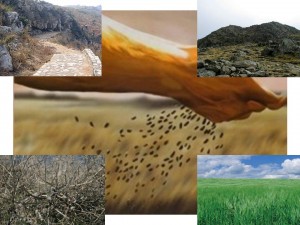
Luke 8:8 Some fell into good soil, and when it grew, it produced a hundredfold.” As he said this, he called out, “Let anyone with ears to hear listen!”

Luke 8:11b The seed is the word of God. – The Sower is Christ

Matthew 13:23 23 But as for what was sown on good soil, this is the one who hears the word and understands it, who indeed bears fruit and yields, in one case a hundredfold, in another sixty, and in another thirty.

Aloha nui loa, ʻŌmea! You know this story, don’t you? It’s the Parable of the Sower. When we hear sermons or homilies about this passage, we usually talk about the soil into which the seed was sown. In poor conditions, nothing grows. In fair conditions, something grows but with a low yield. In better conditions, more grows with a better yield. In the best-possible conditions, a sower gathers a wonderful yield. All of that yield, whether 30- or 60- or 100-fold, comes from good soil. We could look at it like this:

  • Poor = 0 yield
  • Fair = 30 X yield
  • Better = 60 X yield
  • Best = 100 X yield

(See also Mark 4:13-28 which includes 26 He also said, “The kingdom of God is as if someone would scatter seed on the ground, 27 and would sleep and rise night and day, and the seed would sprout and grow, he does not know how. 28 The earth produces of itself, first the stalk, then the head, then the full grain in the head. Also look up Luke 8:11-15 which includes 11 Now the parable is this: The seed is the word of God. And also 15 But as for that in the good soil, these are the ones who, when they hear the word, hold it fast in an honest and good heart, and bear fruit with patient endurance.) We aspire to be that good soil in which the seed can be held fast in an honest and good heart, and bear fruit with patient endurance. We do not want to be the soil that yields less-than-the-best. That’s usually how we think about it, yes? We want to be the “good soil” that has the highest yield.

When we read this, often times we identify with the sower, the farmer who is scattering the seed. He wants the seed to grow, but doesn’t seem to have 100% control over where the seed falls. Some lands in the rocks, some on the path, some in the weeds, and some – hopefully most of it – falls where it grows with great fecundity producing 30 or 60 or even 100 times more seeds in the crop that is harvested. Other times, we might identify with the soil. We are quick to hear the word but slow to take it in and it is whisked away before it can germinate. If it sticks with us for a while, we are shallow and resistive to the rooting of the word, so it sprouts up, but dies quickly. We are so distracted by the temporal and material wants in our lives that when the Word does take root in our hearts, it can’t compete with all the other trash planted there. And once in a while we are so open to the Word, so committed to nurturing its effects in us that we receive the seeds of the Word and its lush harvest is shared. There are several not-so-obvious things to consider here:

   First, the seed falls wherever the sower casts it. The yield depends, in part, on where it is cast. Throw it on the path, and it won’t yield much – it gets carried off by the birds. Throw it on the good soil, and it grows a lot – if you take good care of the growing crop. Toss it into the weeds, and it gets a good start, but gets choked out. Now, the soil can’t move and try to catch the seed, so it has to passively wait to receive the seed. In 3 of 4 cases, there is some yield, some growth that occurs, but the amount of growth depends on where the seed falls and how well it is take care of after it falls. Selah.


Second, the seed grows in all of those conditions. There is always a yield if the seed is received. While the seed cannot – of its own volition – get up and move over to the best soil, neither can the soil – of its own volition – move over to where the seed is scattered. Where the seed can take root, it does, and it yields what it can.

Third, the seed is the Word of God. As we read in Isaiah 55:10-11 10 For as the rain and the snow come down from heaven, and do not return there until they have watered the earth, making it bring forth and sprout, giving seed to the sower and bread to the eater,11 so shall my word be that goes out from my mouth; it shall not return to me empty, but it shall accomplish that which I purpose, and succeed in the thing for which I sent it. Wherever it takes root, it produces a yield.

Fourth, that yield takes time. This is the meaning behind Jesus’ words, “… these are the ones who, when they hear the word, hold it fast in an honest and good heart, and bear fruit with patient endurance.” When I think of that idea, I am often reminded of a story about the effectiveness of cramming before exams. If one fails to study and then hopes to gain enough understanding the night before the exam by staying up all night, it’s a bit like the farmer who sows his crops the month before harvest begins. He probably won’t garner much of a harvest.

Fifth, we also need to look at this from the standpoint of the seed. What happens to a seed that is planted in soil? In the beginning, the ground is broken to receive the seed. Then the seed does what it does – it develops roots, stalk, leaf, and breaks the soil again to enter into the light. Then the seed – which is not there anymore, it’s gone, dead, disappeared – carries on as the new plant with the goal of being fruitful. The seed has to die to unlock the miraculous potential of life within it. Once the fruit comes, the fruit must be harvested. Some of the fruit is retained for future planting. Some of the fruit is drastically altered. It is separated from its husk and boiled, or parched, or crushed into ever-finer powder which is mixed with other ingredients, passes through fire, and becomes bread. In most circumstances, the purpose of the whole process is to provide seed to the sower and bread to the eater.

We’ve looked at preparing the soil, but just for a moment let’s look at the sower. Did he give up because some of the seed was lost? Did he give up because the sun was scorching hot? Did he give up because there were rocks, or weeds, or birds? Did he scatter only ONE handful of seed to see how it would do? Or did he sow great quantities of seed tirelessly and then care for it until the time of harvest? What will we do, Beloved, when it’s time to account for the fields and orchards we have been given to tend? Do any of us know a seed-sower who sows in early September and expects a harvest by the end of October? Even more prevalent these days is the one who neither sows nor reaps; they have neither storehouse nor barn (See Luke 12:24 concerning ravens), but they want what the conscientious farmer has done – without putting in the work or without receiving it from God. (Ravens are illustrative of God’s generous gifts of sustenance for all his creatures. (See, for example, Genesis 8:7, 1 Kings 17:4, Job 38:41, and Psalm 147:9.)

If I am a Disciple, I too must sow the seed; and I must sow it everywhere, but take care to sow it where it will be fruitful. I must nurture it. I must patiently persevere. I must make it my mission to provide seed to the sower and bread to the eater. And if I really want to be the perpetuator of seed and bread, I will take a deep, long-term, personal interest in every aspect of bringing in that crop, storing the seed for next year, and baking the bread for today. How about you? Can you see a future in being part of Bread Blessed and Broken? (↔ Music Link) Are we truly One Bread, One Body? (↔ Music Link)  Can you and I grow to our highest potential and give our highest-possible yield? Can we, can you, can I give all of our being to being willing to allow the Word of God to become fruit in our hearts? Will we satisfy the hungry heart with Gifts of Finest Wheat? (↔ Music Link)

Ah, Belovéd, let us be enlightened in the teaching of the Apostle Paul 2 Corinthians 9:6-15 The point is this: the one who sows sparingly will also reap sparingly, and the one who sows bountifully will also reap bountifully. Each of you must give as you have made up your mind, not reluctantly or under compulsion, for God loves a cheerful giver. And God is able to provide you with every blessing in abundance, so that by always having enough of everything, you may share abundantly in every good work. As it is written,

“He scatters abroad, he gives to the poor; his righteousness endures forever.”

10 He who supplies seed to the sower and bread for food will supply and multiply your seed for sowing and increase the harvest of your righteousness. 11 You will be enriched in every way for your great generosity, which will produce thanksgiving to God through us; 12 for the rendering of this ministry not only supplies the needs of the saints but also overflows with many thanksgivings to God. 13 Through the testing of this ministry you glorify God by your obedience to the confession of the gospel of Christ and by the generosity of your sharing with them and with all others, 14 while they long for you and pray for you because of the surpassing grace of God that he has given you. 15 Thanks be to God for his indescribable gift!

Indeed, blesséd be God forever! No, Belovéd, I am not telling you to strive for homemade religion – remember we are talking abo0ut The Word who is The Bread of Life – nor am I telling you to give unlimited provision to those who are able but unwilling to sow or reap the grain to sustain physical life, expecting instead for us to do that work for them. I am telling you to assiduously cultivate the Word of God in the most fertile regions of your heart with loving care and hopeful perseverance so that you can feed those who hunger for the Word and plant seeds of Faith in the hearts of many. Our mission is to bring the True Bread to everyone who hungers and thirsts after righteousness.

Keep praying for our friends who are struggling with things that can prevent them from being fully fruitful in all their endeavors. Jesus tells us, “Grow Where I Send Thee.” [There’s a pun on this great song: Go where I send thee! (↔ Music Link)] It’s like my dear friend in Arizona says – Bloom where you’re planted. “Let anyone with ears to hear listen!”

Whatever, whenever, wherever, whoever, however, if ever, forever —

at your service, Belovéd!

Please pray with us here at Share-a-Prayer.

Here’s a bonus music link for online readers!

Go where I send thee! (↔ Music Link)

Unless otherwise indicated, all scripture passages are from the New Revised Standard Version Catholic Edition (NRSVCE) New Revised Standard Version Bible: Catholic Edition, copyright © 1989, 1993 the Division of Christian Education of the National Council of the Churches of Christ in the United States of America. Used by permission. All rights reserved.

Creative Commons License
Aloha Friday Messages by Charles O. Todd, III is licensed under a Creative Commons Attribution-ShareAlike 3.0 Unported License

Aloha Friday Message – July 3, 2020 – Longing and Belonging

2027AFC070320 – Longing and Belonging

Read it online here, please. And please, when you visit there, use one of the social media links at the bottom of the page to share this post. Thank you! And remember, we now have a READER VIEW available, so share this link or this email often.

Romans 8:9b , 13 9b Anyone who does not have the Spirit of Christ does not belong to him. 13 for if you live according to the flesh, you will die; but if by the Spirit you put to death the deeds of the body, you will live. (Please use the link provided so you can see these excerpts in context.)

Matthew 10:37-39 37 Whoever loves father or mother more than me is not worthy of me; and whoever loves son or daughter more than me is not worthy of me; 38 and whoever does not take up the cross and follow me is not worthy of me. 39 Those who find their life will lose it, and those who lose their life for my sake will find it.

May Peace always be with you and may God bless you, Belovéd! Back in the days when I worked for the Indian Health Service Agency, I did a lot of management-training sessions. One of the topics I often covered was about human need – what we need to make living “understandable.” Like many training topics, this was presented in a quadrant format:

Attention

Affection

Affiliation

Approval

Attention. Affection. Affiliation. Approval. Four things every human being needs every day. Without these things, we whither. It starts when we are infants. We bond with the persons who hold us and feed us and clean us and love us. Their attention makes our minds, and hearts, grow. The affection we share with parents and siblings, relatives and friends helps define our personality. We have a natural tendency to form community and to express our need for affiliation; we want to belong. And to belong, we require approval. To get approval we have rites and ceremonies, hazings and initiations, standards of conduct and codes of behaviors. And from the attention, affection, and affiliations we have made, the approval we receive tends to foster warmer and closer attention, affection, and affiliations. It’s a nice cycle when it works the way God planned it.

This type of peer relationship, a collegiality of caring, is the basis of our community-centered living. I believe that laws and religions and governments and families all reflect ways we build and strengthen community ties and boundaries. We have requirements for membership in any community whether it is as broad as the whole of humanity or as small as a group of playmates in preschool. Those requirements are based on respect and caring for ourselves and for those around us, respect and caring that has been taught to us through our immersion in the community.

Community, though, is not, or at least should not, be just a human experience. We know that God is also Community expressed as the Holy Trinity. For this community all of the requirements for membership, for participation, for conduct are absolute because the Community is Absolute – Unconditional, Totally Integral, Unlimited, Supreme, Pure, Perfect: God. Not “The Force.” Not “Intelligent Design.” Purely and simply, wonderfully and awesomely GOD in Three Persons. And that Community and our community can also share with one another attention, affection, affiliation, and approval.

How do we give God attention? Listen to what is said by The Word, look at what happens when The Word is expressed, appreciate the effects of that expression, and acknowledge the greatness of each moment spent paying attention to the Creator’s creations.

How do we give God affection? Most of us know that is easy to do. “We love Him because He first Loved us.” I believe He doesn’t love any one of us more than any other of us, so no matter how we say, “I love you” to Him, He hears us saying, “I Love you.” Capitol-L Love is the way God Loves, and He seems to be delighted to believe that we Love Him in the same way.

Affiliation. There’s a tough one. How can we affiliate with God? He’s Perfect, and all those things listed up there with Absolute. Humans can’t affiliate with THAT! Well, God knew we would think like that, so He made the Affiliation part the easiest part, not the most difficult. He became Filios, one of us so He and we could find common ground and therein the basis for affiliation.

So what about approval? Is it possible to show appreciation and agreement with God? Oh, yes! Whenever we praise Him in thought, word or deed, we are showing our appreciation and agreement with His Presence in our world, in our lives, in our hearts and minds. When we realize how much we admire His works and His ways and acknowledge that to each other and to Him, we are showing Him and each other our approval. And that’s a good thing, too.

It is good because we are created to be like Him. We have an affinity for everything that He is: Holy, Integral, Eternal, Just, Loving, Merciful, and most importantly capable of choosing to meld our community with His and His with ours. We need to give and receive attention, affection, affiliation, and approval because God made us that way; He made us in His image and His likeness. We are most complete when we decide to be Community in every way He intended us to be so.

If God’s intention is to make us part of the Community of Faith – part of the Family of God – then becoming one of us was a perfect solution. Still, if we look at the Key Verse for today, we might wonder if God is really welcoming us into Community with him. Anyone who does not have the Spirit of Christ does not belong to him. That’s how the Apostle Paul put it, and Jesus himself said ” … whoever does not take up the cross and follow me is not worthy of me. 39 Those who find their life will lose it, and those who lose their life for my sake will find it.” It’s the kind of thing that can start a riot these days! Of course, sneezing wrong can start a riot it seems. But let’s go past that to what else the Apostle Paul says.

He says, “ if you live according to the flesh, you will die; but if by the Spirit you put to death the deeds of the body, you will live.” Well, that’s more like it! We’ve hashed over “the deeds of the body” often here, so let’s summarize that by saying we “put to death” our Seven Deadly Sins and all that accompanies them in our lives. THAT also makes sense! Let’s consider just one of them – Envy. We want to be virtuous, to do the right thing, and – too many times – we think we can just snap our fingers and we’re done with Envy. Nope, it never worked for me, either! Let’s turn again to the B.I.B.L.E. to find a good strategy.

Take out your Bible and turn to 2 Peter 1:3-7 His divine power has given us everything needed for life and godliness, through the knowledge of him who called us by his own glory and goodness. Thus he has given us, through these things, his precious and very great promises, so that through them you may escape from the corruption that is in the world because of lust, and may become participants of the divine nature. For this very reason, you must make every effort to support your faith with goodness, and goodness with knowledge, and knowledge with self-control, and self-control with endurance, and endurance with godliness, and godliness with mutual affection, and mutual affection with love.

That’s right, Belovéd. The resource for this virtue is not worldly goodness, but spiritual strength obtained directly through the Power of God.  Click here to look at Psalm 119:1-3, and click here to see Psalm 128:1. When we walk in the way of the Lord, when we honor and reverence God (talking about the Trinity here), we have no room for envy or jealousy. We have everything needed for life and godliness and that promotes and fosters the virtue of Kindness. It is so simple! We walk with the Lord and simply Trust and Obey (↔ Music Link). Then we will be empowered to avoid being foolish, disobedient, led astray, slaves to various passions and pleasures, passing our days in malice and envy, despicable, [and] hating one another. (See Titus 3:3) Look at what Jesus said again there at the top of the post – Whoever loves [anyone or anything] more than me is not worthy of me. So there is a conditional phrase there – more than me. What we should all be able to remember as a template for Christian living is the acronym J.O.Y. – J is for Jesus, O is for other, and Y is for you. God comes first; all else should be a distant second. Making God primary in our lives is willingly offering our allegiance to our Creator and Savior. Look at what we find here in Psalm 110:3 Your people will offer themselves willingly on the day you lead your forces on the holy mountains. From the womb of the morning, like dew, your youth will come to you.

Those who reverence the Lord are those who show up at reveille every day, not just when the Last Trumpet sounds. Those who listen attentively to the Gospel and teaching based on the Gospel – and the entire Word of God revealed in Christian Scripture – are those who know and serve God with joy, mercy, grace, peace, love, and especially reverence. If we are “Gate-Post Christians” – someone who does not participate in the Liturgy as part of the Community of Christ but just stands or sits like a gate post, completely unmoved by what is happening – then we are failing to be The Body of Christ, the Bride of Christ, The Church, and Life of the Gospel. There is no sense of gratitude in that sort of failure to worship, to be engaged in the community of believers. We have been taught to be better than that. We are taught to be FAMILY, and that is the in-born desire of every human heart. The psalmist says God will give us the desires of our heart.

Does God really give us the desires of our heart? If our heart’s desire is God, then yes, he does. I invite you to reread Psalm 37, particularly verses 4 and 16. We want attention, affection affiliation, approval, satisfaction for all our hungers, advantage over others, recognition, food, clothing, “stuff.” We spend our lives pursuing these things. We spend what we have been given trying to obtain what we don’t need but absolutely want. There is a more excellent way. In 1 Corinthians 12, Paul describes the spiritual gifts God provides for his faithful. Immediately following his teaching on these gifts, he directs us to “still more excellent way.” God provides everything we need for happiness. We can chose his Gifts or ignore them. If we accept the Gifts, we honor the Giver of all good things. As Jesus himself said, But strive first for the kingdom of God and his righteousness, and all these things will be given to you as well. (See Matthew 6:33) God has not forgotten us, but he has allowed some of the consequences of our disobedience to be felt here and now; we can choose to acknowledge those consequences and to repent of the evil we have done. We can examine our own hearts to see if we desire God above all else. If that examination is carried out in the Light of the Word, then we can embrace the Light and abhor the darkness. As we love the Lord more and more, the desires of our hearts change to the actions of our wills. Remember the power in these words: Thy Kingdom come. Thy will be done. Do not forget the Lord your God who made heaven and earth, and even you and me.

The desires of our hearts should be the desires of the Spirit. It is only that desire which can put to death the deeds of the body and enable us to take up the cross and follow Jesus. What will we do if we give and receive attention, affection, affiliation, and approval in Jesus? We will know the JOY of belonging to the Community of Faith, the Community of The Word. It is the longing for the Peace and Joy we know in Jesus that unites us with that community. We long to belong. Give God what’s right – not what’s left. Man’s way leads to a hopeless end – God’s way leads to an endless hope. We don’t change God’s message – His message changes us. And remember this WARNING: Exposure to the Son may prevent burning.

Whatever, whenever, wherever, whoever, however, if ever, forever —
at your service, Belovéd!

Please pray with us here at Share-a-Prayer.

Unless otherwise indicated, all scripture passages are from the New Revised Standard Version Catholic Edition (NRSVCE) New Revised Standard Version Bible: Catholic Edition, copyright © 1989, 1993 the Division of Christian Education of the National Council of the Churches of Christ in the United States of America. Used by permission. All rights reserved.

Creative Commons License
Aloha Friday Messages by Charles O. Todd, III is licensed under a Creative Commons Attribution-ShareAlike 3.0 Unported License


Aloha Friday Message – June 26, 2020 – On the receiving end

2026AFC062620 – On the receiving end

Read it online here, please. And please, when you visit there, use one of the social media links at the bottom of the page to share this post. Thank you! And remember, we now have a READER VIEW available, so share this link or this email often.

    Matthew 10:40 40 Whoever welcomes you welcomes me, and whoever welcomes me welcomes the one who sent me.

Romans 6:9 We know that Christ, being raised from the dead, will never die again; death no longer has dominion over him.

May Peace always be with you and may God bless you, Belovéd! Today we will look a two excerpts from Sunday’s readings and a whole boatload of other Scripture. We will explore what it means to welcome Jesus, and also look at what many unbelievers will welcome during these perilous days. Let’s get right to it!

Romans 1:17-25 (emphasis added) – 17 For in it the righteousness of God is revealed through faith for faith; as it is written, “The one who is righteous will live by faith.” (Please see Habakkuk 2:4)

18 For the wrath of God is revealed from heaven against all ungodliness and wickedness of those who by their wickedness suppress the truth. 19 For what can be known about God is plain to them, because God has shown it to them. 20 Ever since the creation of the world his eternal power and divine nature, invisible though they are, have been understood and seen through the things he has made. So they are without excuse; 21 for though they knew God, they did not honor him as God or give thanks to him, but they became futile in their thinking, and their senseless minds were darkened. 22 Claiming to be wise, they became fools; 23 and they exchanged the glory of the immortal God for images resembling a mortal human being or birds or four-footed animals or reptiles.

24 Therefore God gave them up in the lusts of their hearts to impurity, to the degrading of their bodies among themselves, 25 because they exchanged the truth about God for a lie and worshiped and served the creature [Creation] rather than the Creator, who is blessed forever! Amen.

And here is an excerpt from a link in last week’s post (Matthew 10:26-33). If you did not use the link (I hope you did), you did not see this. It bears repeating. It’s from just a few verses up the page from today’s Key Verse ~~ Matthew 10:32-33 32 “Everyone therefore who acknowledges me before others, I also will acknowledge before my Father in heaven; 33 but whoever denies me before others, I also will deny before my Father in heaven.”

One of the most difficult parts of living a Christian life is defending the exclusivity inherent in its fundamental basis for Salvation. In John 6:44, for example, we read 44 “No one can come to me unless drawn by the Father who sent me; and I will raise that person up on the last day.” And again in John 14:6-7 we read, Jesus said to him, “I am the way, and the truth, and the life. No one comes to the Father except through me. If you know me, you will know my Father also. From now on you do know him and have seen him.” We believe, therefore, that God has created in us a type of natural, irresistible affinity for him because we are created in his image and likeness. It is natural for us to know God, to see what God has done, and to seek unity with his Perfect Integrity of Oneness. We are aware of his presence even though he is invisible because we see the effect of his presence in his Creation and in living within that Creation because we, too, are an observable part and product of Creation. We know and understand that we did not create ourselves, and most rational people will believe that Creation – including all living and nonliving things – is real, tangible, and observable. We are conscious of “being,” aware of our own existence and of the existence of the rest of Creation. Our “personhood” is an observable fact (although there are some loonies out there who debate that). In this way we are able to conclude that there is a Creation, and therefore there is a Creator. If instead we are determined to claim there is no objective evidence of Creator or Creation, we deny God’s existence. Now, remember that when we say “God,” we mean all of God – the Holy Trinity. If we do not “credit” God with the acts of Creation, Salvation, and Animation then we deny him and everything he is and does. That is where Jesus’ statement comes into play: whoever denies me before others, I also will deny before my Father in heaven.

Because one can see what God does, one can know that God is, and we also have Scripture to tell us what he has done, what he is doing, and what he will do. God is the Source of the act of creation, and Creation is the Object of that act – the Source and the Object are separate. What is it we call that Object? One might call it by many names – the Heavens, outer space, The Great Void, and – quite popular these days – “The Universe.” For some who use that taxonomy, there is often a tendency to give it its own animation, to attribute powers, sentience, will, and identity by self-awareness. One might believe this because, after all, we are part of the universe, and we have powers, sentience, will, and identity by self-awareness. For example, one has the “power of creativity.” Suppose a college student named Mary uses her computer’s word processor as she composes a research paper for her Philosophy class. Did she “create” that body of work? Did the computer “create” that body of work? Did the Universe “create” that body of work? No, none of that can be true. Mary used billions of recycled electrons by accessing the programming in her computer, and the computer facilitates her activities, but the computer does not – and certainly ­cannot­ – create Mary’s document. Additionally, her document is based on research that is the result of scores, or even thousands, of other collectors of knowledge. We talk of creativity in the arts, and even in science (perhaps even politics), but CREATION is the process of making something from nothing. One can make or construct material objects, and even ideas which receive no material characteristics, but all of those are not CREATION. One should be able to conclude, therefore, that all of these things presented are ongoing Objects of one, singular act of Creation.

All of us are familiar with the argument that the likelihood of the universe coming together in such remarkable order and continuity is comparable to expecting the Oxford English Dictionary to come together as the result of an explosion in a printing shop (or of being written by a billion chimpanzees typing on billions more typewriters, hopping from one to another after completion of each word). As ludicrous as that might sound, one still hears people saying things like, “The Universe will punish your for that,” or “The Universe gave me an incredible gift today,” or “I’m counting on the Universe to get me that job” or, most grievous, “I have faith in the Universe because it’s never let me down.” How very tragic that one can accept such balderdash when there is so much evidence to the contrary! Worse still, it is appalling that these statements flatly and utterly reject God, his Creation, and the Object of his Creation because they exchanged the truth about God for a lie and worshiped and served the creature rather than the Creator, who is blessed forever! Amen because whoever denies me before others, I also will deny before my Father in heaven.

Our own existence shows us what the Apostle Paul meant here: Hebrews 11:3 By faith we understand that the worlds were prepared by the word of God, so that what is seen was made from things that are not visible. The Psalmist also concludes in Psalm 33:6 By the word of the Lord the heavens were made, and all their host by the breath of his mouth. Recall as well that we read in the opening verses of the Gospel of John that All things came into being through him, and without him not one thing came into being. (See John 1:3) That includes the universe and all the objects in it – you and me for example. There is an even greater consequence for deifying the universe; it has no power of resurrection. Only God has that power, remember? We know that Christ, being raised from the dead, will never die again; death no longer has dominion over him. Christ, who is God, is Resurrected. We sometimes think of persons “raised from the dead” as being resurrected, but that is as false a notion as believing the universe can have its own volition. Lazarus, for example, was resuscitated – he experienced the reanimation of his natural, physical, mortal body. Jesus is RESURRECTED.

     This is why he said in John 11:25-26 25 Jesus said to her, “I am the resurrection and the life. Those who believe in me, even though they die, will live, 26 and everyone who lives and believes in me will never die. Do you believe this?” If one believes “The Universe” created us, cares for and about us, and provides us with the good things we desire, WE DENY GOD’S CREATION, REJECT Christ, and endanger our salvation which is the source of hope in our resurrection. We must instead WELCOME Christ, as God intends. Never forget, Belovéd, that everyone, every living soul past and present and future, will experience the Resurrection to Eternal recompense. Those who are called by the Father and go to him through the Son are destined for Eternal Life and Endless Joy in the presence of God. Those who are called by the Father and reject that call by rejecting the Son and counting instead on an Object named “The Universe,” an idol of their own making, are destined for Eternal Death and Endless Sorrow in the absence of God. When Jesus spoke of his identity as “The Resurrection,” the Greek word we have in Scripture is ἀνάστασις (← Check it out!) (anastasis) { an-as’-tas-is} a standing up, a resurrection, a raising up, rising up alive and transformed – it refers to the physical, bodily resurrection of Christ – and people (both of the redeemed and the unredeemed).

Just as Mary’s paper is not contingent on the volition of her computer, the course and outcome of our lives is not contingent on the volition of “The Universe.” (OR the stars for that matter.) Where did Mary’s thoughts originate, and what things were caused or effected by them? Her thoughts had an object – her paper – and all thinking, the making of connections between things we know to be sensible, has to be in relation to another object, that is, they have aspects of existence involving thoughts such as beliefs or desires about different kinds of objects, including those that have no actual existence. Only animate objects think – earthlings and many forms of animal life. Vegetable, mineral, and “outer space” or “the Heavens” or “The Universe” do not think or act and have no volitional characteristics. They have only existence which one accepts as true because one chooses to do so. It is through that choice that we receive what God gave us as opportunities of good works he prepared for us to complete before he created us. In James 3:13, the Apostle James reminds us 13 Who is wise and understanding among you? Show by your good life that your works are done with gentleness born of wisdom. Is it only believers then who are good and gentle and wise? No Belovéd, all of us know persons whose generosity and kindness are irreproachable even if they put their faith in the universe instead of God. We know that 17 Every generous act of giving, with every perfect gift, is from above, coming down from the Father of lights, with whom there is no variation or shadow due to change. (See James 1:13-17). We are always on the receiving end of what God has created in and for us. “The Universe” exists as an object from or to which other objects can be taken – or sent – by or through choices it does not make on its own. The best one can say about the universe is For in it the righteousness of God is revealed through faith for faith; as it is written, “The one who is righteous will live by faith.” Faith in “The Universe” is not righteousness because it is not faith in our Creator but rather faith in his Creation. One thereby rejects God’s perfect integrity, endless mercy, and eternal salvation through Christ our Lord. Death still holds dominion over those whose faith is based on something that is not Eternal. Therefore, “Choose life so that you and your descendants may live” with God forever. (See Deuteronomy 30:19) We must make wise choices that do not exclude God’s gifts to us and as the Apostle James says in James 1:5-8 If any of you is lacking in wisdom, ask God, who gives to all generously and ungrudgingly, and it will be given you. But ask in faith, never doubting, for the one who doubts is like a wave of the sea, driven and tossed by the wind; 7, 8 for the doubter, being double-minded and unstable in every way, must not expect to receive anything from the Lord.

Whatever, whenever, wherever, whoever, however, if ever, forever —
at your service, Belovéd

Please pray with us here at Share-a-Prayer.

Unless otherwise indicated, all scripture passages are from the New Revised Standard Version Catholic Edition (NRSVCE) New Revised Standard Version Bible: Catholic Edition, copyright © 1989, 1993 the Division of Christian Education of the National Council of the Churches of Christ in the United States of America. Used by permission. All rights reserved.

Biblical languages inserts from Bible Hub (Bible Hub: Search, Read, Study the Bible in Many Languages) Visit at http://biblehub.com

Creative Commons License
Aloha Friday Messages by Charles O. Todd, III is licensed under a Creative Commons Attribution-ShareAlike 3.0 Unported License

Pages Email Newsletter Categories Archives Connect
  • Connct to us here