2613AFC032926 – Gloria in excelsis deo! ← PODCAST LINK 😀
Read it online here, please. And please – when you visit there – use one of the social media links at the bottom of the page to share this post. Thank you! And remember, we now have a READER VIEW available, so share this link or this email often. And please, when you visit there, use one of the social media links at the bottom of the page to share this post.
Do you know someone who enjoys Bible study, or who might like to read this? Please forward this to them and ask them also to share it to others.

Philippians 2:5-11 – 5 Let the same mind be in you that was in Christ Jesus,
6 who, though he was in the form of God,
did not regard equality with God
as something to be exploited,
7 but emptied himself,
taking the form of a slave,
being born in human likeness.
And being found in human form,
8 he humbled himself
and became obedient to the point of death—
even death on a cross.
9 Therefore God also highly exalted him
and gave him the name
that is above every name,
10 so that at the name of Jesus
every knee should bend,
in heaven and on earth and under the earth,
11 and every tongue should confess
that Jesus Christ is Lord,
to the glory of God the Father.
Grace to you and peace from God our Father and the Lord Jesus Christ, who gave himself for our sins to set us free from the present evil age, according to the will of our God and Father, to whom be the glory forever and ever. Amen. This post is intended to help us prepare for the beginning of Holy Week, and our immersion in the Passion of Christ. Do we remember what Jesus told James and John, the sons of Zebedee – the same guys Jesus called “the sons of thunder” – when they (and/or their mother) asked Jesus if they could sit on either side of him when he came into his kingdom? He said, “You do not know what you are asking. Are you able to drink the cup that I drink, or be baptized with the baptism that I am baptized with?” (See Mark 10:38) Let us be sure to recall that the Greek word βάπτισμα, describes the act of Baptism in which there can be a complete immersion, or submersion, which has its roots in Jewish ceremonial washing. Do we dare to be spiritually immersed – Baptized – in the simple majesty and Joy of the Entry into Jerusalem as well as the horror and sorrow of the Passion?
We might be able to tolerate that contemplative Baptism if we recall the words of Bishop Fulton Sheen (soon to be Venerable Bishop Fulton Sheen) who said “Unless there is a Good Friday in our lives, there will never be an Easter Sunday. The Cross is the condition of the empty tomb, and the crown of thorns is the preface to the halo of light.”
March 29, 2026, (← Check it out!) marks the beginning of Holy Week as Palm Sunday, (↔ Learning Link) and discerning hearts around the globe will be contemplating a prodigious message of Hope, and invitation to deep, deep reflection, and the Glory of God’s Word-made-Flesh will be lifted up in Christian hearts, and hands, and voices. I like to call it “Hosannah Sunday!” All the dried-out, sometimes carefully woven and plaited palm fronds from the last Hosannah Sunday were burned and ground into a smooth black paste for Ash Wednesday. This coming Sonday [sic] we will receive another batch of fresh, green palm fronds to take home. There is an old tradition in some parts of the USA wherein people say that, “if you burn the dried palm leaves during a storm, it helps weaken the storm or even cause it to pass by you.” Well, that and burying a statue of St. Joseph upside down in the garden are OK for some but not for others.
I chose this longish passage from Philippians because it has so many GREAT nuggets. Some authorities hypothesize that this might have been a Christian hymn of the period when it was paraphrased by The Apostle Paul. There’s a LOT to think about here! Let’s start at the beginning (always a good place to start!)
Let the same mind be in you that was in Christ Jesus. Now, there is a metanoia that is definitely challenging! The Apostle Paul is, of course, beginning his exhortation to edify the Christians in Philippi about the extraordinary Majesty of the Life, Passion, Death, Resurrection, and Ascension of Jesus, the Christ of God.
The Apostle Paul is exhorting us to take on Christ’s humility for though he was in the form of God, [he] did not regard equality with God as something to be exploited …. Now, one thing we can see right off in this short phrase is that he was in the form of God. I include that for the folks who somehow mistakenly believe that Jesus set aside his divinity so he would be 100% human. This is a heresy. Jesus was fully human and fully divine simultaneously. It is a Mystery of Faith earthlings cannot and do not understand intellectually, but can accept as a matter of Faith. Christ, then, being fully human and fully divine lived in humility so great that he surrendered everything to God The Father.
Even everything he said and did was from The Father. His will, his attitude, his opinion of himself and his mission was from God. Jesus put everyone – yes, EVERYONE – ahead of himself. That was his mindset, his attitude, his self-image if you will. Here is the result as it is found in Philippians 2:1-4 – 1 If then there is any encouragement in Christ, any consolation from love, any sharing in the Spirit, any compassion and sympathy, 2 make my joy complete: be of the same mind, having the same love, being in full accord and of one mind. 3 Do nothing from selfish ambition or conceit, but in humility regard others as better than yourselves. 4 Let each of you look not to your own interests, but to the interests of others.
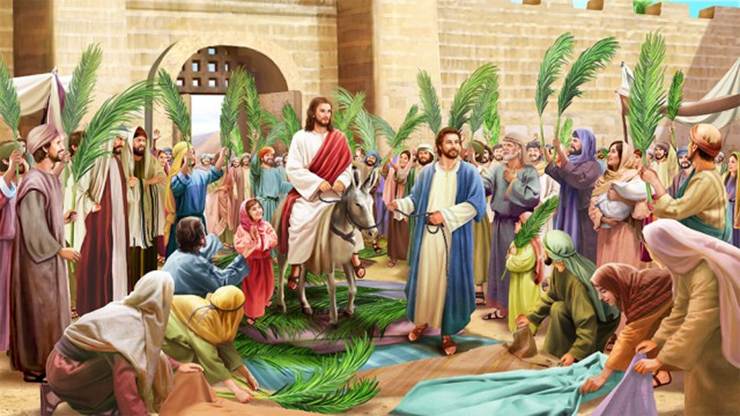
In Sunday’s Gospel, we will first hear about the colt, the foal of a donkey, who has not been ridden, as Jesus makes his triumphal entry into Jerusalem. Jesus has become well known by thousands because of his marvelous deeds – feeding great crowds of people, speaking with authority, raising the dead. Now he enters the city of Jerusalem, riding on a baby donkey. The fact that Jesus rode into Jerusalem on a donkey was, in part, a fulfillment of scripture. But there’s more. A king who rides in on a donkey is coming peacefully. A king who rides in on a horse is coming to make war. It is also significant that the colt Jesus’ disciples borrow is one that has never been ridden. Here the King of Peace is so gentle and so humble that even a young colt never before ridden submits to Jesus’ presence. Instead of bucking him off, the colt meekly carries a full-grown man. It is interesting to me that the disciples who went to fetch it did so without question, and then they put their own cloaks on the back of the colt to make a more comfortable seat. I think it might have also been more comfortable for the colt! And you know, I think that colt’s mama walked next to him on that journey. Read it again and see if you think so, too.
As he rode through Jerusalem, people in the crowds recognized him and paid him homage: Mark 11:9 – And those who went before and those who followed were shouting, “Hosanna! Blessed is he who comes in the name of the Lord! Blessed is the coming kingdom of our father David! Hosanna in the highest!” That word, Hosanna, is found only in the New Testament, but there are echoes of it in other places in the Old Testament, too. It means to help or to save (See Psalm 118:25, for example). It comes from a Hebrew phrase hoshiya na. in Psalm 118:26, it is followed by Blessed is he who comes in the name of the Lord! Over the centuries between David and Jesus, the expression hoshiya na had come to mean Salvation is now! When Jesus got on that baby donkey, he started toward Jerusalem to fulfill what had been prophesied about the Messiah.
Jesus was in Bethany, close to Bethpage (“Place of new – or unripe – figs”) somewhere perhaps around the Mount of Olives. He gets on the colt in Bethany – about 2 miles from Jerusalem, and heads into town. On the way people who have seen him, who know him – some intimately, some only by reputation – get excited about seeing him, and they begin to remember Zechariah 9:9 . They start pulling down palm fronds and laying them on the path in front of him or waving them in the air. The palm was a symbol of victory – even Holy Victory. In addition people were laying their cloaks down in the road and letting the little donkey pass over them. A similar event is reported in 2 Kings 9. [They hurried and took their cloaks and spread them under him on the bare steps. Then they blew the trumpet and shouted, “Jehu is king!”] Elisha had just anointed Jehu (“Yahweh is He”) as King of Israel, and had ordered him to go avenge the murders committed by Jezebel’s forces when she had the prophets slaughtered. The king, Ahab, had permitted this, and Jehu was told to destroy Ahab as well.
Spreading cloaks or other objects to “pave the way” was a common demonstration of respect for the dignity and power of a person – a King, a general, even a prophet. So now we have Jesus on a baby donkey and everyone is shouting and happy and cheering and dancing and running ahead and coming back and just going nuts over what Jesus is doing. He was finally defining himself as the Messiah, the Ruler of Israel, The Son of David! And, they surely thought he was about to kick the Romans out of town because he was the Rightful Ruler.
But, he was on a donkey, not a horse. And the people understood. They identified with him. Until they turned against him.
Palm Sunday, Hosannah Sunday, is also called Passion Sunday because the Gospel reading ends with Jesus’ dead body sealed in a borrowed tomb and guarded by Roman soldiers. The Apostle Paul tells us –
though he was in the form of God,
he did not regard equality with God
as something to be exploited,
7 but emptied himself,
taking the form of a slave,
being born in human likeness.
And being found in human form,
he humbled himself
and became obedient to the point of death—
even death on a cross.

Jesus knew what to expect. He warned his disciples, the Apostles, at least three times about what was going to happen to him – please take a look at these. All you need to do is click on the links: Matthew 17:22, 26:2; Matthew 20:17-19; (←Stop here and read this.) Mark 9:31; Luke 9:43-45. We should not be at all surprised that in the garden of Gethsemane Jesus was sweating copiously in anticipation of the humiliation and pain he was about to face. I’m sending out a challenge to anyone who is willing to take it up: Set a timer and spend 5 minutes, just 5 minutes, on what it would be like to be flogged so hard that the skin came off your back, to have every surface of your body bruised and torn open over and over, to be struck in the groin multiple times with a flagrum like this, then to carry about 200 pounds of timber on your right shoulder, then to have a large spike, 7 inches and about half-an-inch wide driven through the bones of your wrists and feet after your severely-injured right shoulder was dislocated, and extreme damage was done to one eye. Can you, can I, can we be immersed (βάπτισμα) enough in the Passion that it troubles our hearts and tears well up?
After all that, could we face the humongous reality of the Resurrection and the massive dichotomy of Joy tinged with horror as we probe the wounds in the hands, feet, and side of Jesus? Dare we join James and John in asking for a share in Jesus’ Majesty without taking a share in Jesus’ suffering? Even if our suffering is more than a spiritual exercise, even if we are actually in a form of physical duress, great or small, for each Believer there must be that salvific sequence in our lives – the Cross, the Tomb, and the Glory.
As we begin Holy week, can we prepare our hearts, our minds, and our souls to sing with gusto “Gloria in excelsis deo!” for each step along the way, crossing over the palms and cloaks, passing over the Brook Kidron to Gethsemane, and then still sing it through the sham trial, the extreme pain, pass over the edge of Life into Sheol, and then cross over again into New Life? Do we have the Faith, the Discernment, the Patience and Perseverance; and especially the Humility – as HE was humble? – to walk with Jesus through all of that? Every step of every moment we hear during Holy Week is an opportunity to praise God, so indeed! – Gloria in Excelsis Deo!

Whatever, whenever, wherever, whoever, however, if ever, forever —
at your service, Belovéd!
Please pray with us here at Share-a-Prayer.
Unless otherwise indicated, all scripture passages are from the New Revised Standard Version Catholic Edition (NRSVCE) New Revised Standard Version Bible: Catholic Edition, copyright © 1989, 1993 the Division of Christian Education of the National Council of the Churches of Christ in the United States of America. Used by permission. All rights reserved.
Biblical languages inserts from Bible Hub (Bible Hub: Search, Read, Study the Bible in Many Languages) Visit at http://biblehub.com
 Aloha Friday Messages by Charles O. Todd, III is licensed under a Creative Commons Attribution-ShareAlike 3.0 Unported License