Aloha Friday Message – March 14, 2025 – THE Power of THE WORD of God.

2511AFC031425 – THE Power of THE WORD of God

Read it online here, please. And please – when you visit there – use one of the social media links at the bottom of the page to share this post. Thank you! And remember, we now have a READER VIEW available, so share this link or this email often.
Do you know someone who enjoys Bible study, or who might like to read this? Ask them to email us or to subscribe on our blog-site.

Genesis 15:17-1817 When the sun had gone down and it was dark, a smoking fire pot and a flaming torch passed between these pieces. 18 On that day the Lord made a covenant with Abram, saying, “To your descendants I give this land, from the river of Egypt to the great river, the river Euphrates

Psalm 27:13-14(GNT) [1]
13 I know that I will live to see
    the Lord’s goodness in this present life.
14 Trust in the Lord.
    Have faith, do not despair.
Trust in the Lord.

(NRSVCE)
13 I believe that I shall see the goodness of the Lord
    in the land of the living.
14 Wait for the Lord;
    be strong, and let your heart take courage;
    wait for the Lord!

Philippians 3:19-2019 They (unrepentant sinners) are going to end up in hell, because their god is their bodily desires. They are proud of what they should be ashamed of, and they think only of things that belong to this world. 20 We, however, are citizens of heaven, and we eagerly wait for our Savior, the Lord Jesus Christ, to come from heaven.

Luke 9:34 b -36 a cloud came and overshadowed them; and they were terrified as they entered the cloud. 35 Then from the cloud came a voice that said, “This is my Son, my Chosen, listen to him!” 36 When the voice had spoken, Jesus was found alone. And they kept silent and in those days told no one any of the things they had seen.

La grazia del Signore Gesù Cristo, l’amore di Dio e la comunione dello Spirito Santo siano con tutti voi. OK. I admit, that’s not fair. Most likely many of us will recognize that those words are in Italian, and perhaps a few of us can decipher it closely enough to know that it says “The grace of our Lord Jesus Christ, and the love of God, and the communion of the Holy Spirit be with you all.” It is in our Bibles in 2 Corinthians 13:13. We might also recognize it as one of the responses at the beginning of every Mass (← Check it out!) in any language. When we realize that everything in every Mass is based on Scripture and Tradition, then we begin to understand how constantly and patiently Our Father in Heaven speaks to us – always conveying the same message: “I created you in Love so that we could Love each other.” Those words are the substance of the Word of God – I LOVE YOU. God started it by saying it first, and we perpetuate it by replying “I Love you, too.” There is an important difference between his statement and our response.

What God speaks becomes what is. He says it, and it happens. His Word causes action and change. Our words, on the other hand, can be superficial and lacking in spiritual power. We are subjected to many distractions and prone to “phone it in” sometimes. That’s why, I believe, God keeps sending us the same message: I AM here for the sake of your necessary Salvation. This is my Word. LISTEN! Sometimes our response looks like, “Yeah, yeah, yeah, I know. I love you, too. Let’s circle back to that in a bit. No worries. I’ll get back in touch asap.” Many people will find that this approach leads to being deaf and blind to the Word. If they do still go to Church, they become what I call “fencepost Christians.” They stand, or sit, or kneel when everyone else does, but they do not sing, or pray, or engage in the Mass. (See 1908AFC022219 – Our Call to Mercy) It seems to me quite clear that the very reason we have the Word of God – Sacred Scripture – is to cause our edification about how to use, to engage in – the dialog between us and God. If what God speaks becomes what is, then we should strive to do everything we can to mirror that action and make what we speak become what is.

“I believe in God the Father Almighty,…” Do I? Am I always aware that he is THE Creator, that he created everything that exists – from all the starry cosmos with its strings and photons, quarks and dark matter, nebulae and black holes – and he even took a quick nanosecond or two to create you and me? Is there ever a moment in any day that I do not recall that This Is My Fathers World (↔ Music Link)? We are unlikely to be always aware of God’s perpetual presence in the life of every living soul at every single moment. And when we do acknowledge how many moments of our lives have been stored up as things that cause us to ignore The Word, they add up to something like Fibber McGee’s Closet. It all comes tumbling out  in a terrible racket if ever we open our heart to try and let God come in. That’s embarrassing, and it should be because, as Molly always said, “Tain’t funny, McGee.” (↔ Learning Link) In our Key Verse from Genesis for today, we have the account of the establishing of an unending covenant between Abram and God. Abram was willing to give up all doubt of God’s WORD, give up the fear of the darkness, the appearance of the visions of the brazier and torch, and accept and commit to God’s promise even though it seemed incomprehensible. Shown here is a map of the lands God promised to Abram and his descendants. Those descendants did not obey God in subsequent centuries, and so what they were able to claim was far less than what God had promised. It was less because they chose less. This is Our Father’s World, and he can give it to us however he wants. How we accept it is USUALLY quite different!

Let’s see if we can figure this out then, why don’t we pay attention to what Our Father in Heaven says to us? Since the best place to start is the beginning, let’s start with the narratives of Creation and The Fall in Genesis. God spoke, and everything he spoke came into being. He created earthlings to be like him – good, spiritual, loving, and eternal; but he  added a part in us to make us accountable for our faithfulness. He Loved us so much that he allowed us to choose whether or not we would Love him in return. Our First Parents made that choice, and instantly Sin entered the lives of every earthling after them. In that same instant as well, God provided for our Salvation – The Absolutely Perfect Plan – and at that same moment, the Word of God prepared to take on our likeness, to become flesh, and to live among us and finally die for us and for our Salvation. Even though we inherited that unfaithfulness and still perpetuate it with our life-choices, God always remains faithful to his Word because The Word is God. I am reminded of a musical expression of Our Heavenly Father’s faithfulness whenever I hear Great is Thy Faithfulness (↔ Music Link).

It is true that “As Thou hast been, Thou forever will be. All I have needed Thy hand hath provided. Great is Thy faithfulness, Lord unto me.” All of us must most likely confess, “I cannot say that about me.”

And in the instant we say that, God’s persistent, consistent, immersive Love affects all of our senses and we have the opportunity to also confess that we can and “will live to see the Lord’s goodness in this present life.” Why? How? The Psalmist gives us the answer – Trust in the Lord. Have faith, do not despair. Trust in the Lord. The Apostle Paul was able to trust in the Lord so deeply that he expected to continue to serve him even after death. We are reminded of this famous passage in 2 Timothy 2:11-13 (GNT) which may have been an early Christian hymn or perhaps a teaching slogan:


11 This is a true saying:

“If we have died with him,
    we shall also live with him.
12 If we continue to endure,
    we shall also rule with him.
If we deny him,
    he also will deny us.
13 If we are not faithful,
    he remains faithful,
    because he cannot be false to himself.”

The KJV version of that passage starts with, “It is a faithful saying.” Can we dare to imagine that “if we are not faithful, he remains faithful, because he cannot deny himself.”?

What Wonderful Words of Life (↔ Music Link) these are!! The Apostle Paul received from Our Father in Heaven the assurance that Scripture is THE Power of THE WORD of God. We can, therefore, declare that whatever God says becomes All that is. I know several good preachers who often proclaim that Jesus talks about Hell more often than he talks about Heaven. Others insist that the opposite is true. Neither of these pronouncements are important. What really is important is that he mentioned both of them often enough to demonstrate that whichever one we choose, that will be our permanent, eternal residence! Even more important is that we have the power to choose between the two.

“With great power comes great responsibility,” and if we want to see the goodness of the Lord in the land of the living, then we have to be responsible about consistently choosing not only to receive that which is good, but also to give that which is good. There’s an old adage that says, “Give God what is just and right, not just what is left.” The Apostle Paul is in full agreement with Christ (and the Church is in agreement with both) that They (unrepentant sinners) are going to end up in hell, because their god is their bodily desires. They are proud of what they should be ashamed of, and they think only of things that belong to this world. Those disordered appetites we nurture in ourselves make us unable to do what we know is right and instead do what we know is wrong. (See Romans 7:15-20) It is the sin that lives in us, present in every earthling since the earlier referenced Fall in Genesis which we permit to direct our actions even when we don’t want that to happen. It is clear that what we say does not always become what is. But, “not always” is not “never” and so sometimes we do get it right; and to our great relief God is there to accept that odd moment of goodness we somehow manage to accomplish.

How, then, do these rare moments of clarity come about? Well, we get a little help from our Friend, the Holy Spirit. If only we would remember to begin our quirky expeditions in life with a quick prayer saying, Spirit of God Descend upon My Heart (↔ Music Link). Here, in the land of the Living, we can call upon the Lord to help us “To check the doubt, the rising rebel sigh; teach me the patience of unanswered prayer.” In response to those Divine gifts, we can offer up our Praise to Our Father in Heaven as a Love offering more precious to God than our most articulate prayers. It is a familiar and faithful saying – “Acknowledge (confess) your sins and repent,” as well as “Repent and believe the Gospel.” We may feel, may even know, that the Power to do that is within reach, but we may not feel we can possess it. That is when we must recall the rearranged title of this post: Scripture is THE WORD of THE Power of God. When we speak the Scriptures – silently or boldly aloud – we speak THE WORD of THE Power of God, and whatever God speaks becomes what is. He has clearly spoken to us through the Apostles what we are to do about the Word: “This is my Son, my Chosen, listen to him!” It could not be any more clear. Belovéd, we are his chosen and adopted children. We must listen to him, THE WORD of God!

I apologize for the length of this so far. I’ll make only a brief few statements about our person of the week. Purim, a Jewish holiday commemorating the deliverance of the Jews in ancient Persia, begins on the evening of Thursday, March 13th, and continues through Friday, March 14th. Purim is a joyous holiday celebrated by Jews worldwide, commemorating the story in the Book of Esther where Queen Esther and her cousin Mordechai save the Jewish people from a plot to destroy them by the wicked Haman. Esther is one of the most outstanding female protagonists in Scripture. She is the epitome of the bold and beautiful servants of Our Heavenly Father. The story has been somewhat fragmented across the millennia, but it is fascinating. I recommend looking for it here. I assure you it is well worth the time. And to all who cherish Purim, שָׂמַח samach with great שִׂמְחָה simcha! I may not have gotten that right, so Rejoice with Great Joy! Amein! Our Hope is in the Lord!! 

Whatever, whenever, wherever, whoever, however, if ever, forever —
at your service, Belovéd!

Please pray with us here at Share-a-Prayer.

Please remember DT, TT, KG, MC, RB, OC,

and the people suffering hatred, violence, war, and famine

all across the Globe.

Unless otherwise indicated, all scripture passages are from the New Revised Standard Version Catholic Edition (NRSVCE) New Revised Standard Version Bible: Catholic Edition, copyright © 1989, 1993 the Division of Christian Education of the National Council of the Churches of Christ in the United States of America. Used by permission. All rights reserved.

Biblical languages inserts from Bible Hub (Bible Hub: Search, Read, Study the Bible in Many Languages) Visit at http://biblehub.com


Aloha Friday Messages by Charles O. Todd, III is licensed under a Creative Commons Attribution-ShareAlike 3.0 Unported License


[1] Passages marked (GNT): Good News Translation (GNT) are from the Good News Translation® (Today’s English Version, Second Edition)© 1992 American Bible Society. All rights reserved. For more information about GNT, visit www.bibles.com and www.gnt.bible.

Aloha Friday Message – 1st Sunday of Lent – Repent! Believe! Confess!

2510AFC030725 – 1st Sunday of Lent – Repent! Believe! Confess!

Read it online here, please. And please – when you visit there – use one of the social media links at the bottom of the page to share this post. Thank you! And remember, we now have a READER VIEW available, so share this link or this email often.
Do you know someone who enjoys Bible study, or who might like to read this? Ask them to email us or to subscribe on our blog-site.

Luke 4:9-12 Then the devil took him to Jerusalem, and placed him on the pinnacle of the temple, saying to him, “If you are the Son of God, throw yourself down from here, 10 for it is written,
‘He will command his angels concerning you,
    to protect you,’
11 and
‘On their hands they will bear you up,
    so that you will not dash your foot against a stone.’”

12 Jesus answered him, “It is said, ‘Do not put the Lord your God to the test.’” 

Romans 10:6-11 – But the righteousness that comes from faith says, “Do not say in your heart, ‘Who will ascend into heaven?’” (that is, to bring Christ down) “or ‘Who will descend into the abyss?’” (that is, to bring Christ up from the dead). But what does it say?
“The word is near you,
    on your lips and in your heart”
(that is, the word of faith that we proclaim); because if you confess with your lips that Jesus is Lord and believe in your heart that God raised him from the dead, you will be saved. 10 For one believes with the heart and so is justified, and one confesses with the mouth and so is saved. 11 The scripture says, “No one who believes in him will be put to shame.”

Psalm 91:14-15
14 Those who love me, I will deliver;
    I will protect those who know my name.
15 When they call to me, I will answer them;
    I will be with them in trouble,
    I will rescue them and honor them.

Aloha nui loa, ʻŌmea! Grace and Peace to each of you from God our Father and our Lord, Jesus the Christ, in the Power of the Holy Spirit. Adelphos, we are finally here! It is the 1st Sunday of Lent. This incredibly rich Season of Scripture and Praise, and Service and Love is NOW, so we bring out all the purple, violet, orchid, thistle, and plum colors to signify our willingness to recognize the necessities of introspection, repentance, preparation, meaningful sacrifice, transformation, and restoration. Boy! That’s lot of things to work on. Holy Mother Church wisely gives us 7 weeks – 40+ days of recapitulating Israel’s 40 years in the desert, and Jesus’ 40-day time of prayer and preparation in the desert. What a glorious opportunity to get down to basics and resume our daily face-to-face, heart-to-heart, communication with our Creator. I want to begin today by telling why I refer to all of us as earthlings. It has a direct connection with Ash Wednesday.

“Remember that you are dust, and to dust you shall return,” or “Repent and Believe the Gospel.” Those ashes coupled with these words remind us that we come from the Earth, from the fiery act of creation, from the patient molding of all creatures, space, and time as an integral part of the Universe. I am, you are, we are created from the Earth. Have we ever reflected on what that means? Pick up a handful of soil and look at our origins. And remember that God made the Earth to be our origin and our home and the rest of the universe to teach us how incredibly Great and Majestic and Powerful our God is! This scripture is a special passage I want to share with you because it is a great way to open our daily prayers with the sacrifice of praise. Imagine looking over to God and saying these words from 1 Chronicles 29:11-1211 Yours, O Lord, are the greatness, the power, the glory, the victory, and the majesty; for all that is in the heavens and on the earth is yours; yours is the kingdom, O Lord, and you are exalted as head above all. 12 Riches and honor come from you, and you rule over all. In your hand are power and might; and it is in your hand to make great and to give strength to all. God himself told us “Let Judah (Praise) go up first,” [See Judges 1:2,(GNT)][1] so Judah (God is to bepraised) is – in effect – the spearhead of our prayers, and God says when Judah goes first, he will assure the victory. Way cool! I mean, that’s exciting stuff!. Now, I want to look at the Gospel Key Verse a bit.

Old Scratch told Jesus he would give him the Earthly kingdoms and power that were (and still are) under his control. He needs a copy of a book like “Temptation Strategies for Dummies”  because he was (as always) using his DIY plan because he hated the APP. Can you imagine offering The King of the Universe a puny little gift like a ball of dirt and water? That Evil One led Jesus to Jerusalem and put him on the parapet – the highest point of the Temple – and said, in effect, “go ahead and jump from here. Your Father’s Angels will catch you and then you can have all this mess.” Jesus left behind even greater Powers and Grandeur than that for one simple reason: Love. I’ll ask you to listen to one hymn here. It was my dad’s favorite, and I’ve sung it many times. If you’re reading this on the blog site, you can follow along with the image of a page from the hymnal we used when I was a kid. Scroll down to the Prayer Request line) It’s called “Out of the Ivory Palaces.” (↔ Music Link) Jesus gave up everything so he – as the Second Person of the Trinity – could fully experience the condition of being made from the Earth (which he created, BTW!) and do that without sinning. That is breath-takingly astonishing. Jesus’ answer shut down the Devil’s sketchy plan and so he left … for a while. Alrighty then, what does the Key Verse from The Apostle Paul tell us? This is one of the most quoted passages of New Testament Scripture. Romans 10:9 (AKJV) [2]that if thou shalt confess with thy mouth the Lord Jesus, and shalt believe in thine heart that God hath raised him from the dead, thou shalt be saved. The NRSVCE has it as above – because if you confess with your lips that Jesus is Lord and believe in your heart that God raised him from the dead, you will be saved. So, adelphos, we have to actually say it out loud, Jesus IS Lord, AND then believe in your heart – in the from your lips and eyes all the way in to the very Core of your Spirit, the Life God put into you with HIS OWN BREATH (Ruach, Spirit), then anchor the belief in Hope, and that is Praise that goes up to God first!

Always, always, all ways remember this: John 14:1515 “If you love me, you will keep my commandments. And also Those who love me, I will deliver. Loving Obedience is extraordinary Praise. Obedient Loving is extraordinary Praise. Praise is extraordinary Obedience to Love. That gives us reasons to give God our permission to love us, and to save us. For that we sing Praise To The Lord, the Almighty (↔ Wowzer Music Link!) Lent, the season that teaches us to patiently lovingly, and to peacefully wait for the Passion, death, Resurrection, and ascension of our Lord and Savior Jesus, the Christ of God. What a privilege and humbling honor it is for a bagful of mostly-water with some dirt made of stardust dirt to express wonder, awe, Praise, Worship, Adoration, and Consecrated Service to El Shaddai-Olam. Why, in this amazing creation of God, are we invited to acknowledge his Generosity, faithfulness, Mercy and Grace? What can we tell him that is at least a small step toward adequacy?

Here’s an idea. You know I’ve told you there is always at least one song going on in the back of my head. At this very moment it is this hymn – I kid you not – that is guiding my clumsy arthritic fingers: Great is Thy Faithfulness (↔ Music Link). I am sorry, my dear friends, to submit you to my Scripture Juke Box, but I do so in part to encourage you to find some little thing – a daily occurrence or an unexpected blessing – you can chip in to make Lent even more beautiful for each and all of us. See a pretty flower? Praise the Lord! A gust of wind refreshes you? Praise the Lord! Your spouse or your kid or your friend or your coworker blesses you with a kind moment? Praise the Lord! You wake up and get out of bed in the morning? Praise the Lord! Praise the Lord!

During Lent, we should use the Gift of our imagination to see what Jesus sees in the daily readings during Lent. There are some amazing opportunities to enter in to that face-to-face encounter with our Creator. Jesus would not ever miss that for the World even if the Devil threw in half of the universe too. NEITHER SHOULD I, NEITHER SHOULD YOU, NEITHER SHOULD WE. It’s time to get down to what really matters – Walking with Jesus (↔ Music Link) straight to Calvary.

Repent! Believe! Confess! Experience the Blessed Assurance (↔ Music Link) of God’s Absolutely Perfect Plan which he made just for you when he Loved you and me so much that he created us to Love him, to serve him, and to Live forever with him in Heaven. Say it out loud! Sing it even louder!

Who shall we choose for person of the week? Today I chose one of the three sons of Abraham who ended up being Patriarchs of three great nations. The first of these sons was יִשְׁמָעֵאל Yishma`e’l {yish-maw-ale’} in English, Ishmael which means “God hears” because Hagar called out to God in her labor pains. Ismael is a good example of a bad example. Abram’s wife, Sarai, knew God had promised her husband that he would be the “Father of many nations.,” and yet, Sarai had not yet gotten pregnant. She became impatient, and decided she would take the matter into her own control. That is a classic example of how we earthlings choose the “DIY route” instead of LG&LG – let go and let God. Sarah decided to skip a few steps in the APP and sent her maidservant, Hagar, to Abram in the hope that she would conceive. Sarai mistreated Hagar and Hagar hated Sarai. Abram listened to the voice of Sarai, and so the progenitor of the Arabian Peoples came into being. However, he was the child of slavery and disobedience, and not the Child of Promise.

Sarai wanted to short-circuit the APP and use her DIY idea to speed up the process of getting Abram a son. Abram “listened to the voice of Sarai,” and agreed. Hagar did get pregnant, and treated Sarai with contempt. Sarai kicked her out of the camp and into the desert. She ran out of water and fear she and her child would die. The Angel of the Lord appeared to her and ordered her to go back and submit to her mistress, and to name the child Ishmael. She delivered a son, and Abram named did him Ishmael because God had her the cries in the desert. The angel told her (See the whole story in Genesis 16) Genesis 16:9-12 – (GNT) He said, “Go back to her and be her slave.” 10 Then he said, “I will give you so many descendants that no one will be able to count them. 11 You are going to have a son, and you will name him Ishmael,  because the Lord has heard your cry of distress. 12 But your son will live like a wild donkey; he will be against everyone, and everyone will be against him. He will live apart from all his relatives.”

The expanse of their territories was eventually quite large. They were nomadic people and Ishmael’s sons also became leaders of large tribes. Even today there is tension between the descendants of Ishmael and the descendants of Isaac. One of the many lessons we can learn from this story is that it is always better to keep God in control instead of taking the DIY path against his Will. It is said, and it is True: “Do not put the Lord your God to the test.

Whatever, whenever, wherever, whoever, however, if ever, forever —
at your service, Belovéd!

 Please pray with us here at Share-a-Prayer.

Unless otherwise indicated, all scripture passages are from the New Revised Standard Version Catholic Edition (NRSVCE) New Revised Standard Version Bible: Catholic Edition, copyright © 1989, 1993 the Division of Christian Education of the National Council of the Churches of Christ in the United States of America. Used by permission. All rights reserved.

Biblical languages inserts from Bible Hub (Bible Hub: Search, Read, Study the Bible in Many Languages) Visit at http://biblehub.com

Creative Commons License Aloha Friday Messages by Charles O. Todd, III is licensed under a Creative Commons Attribution-ShareAlike 3.0 Unported License

[1] Passages marked (GNT): Good News Translation (GNT) are from the Good News Translation® (Today’s English Version, Second Edition)© 1992 American Bible Society. All rights reserved. For more information about GNT, visit www.bibles.com and www.gnt.bible.

[2] Authorized (King James) Version (AKJV) KJV reproduced by permission of Cambridge University Press, the Crown’s patentee in the UK.

Aloha Friday Message – February 28, 2025 – A Daily Life Spent Without Evident Greatness

2509AFC022825 – A Daily Life 😀 ← PODCAST LINK

Read it online here, please. And please – when you visit there – use one of the social media links at the bottom of the page to share this post. Thank you! And remember, we now have a READER VIEW available, so share this link or this email often.
Do you know someone who enjoys Bible study, or who might like to read this? Ask them to email us or to subscribe on our blog-site.

Sirach 27:7
Do not praise anyone before he speaks,
    for this is the way people are tested.

Psalm 92:1
It is good to give thanks to the Lord,
    to sing praises to your name, O Most High
(Elyon)

1 Corinthians 15:58 (GNT) [1]58 So then, my dear friends, stand firm and steady. Keep busy always in your work for the Lord, since you know that nothing you do in the Lord’s service is ever useless.

Luke 6:4545 The good person out of the good treasure of the heart produces good, and the evil person out of evil treasure produces evil; for it is out of the abundance of the heart that the mouth speaks.

Aloha nui loa, ʻŌmea! Grace and Peace to each of you from God our Father and our Lord, Jesus the Christ, in the Power of the Holy Spirit. Today’s title is drawn from the Catechism of the Catholic Church (CCC) §531 where we find the phrase “a daily life spent without evident greatness.” It Isaiah description of the “hidden life” of Jesus and the Holy Family of Joseph – his foster father, Mary – his Blesséd Mother (and ours, too), and Jesus for all those years between infancy and age 12 and then twelve to presumably age 30 or so. What did he do? Where did he go? How and where did he learn all the things he later said? Was he really a carpenter? What kind of food did he like – or not like? Did he really bring a kid back to life when he was a kid? Did he make a bird in his own little hands and it flew away? The answer to all of these questions is, “God knows, but he’s not telling.” Why? Those things are not important. A couple of pages previous in the CCC we find this:
The whole life of Christ is a mystery

§514 Many things about Jesus that interest human curiosity are not mentioned in the Gospel. Almost nothing is said about his life in Nazareth, and even a large part of his public life is not narrated (cf. John 20:30). What is written in the Gospels is written “so that you may believe that Jesus is the Christ, the Son of God, and that by believing you may have life in his name” (John 20:31). What is written in the Gospels is written “so that you may believe that Jesus is the Christ, the Son of God, and that by believing you may have life in his name” (John 20:31). That which is important, that which we need to learn and believe is what Jesus did in selfless obedience to his Father, and what he said during his Sacred Pilgrimage to Calvary. Think about this: if we did not have Scripture and Tradition, how would we know who Jesus was and what Jesus did? And, if we did not have the teaching authority of the Church – the Magisterium – how would we know and understand what Jesus said?

What he said and what he did are important and inseparable. Of  these two things, one cannot be sustained without the other. If we rely only on Scripture which tells us only what Jesus said and did, we have what is called Sola Scriptura – Scripture Alone – which leaves the teaching and understanding of Scripture open to many sources of understanding – hence we now have about FOUR-THOUSAND+ different ways to interpret, understand, and apply Scripture. That is because, without the Magisterium there is no unified standard of catechesis.

If Scripture and Tradition are inseparable, is it possible that one is more important than the other? Personally, I don’t think so. Sometimes each can be used separately. We know that Tradition precedes Scripture – the texts that are in the Canon were originally transmitted through spoken words – and we know that Scripture follows Tradition in form and function. Remember this: Everything that has ever existed in Time and Space began with the spoken Word of God.

When we wish to better understand Scripture, we look to Tradition for context taking note of what was said, and where, and why, and how, by whom, to whom – the era, the conditions, the languages, the genre – and our understanding is fortified by that knowledge. When we wish to examine Tradition, we use Scripture and the Magisterium to illuminate what has been passed down to us ahead of, within, and by, and through those resources. We could sum it up in a sort of extension of what is often expressed here:

What we do says who we are.
Actions speak louder than words.

and

What we say reveals
how we walk in The Way.

We know it is true that Scripture and Apostolic Tradition were generated through the spoken Word. Words tell us about deeds and deeds tell us about purpose. This is how we know that everything done by God from creation to the present moment is for the purpose of establishing the Salvation given to us in the Grace of God. Without the words that tell us of the deeds, we would not know anything about everything. Think of it! We would not know about Creation, the Fall of earthlings, the promise of Salvation, the calling of Abram, the Priestly Order of Melchizedek, or anything else between “Let there be,” and Revelation 22:2121 The grace of the Lord Jesus be with all the saints. Amen. Nonetheless, there are a lot of “blank spots” here and there, times of silence and even Mystery.

One of those Mysteries we’ve just mentioned: “Why don’t we know more about Jesus growing up, where he went to school, and who taught him?” As we always say for such Mysteries – from why I banged my elbow to how Jesus was raised from the dead – “It is a Mystery.” Why is that? Why won’t God fill in those answers for us? We really want to know; however, all of the “files” containing those data are marked “NTKO” and “EOG” – Need To Know Only and :Eyes Only: God. See, all of that stuff is stuff we want to know, but “God doesn’t always give us what we want. He only gives us what we need.

God’s silence is every bit as Powerful as his Word. When he does not speak or act (same-same in his actuality), nothing in Eternity changes because it is his will that it does not change. Our perception of change or lack of change doesn’t have any effect on the origin or outcome of his silence. He will not tell us those things we do not need to know. Now comes the question that often comes up in sophomoric arguments: “if we want to know something but we don’t need to know it, how can we learn what we don’t need to know.” The answer is simple: LOOK and LISTEN for an answer. If none is apparent, we don’t need to know. It’s OK to ask. It’s not OK to pout about God’s silence on the matter.

Should we really just dismiss everything that we can’t comprehend as “one of God’s Mysteries?” No. We do not dismiss God’s Words, and neither should we dismiss his silences. Our Blesséd Mother has sound advice on dealing with God’s Words and God’s Silence. She told her experiences to the Apostles, and eventually Luke wrote down her account of it in Luke 2:19 (GNT) [1]19 Mary remembered all these things and thought deeply about them. I try to remember it this way: Those things about which God is silent are things of Heaven, not of Earth. In Heaven, the only thing there that is of the Earth are the scars (↔ Music Link) in the hands of Jesus. In a future post we’ll talk about why those scars were still visible after the Resurrection.

In our first Key Verse today we read we should wait until we hear someone speak before we praise them. If what they say is praiseworthy, then we should let them know. If not, we should just turn away, or confront them so that they will flee (Follow this link to discover how!) We ask therefore, “Is what the Lord God Almighty says praiseworthy?” Most assuredly! God is Infinitely more trustworthy, praiseworthy, and worthy of all Glory and Honor than any earthling in all his Creation. That is why the Psalmist says It is good to give thanks to the Lord, to sing praises to your name, O Most High (Elyon). We recall that The Apostle Paul told us to Rejoice always, (↔ Music Link), pray without ceasing. (See 1 Thessalonians 5:16-17) How do we do that? well, one option is a Daily Offering (Stop here and read this.) because that basically makes your entire day a continuous prayer. You can give it a boost by following The Apostle Paul’s advice about saturating your day with the presence of Christ: Keep busy always in your work for the Lord, since you know that nothing you do in the Lord’s service is ever useless. AND

Ephesians 5:14 c-20

“Sleeper, awake!
    Rise from the dead,
and Christ will shine on you.”

15 Be careful then how you live, not as unwise people but as wise, 16 making the most of the time, because the days are evil. 17 So do not be foolish, but understand what the will of the Lord is. 18 Do not get drunk with wine, for that is debauchery; but be filled with the Spirit, 19 as you sing psalms and hymns and spiritual songs among yourselves, singing and making melody to the Lord in your hearts, 20 giving thanks to God the Father at all times and for everything in the name of our Lord Jesus Christ.

Finally, remember our Gospel Key Verse, Luke 6:4545 The good person out of the good treasure of the heart produces good, and the evil person out of evil treasure produces evil; for it is out of the abundance of the heart that the mouth speaks. If we but combine the words of The Apostle Paul and Jesus, we can give ourselves to God at the start of every day and then brighten the day by singing all those Wonderful Words of Life (↔ Music Link).

Jesus’ quiet, hidden life isn’t given to us in the Gospels because we don’t need those things for the purpose of knowing about his saving Grace and why God gives us that Grace in Christ Jesus. All we need to know is that everything, everyone, every place, and every time is given to us through Love. We should not want more, and we need nothing less. If our lives seem to be “a daily life spent without evident greatness” not to worry! We’re in good company! And besides, our Lord and God certainly knows the content of all the “blank spots.”

Today we also recall another extraordinary woman in the Bible – Sarah. That name was given to her by God when he established his covenant with Abram. He told Abram (See 2503AFC011725) he would be the Father of Many Nations and changed his name to Abraham. He also promised Sarai that she would bear a son and call him Isaac. At that time God changed her name from Sarai to Sarah. Sarai means Princess or my Princess. She was the Princess of her household and probably of he Tribe. When God established that covenant, the tradition was to ratify the covenant which was the creation of a new relationship with God. the symbol of that ratification was the new names given to Abram and Sarai – Abraham and Sarah – which was a symbol or Type of a new relationship based on faith and the joint promise of a new life and greatly enlarged lineage. Sarah’s hopelessness in being barren was totally reversed by God’s Gift of extraordinary Graces to her.

Adelphos, we share in their covenant-joy as we are grafted in to that lineage! Our God is SO GOOD!!!

Whatever, whenever, wherever, whoever, however, if ever, forever —
at your service, Belovéd!

Please pray with us here at Share-a-Prayer.

About the keys by the Key Verses: they look like something is missing, but what is missing is not important because they still unlock or lock whatever they were constructed to manage – just like Scripture and Tradition. The key-ring in the middle is like the Magisterium which keeps the two connected so that neither is lost while using the other.


[1] Passages marked (GNT): Good News Translation (GNT) are from the Good News Translation® (Today’s English Version, Second Edition)© 1992 American Bible Society. All rights reserved. For more information about GNT, visit www.bibles.com and www.gnt.bible.


[1] Passages marked (GNT): Good News Translation (GNT) are from the Good News Translation® (Today’s English Version, Second Edition)© 1992 American Bible Society. All rights reserved. For more information about GNT, visit www.bibles.com and www.gnt.bible.

Aloha Friday Message – February 21. 2025 – Do not harm God’s anointed

2508AFC022125 – Do not harm God’s anointed Read it online here, please. And please – when you visit there – use one of the social media links at the bottom of the page to share this post. Thank you! And remember, we now have a READER VIEW available, so share this link or this email often.
Do you know someone who enjoys Bible study, or who might like to read this? Ask them to email us or to subscribe on our blog-site.

1 Samuel 26:23 cI would not raise my hand against the Lord’s anointed.

1 Corinthians 15:48-4948 As was the man of dust, so are those who are of the dust; and as is the man of heaven, so are those who are of heaven. 49 Just as we have borne the image of the man of dust, we will also bear the image of the man of heaven.

Psalm 103:1-2
Bless the Lord, O my soul,
    and all that is within me,
    bless his holy name.
Bless the Lord, O my soul,
    and do not forget all his benefits

Luke 6:3838 give, and it will be given to you. A good measure, pressed down, shaken together, running over, will be put into your lap; for the measure you give will be the measure you get back.”

(GNT) [1]38 Give to others, and God will give to you. Indeed, you will receive a full measure, a generous helping, poured into your hands—all that you can hold. The measure you use for others is the one that God will use for you.”

La grâce du Seigneur Jésus-Christ, l’amour de Dieu et la communion du Saint-Esprit soient avec vous tous. Well, “pardon my French” for this opener. I’ve had salutations in Spanish, Hawaiʻian, and English, one with a touch of Latin, and – since I spent about 8 years in school (5th – 12th Grades) studying french, I decided, “Why not?” That translates as The grace of the Lord Jesus Christ and the love of God and the fellowship of the Holy Spirit be with all of you. As I prepared for this topic, my inmost-self felt a comfortable and desirable communion with you. It’s quite likely that if you are reading this, you have been sacramentally anointed. That anointing makes us members of the same family.

It is a HUGE family – an estimate of more than 2.5 billion living all around the Earth in 2024. And that’s just the LIVING family members! Over the past 2000 years or so it is estimated that over 2.4 TRILLION persons have lived their lives as Christians. If I did not believe that is possible, I would call it incredible – but it is not incredible! It is very credible! And every Christian is anointed with the Holy Spirit. It is one of those very important things that is obvious because it is so prominent, but the very nature of its ubiquity is cloaked in its Mystery. What does it mean to be “anointed?”

This is a practice that goes w-a-a-a-a-y back. Priests, Prophets, and Kings were anointed to signify that they were consecrated to service of God and community and to strengthen them in their roles as leaders. In the history of Israel, the anointed were “ha-Meshiach” – the Anointed – and Meshiach is the root-word for Messiah. We see this, for example, in Leviticus 4:3 – If it is the anointed priest who sins, thus bringing guilt on the people, he shall offer for the sin that he has committed a bull of the herd without blemish as a sin offering to the Lord. The word anointed is הַמָּשִׁ֛יחַ – ham-mā-šî-aḥ – and the anointing is for a Priest who has been consecrated to God. In today’s Key Verse from 1 Samuel, David, already consecrated by Samuel to be King, will not harm Saul who is chasing David with the intention of killing him. David refers to Saul as “the Lord’s anointed(↔ Music Link) because Samuel had anointed him to be Israel’s first King at God’s command. David, too, was the Lord’s anointed, so Saul should not have been seeking ways to kill David. It would be a great sin to harm The Lord’s Anointed. It was indeed a great sin for Saul, one for which he soon had an opportunity for repentance. He did repent – then – and David’s life was spared because he had spared Saul’s life. For the second time! It’s a great tale of bravery and daring and you can read it in 1 Samuel 24 and 1 Samuel 26.

Well, there you have it. David said not to harm the Lord’s Anointed, and he followed that teaching to the letter when it came to Saul. BUT, when it came to following that teaching not to harm the Lord’s anointed, David failed to apply it to himself. Belovéd, isn’t that what we also do? We are the Lord’s anointed if we are Baptized. We are the Lord’s anointed if we are set aside for him, that is, if we are consecrated to him. We are under the same teaching as David, and Saul, and Samuel, and Elijah, and Ezekiel, The Apostle Peter, The Apostle Paul, and … Jesus! He is, I am, you are, we are the Lord’s anointed, (↔ Music Link) and we are taught – we might as well say required NOT to harm the Lord’s anointed. That means, to my thinking, that we should not do harm to any of God’s anointed – including ourselves. Do we, can we, should we, must we refrain from harming any of God’s anointed? Wouldn’t that include Jesus as well? Isn’t it apparent that we must not harm ourselves because we are the Lord’s anointed? If we have a crucifix nearby, we can take a quick peek at that and ask ourselves what our own degree of culpability we have to shoulder because of that image of Truth. Can each of us say with genuine conviction (think about what that word means), “I did that. he would have done that for me if I was the only earthling on the planet!”

We are each born of dust and return to dust, except that dust is not all that we are. We are also spirit, and if that Spirit has been dedicated to the Lord, if that Spirit belongs to the Lord, then the image of dust will be left behind and the image of Spirit will go forward because Just as we have borne the image of the man of dust, we will also bear the image of the man of heaven. Now there is a GREAT reason to say Bless the Lord, O my soul, and do not forget all his benefits! And how do we bless the Lord?

We bless the Lord when we [1] acknowledge his Gifts, [2] thank him for his Gifts, and [3] make good use of his Gifts! When we choose to Bless the Lord, we choose to make him happy, and when he’s happy, we’re happy, too.  God made everything beautiful and blessed it … but we broke it, and it stays broke. Still, we can rejoice in thanking him for the beauty of the Earth. (↔ Music Link) Why? Because we are of the Earth, and the Earth is Beautiful and Good, Why? Because God SAID SO, and continues to do so every moment of every day, because God is Good. (↔ Music Link).

So don’t harm the Lord’s anointed within or outside of your own life, and you will make God happy. Happy God – happy you. And you must surely know that, as God’s anointed, whatever we Gift to God, he returns to us 30-, 60-, and 100-fold. Whatever measure you use to give back he uses that measure to bless you. And here’s how that works whenever you Gift to God from the Gifts you have received:

The Measure of Giving and of Return
Your measure
Your returnGod’s next step
A thimbleA thimbleful brimming overA teacup
A teacupOverflowing into the saucerA coffee mug
A coffee mug“Bottomless” refillsA stewing pot
A stewing potAdd a sauce panA horse & cattle trough
A horse & cattle troughIncludes a windmill pumpA tanker truck
A tanker truckA double tanker truckA boxcar
A boxcarDouble-stacked three packsA cargo ship
A cargo shipAFRAMAX (↔ Click Link)An Ultra-super-tanker ship
You get the idea! If you give what you get, you get what you give, only you get more of it for giving next.

Alrighty now, let’s look at our person of the week. This time I chose two men who were kings in Israel and Judah – Hezekiah and Jehoshaphat.

Hezekiah – Righteous King of Judah probably around 715-687 BC. He was the son of the very wicked king Ahaz. His mother was Abijah (recall that the Queen Mother is always named in the succession of kings because she served as the regent). Hezekiah was 25 years old when he ascended to the throne, and for 29 years he reformed the religious practices in Judah, reversing the foolishly idolatrous policies of Ahaz. He made many religious reforms, reorganized the Priesthood which had been corrupted by his predecessors, abolished and destroyed the idols and “sacred poles” used to worship false gods, repaired the temple and the Temple implements, and revived the observance of Passover.

Toward the end of his reign he chose to cease paying tribute to Assyria’s King, Sennacherib. Sennacherib laid siege to Jerusalem around 701 BC, but the Lord came to Hezekiah’s   aid and slew 185,000 of Sennacherib’s army. Sennacherib later claimed he had left Hezekiah “trapped like a bird in a cage.” Sennacherib was later assassinated by his sons. In these writings, we have often referred to Hezekiah 9:9 – God helps those who help themselves. Since there is no book of the Bible named Hezekiah, this popular saying is most definitely not in the Bible. The following passage describes how Hezekiah’s reign was remembered.
2 Kings 18:5-8He trusted in the Lord the God of Israel; so that there was no one like him among all the kings of Judah after him, or among those who were before him. For he held fast to the Lord; he did not depart from following him but kept the commandments that the Lord commanded Moses. The Lord was with him; wherever he went, he prospered. He rebelled against the king of Assyria and would not serve him. He attacked the Philistines as far as Gaza and its territory, from watchtower to fortified city.

Jehoshaphat – Do you remember this guy on the leff? One of his famous sayings was “Jumpin’ Jehoshaphat!” Yosemite Sam used a lot of musza-rabble, frackadackus, syllabackus-skunkadunk language. The consonance in Jumpin’ Jehosaphat fits his style of commentary. Are things going well? OK! “Jumpin’ Jehoshaphat!” See something unusual? “Jumpin’ Jehoshaphat!” Find Bugs Bunny standing behind you? “Jumpin’ Jehoshaphat!” For those of us “of a certain age” who watched Looney Toons Cartoon every Saturday morning, “Jumpin’ Jehoshaphat!” (↔ Enjoyable Learning Link) was part of our lingo. But was there really a guy name Jehoshaphat and why was he jumpin’?

The name Jehoshaphat means “YHWH will judge.” He was the fourth King of Israel , succeeding his father, Asa. Azubah was the queen mother of Jehoshaphat, king of Judah. She was the daughter of Shilhi and the wife of King Asa. He also made many reforms and is considered one of the “Good Kings” (a rare occurrence). He made peace with the King of Israel (Ahaz). He relied on the words of the Prophet, Elishah, when allied with Jehoram, King of Israel, and an unnamed governor of Edom appointed by Jehoshaphat. He went to war against the King of Moab (Mesha). Elisha prophesied that, for the sake of Judah, God would deliver these three kings. In the end, Mesha lost the battle because, believing he could appease his gods, he took his firstborn son who was to succeed him, and offered him as a burnt offering on the wall. And great wrath came upon Israel, so they withdrew from him and returned to their own land. The alliterative phrase Jumpin’ Jehoshaphat obviously has nothing to do with history. It’s just a handy phrase used by a rootin’ tootin’ six-gun-shootin’ big little sonuvagun voiced by the inimitable Mel Blanc (and others in later years).

Remember,
LIGHT ≡ GOD ≡ TRUTH ≡ WAY ≡ LIFE ≡ ETERNAL ≡ LOVE
so,
May the God of Peace himself sanctify you entirely; and may your spirit and soul and body be kept sound and blameless at the coming of our Lord Jesus Christ.

Do no harm to God’s anointed.

(including you and me and Jesus and them)

Whatever, whenever, wherever, whoever, however, if ever, forever —
at your service, Belovéd!
Please pray with us here at Share-a-Prayer.

Unless otherwise indicated, all scripture passages are from the New Revised Standard Version Catholic Edition (NRSVCE) New Revised Standard Version Bible: Catholic Edition, copyright © 1989, 1993 the Division of Christian Education of the National Council of the Churches of Christ in the United States of America. Used by permission. All rights reserved.

Biblical languages inserts from Bible Hub (Bible Hub: Search, Read, Study the Bible in Many Languages) Visit at http://biblehub.com

Creative Commons License Aloha Friday Messages by Charles O. Todd, III is licensed under a Creative Commons Attribution-ShareAlike 3.0 Unported License

Aloha Friday Message – February 14, 2025 – Patiently hoping in the Lord.

2507AFC021425 – Patiently hoping in the Lord.

Read it online here, please. And please – when you visit there – use one of the social media links at the bottom of the page to share this post. Thank you! And remember, we now have a READER VIEW available, so share this link or this email often.
Do you know someone who enjoys Bible study, or who might like to read this? Ask them to email us or to subscribe on our blog-site.

Jeremiah 17:5, 7
Thus says the Lord:
Cursed are those who trust in mere mortals
    and make mere flesh their strength,
    whose hearts turn away from the Lord.

Blessed are those who trust in the Lord,
    whose trust is the Lord.

Psalm 1:1-2(GNT) 1
1 Happy [Blessed] are those
    who reject the advice of evil people,
    who do not follow the example of sinners
    or join those who have no use for God.
Instead, they find joy in obeying the Law of the Lord,
    and they study it day and night.

1 Corinthians 15:19-20 (GNT) [1]19 If our hope in Christ is good for this life only and no more, then we deserve more pity than anyone else in all the world.
20 But the truth is that Christ has been raised from death, as the guarantee that those who sleep in death will also be raised.

May the God of hope fill you with all joy and peace in believing, so that by the power of the Holy Spirit you may abound in hope! Happy Aloha Friday! This week I have been thinking about two BIG things: Hope and Obedience. We can take another look at something from a long time ago call The Circle of Hope. Let’s begin with Obedience. We all can be more comfortable obeying someone we trust, right? We can obey someone who is forcing us to do something, but it is reluctant obedience because of our disdain. It is much more natural to obey those whom we trust. Here are some thought on that:

  • Obedience without understanding is fright.
  • Obedience with understanding is trust.
  • Obedience with trust is faith.
  • Obedience with faith is righteousness.
  • Obedience with righteousness is the foundation of Hope.
  • Hope is the outcome of humble Love to the very end of everything.

Jeremiah tells us those who do not – will not – trust in the Lord are cursed, whereas those who do trust in the Lord are blessed. Their Trust is the outcome of Humble Love. Humble Love can be visualized like this: As Jesus carried the cross to Calvary, the entire world was on his back and he carried all of it – including us – to God his Father. It was more than those three terrible nails that held him fixed to the wood of the Cross. It was something much more powerful. It was Love. Jesus’ Love is Love which is humble unto the very end. Many martyrs have Loved humbly unto the end. Many parents have Loved unto the end despite tragic consequences of disobedience and betrayal of Love by their children.

Humble Love unto the end is a gift of Grace, and that gift is the seed from which Hope sprouts and bears fruit. Hope comes from humble Love because Hope is neither selfish nor proud. Indeed, Hope is selfless and humble. There is a Latin phrase, “Semper Idem, Semper Fidelis, Spes Numquam Deficit.” This means: “Always the same, always faithful, Hope never fails.” Hope is always the antecedent of Peace. Peace is the realization of Hope.

Remember that old aphorism “Where there’s life there’s Hope.”? Well, where there is Hope, there is also Peace because true Hope truly is always the same, always faithful, never broken by greed, or pride, or any other evil. Many seek Hope in religion like Simon the Pharisee (See Luke 7:36-50) who felt his own righteous compliance with The Law justified is judgment against those whose sins he deemed greater than his. Religion can show us the effects of humble Love until the end, but only Hope can help us Live like that. Humble Love seeks only to give Love because Love that is freely given always returns, and that is a lot to Hope for. If we look back at 1 Corinthians 15:20, we will see the word “guarantee.” Belovéd, my Dear Friend told me somewhat a humorous quip: They say there’s no guarantees in life, but The Apostle Paul tells us there is certainly a guarantee to be found in Death.”

My Hope for you today is that you will know you are freely Loved in ways that surpass all understanding, and that is a Love so great that it most surely will engender greater Hope.

Hope is a Divine Gift from God, a gift of Grace, Grace that is greater than all our sins. Do you remember the Circle of Life as Disney presented it?  It portrays a cycle of destruction and renewal, of birth and death, of fate and destiny. There is something greater than the Circle of Life, and that is why I also want to share with you something from many years ago called the Circle of Hope.

And so it continues. Make it a great day, Belovéd

And even in the darkest hour

SHINE.

“I am come that they might have Life, and have it more abundantly.”

(and where there’s Life . . . )

There is no hope without Trust. In Adam we lost our trusting in the evidence that God had made us for eternal life and fellowship with him. Satan broke that treasure of Trust when he beguiled Eve and Adam to disbelieve God gave them the maximum access to his Glory and his Eternal Presence. Our Creator’s response was to immediately put into place the Hope The Creator had prepared against that eventuality – the promise of Salvation and restoration of that Wholley Holy Union of First Innocence (See this reference). Let’s get into the Wayback Machine and listen to a Golden Oldie Hymn: Trust and obey (↔ Music Link) “If you love me you will keep my commandments.” Trust becomes obedience. It takes courage to trust what we cannot see, hear, taste, touch, or smell. Could it be that courage, obedience, and Love are somehow related? Try this out for a clue:

1 Corinthians 16:13-1413 Keep alert, stand firm in your faith, be courageous, be strong. 14 Let all that you do be done in love. And The Apostle Paul continues with: 1 Corinthians 16:2222 Let anyone be accursed who has no love for the Lord. Our Lord, come. Many translations read “let him be Anathema Maranatha.” I agree with the position that, in Koine Greek there is no punctuation, so that could read “let him be Anathema. Maranatha.” The Aramaic word, Maranatha, as we have often discussed here can be Maran atha and/or Maran atha. Here is a sampling of the words’ origins and meanings, starting with the Greek words: Μαρανα θα! Μαραν αθα! Maranâ thâ‘! (↔ Click it) Maran ‘athâ’ (Aramaic: מרנאתא‎) – Come Lord! Our Lord has come! This word occurs only once in Scripture in 1 Corinthians 16:22 (follow this to see multiple translations of how this is used – and sometimes abused!)

 Why do we want Our Lord to come? BECAUSE WE TRUST HIM TO RETURN LIKE HE SAID HE WOULD, and that, ʻŌmea, is guaranteed HOPE!!

Now, who can recall the name of the Bible Personality alluded to last week? It was JUDITH. The Book of Judith is one of the so-called “apocryphal books,” that is, it is one of the 7 books in the “Catholic Bible” that are not in the Bible most non-Catholics use – the King James Version or similar translations. Who, then, was Judith?

The book of Judith (← Check it out!) is regarded by modern scholars as a work of historical fiction – a docudrama in current terms – and it draws information from disparate times, places, and persons. The name of the main character, Judith, is the first clue to it’s unique formation. Judith means “Jewess” aka “Jewish woman.” It is cast during the time of Nebuchadnezzar. There are other characters included which do not fit that timeline. Judith is a virtuous widow who is portrayed as a faithful, brave, resourceful, and attractive woman (as in drop-dead gorgeous). Her home town is “Bethulia.” She boldly steps forward to say she can, with God’s help, defeat the enemy and save Bethulia.

Bethulia was an imaginary city that was endowed with a theophoric name for the purposes of a historical-romance novella. The construction of the name could be a theomorphic portmanteau of “Beth” – house, and Betulah – a woman set apart, such as a virgin or a widow. Bethulia, then, is the house (home) of a woman set apart – i.e., a chaste widow. Bethulia is under siege by Holofernes (hah-lah-FUR-neez), an Assyrian general intent on capturing Bethulia because of its strategic location near Jerusalem and the hills of Judea. The town was in bad straits and on the verge of surrender, when Judith says she can save the town.

She put on all her finest apparel, jewelry, got a swanky hairdo, and went out with her maid (and coconspirator) to meet with Holofernes. Holofernes had been hard at war for a long time, and the attention of a gorgeous woman was very appealing. She and her maid were admitted to his tent, and she assured him she would lead him through Jerusalem and into Judea. She ended up staying three days and nights, all the while using her own provisions and only pretending the match Holofernes’s copious consumption of strong wine. In the middle of the night she would get up, go back into town, bathe, and pray for God’s guidance and protection. On the 4th day of her infiltration into his camp, he threw a big banquet for just the servants (no officers invited!).

The beguiled general got “totally plastered” and passed out. Everyone else left and she was alone with Holofernes in the sleeping area. She said a quick prayer of courageous love of God and Country. She went to the top of the bed where his sword was hanging, pulled it out, took a mighty swing, and cut off his head. She had her maid put his head in the basket they used for bringing provisions into the camp, and hustled back to Bethulia. Once inside the gate, she pulled out the head and declared victory over the encroaching Assyrians. She kept her promise to Holofernes because she said she would “lead him through Jerusalem and into Judea. That’s exactly where his head went!

That’s all for today adelphos. Tune in next week for more Bible study and a new Person of the Week. Aloha nui loa, ʻŌmea! Be at peace in the Hope found in the Spirit of God (↔ Music Link)

Whatever, whenever, wherever, whoever, however, if ever, forever —
at your service, Belovéd!

Please pray with us here at Share-a-Prayer.

Unless otherwise indicated, all scripture passages are from the New Revised Standard Version Catholic Edition (NRSVCE) New Revised Standard Version Bible: Catholic Edition, copyright © 1989, 1993 the Division of Christian Education of the National Council of the Churches of Christ in the United States of America. Used by permission. All rights reserved.

Biblical languages inserts from Bible Hub (Bible Hub: Search, Read, Study the Bible in Many Languages) Visit at http://biblehub.com

Creative Commons License Aloha Friday Messages by Charles O. Todd, III is licensed under a Creative Commons Attribution-ShareAlike 3.0 Unported License


[1] Passages marked (GNT): Good News Translation (GNT) are from the Good News Translation® (Today’s English Version, Second Edition)© 1992 American Bible Society. All rights reserved. For more information about GNT, visit www.bibles.com and www.gnt.bible.

Aloha Friday Message – February 7,2025 – The sinners and their Angel

2506AFC020735 – The sinners and their Angels

Read it online here, please. And please – when you visit there – use one of the social media links at the bottom of the page to share this post. Thank you! And remember, we now have a READER VIEW available, so share this link or this email often.
Do you know someone who enjoys Bible study, or who might like to read this? Ask them to email us or to subscribe on our blog-site.

Psalm 138:1 – (CPDV) – 1 Of David himself. O Lord, I will confess to you with my whole heart, for you have heard the words of my mouth. I will sing psalms to you in the sight of the Angels. (Check this Bible version out. It’s a great source and it is FREE!)

I pray that the God of our Lord Jesus Christ, the Father of glory, may give you a spirit of wisdom and revelation as you come to know him. Aloha nui loa, ʻŌmea! It was tempting today to grab the concept of “fishers of men” for this post, but when I tried to start that Someone said something like, “Nope. We’re going to go with Angels this week.” OK, some changes had to be made. That said, here we go!

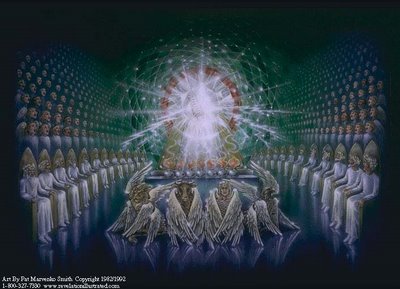
About the picture: Imagine that each dot is a set of 10,000 pages that look like this one in the image above, and that each dot on each page represents one angel. That’s a beginning. Then imagine a Google of Googles (one Google is 6.023×10^23 individuals) of such collections of 10000 pages, and well, that’s still just a beginning. Now, think about all of those angels singing with you, “Holy. Holy. Holy LORD, God of power and might. Heaven and Earth are full of your Glory! Hosanna in the Highest!…

All of us can most likely remember hearing the following passages:
 Isaiah 6:3And one called to another and said:
“Holy, holy, holy is the Lord of hosts;
the whole earth is full of his glory.”

Revelation 4:8And the four living creatures, each of them with six wings, are full of eyes all around and inside. Day and night without ceasing they sing,
“Holy, holy, holy,
the Lord God the Almighty,
    who was and is and is to come.”

Luke 2:13-1413 And suddenly there was with the angel a multitude of the heavenly host,* praising God and saying,
14 “Glory to God in the highest heaven,
    and on earth peace among those whom he favors!”

I want to share with you a lyric of a tune I wrote in 2006. It’s based on my favorite Psalm, Psalm 138. The melody is in the genre of four-part gospel harmony as you would hear from groups like The Florida Boys. Anyway, I’m trying to memorize it because it’s fun to sing. If you get a chance, look up Psalm 138 and read it for yourself. I just love the idea of standing with the angels and lifting up my hands to praise God. That’s quite a picture! So, enough of that. Here are the lyrics. Have a great weekend, beloved, and maybe you can make up your own tune for this little ditty! In my version, the chorus and the verse use the same tune, so that makes it easier to sing.

CHORUS:

In the presence of the Angels I will sing your praise.
I will lift up my hands And I will bless your holy name.
I will bow down before You And your Temple on High.
I will sing of your promises, Your faithfulness and love.

1: I know that you hear me Every time I pray.
You strengthen my heart And you get me through the day.
All of Earth’s Kings and Princes And Peoples of  all lands
Praise your Name for your Promises. They shout, and clap their hands.
And …: Chorus

2: Father, God Almighty, I live safely in your care.
The proud and the wicked You point out everywhere.
You bless the meek and lowly, And fill them with your Light.
To the fury of my enemies You lead me in my fight.
So …: Chorus

3: Though danger’s all around me, And enemies close in
Your strong right hand will save me. You are with me to the end.
Your love endures forever! You will not abandon me!
I will sing your praise forever In eternal harmony!
For …: Chorus

Did you know that when you sing praise to God, the Angels join in? They already know all the words and melodies! Next time you sing “Holy, Holy, Holy Lord, Lord God of Hosts …” listen for the angels – in particular your angel – then imagine singing with a google of googles of angels singing with you. Our Guardian Angels are right by each and every one of us as we sing our praises to God. Our Guardian Angels? Of course! In the Common Preface of the Eucharistic Prayer, the Priest says, “And so with the Angels and Archangels, with Thrones and Dominions, and with all the hosts and Powers of Heaven. We sing the hymn of your glory, as without end we acclaim: Holy, Holy, Holy Lord God of Hosts. Heaven and Earth are full of your glory. Hosanna in the highest Blesséd is He who comes in the name of the Lord. Hosanna in the highest.”

Now, Imagine you could look into that Throne Room and see THIS! 

Art used by Pat Marvenko Smith, copyright 1992, 2002. To order prints visit her “Revelation Illustrated” site, http://revelationillustrated.com. Contact us and let us know which one you need to use. If you wish to use more than one, you should purchase the 40 image CD .You will also be required to add a right-click copy protection code to each image. For use as wallpaper on your computer, just let us know which one you need. For use as a screensaver, please go here where you can get information on the new “Revelation Illustrated” screensaver program. Now, let’s pick up that asterisk in the Key Verse from Luke.
* There is a special word used to describe “the heavenly host.” That Greek word is “stratia” (στρατιά) primarily refers to an organized group of soldiers, an army, or a host. In the New Testament, it is often used metaphorically to describe the heavenly host or the angelic armies of God. The term conveys the idea of a structured and powerful force, often under divine command. In Jewish and early Christian thought, the heavenly host was seen as a divine army led by God, ready to execute His will. This imagery is rooted in the Old Testament, where God is often depicted as a warrior leading His people to victory. When we say,” God of Hosts,” that’s not limited to just the Warrior Angels of the Army of God. In that phrase, “hosts” means EVERY thing God created! From strings and quarks, and quasars to galaxies and worlds and moons, to Dick and Jane and Spot and Puff, and even you and me.

Yes! God created the universe out of Love for Love because God IS love. And God Loves you, Loves me, Loves all of us so much that he chose to include us in his Absolutely Perfect Plan! Please remember that and let it inspire your Praise when you give God the Glory.

Now, I want to share a brief look at someone who was a very unlikely hero in the history of Israel, a brave, clever, woman named Jael [Jael (/ˈdʒeɪəl/) or Yael (/ˈjeɪəl/’ Hebrew: יָעֵל Yāʿēl)]. You can find her story in the book of Judges 4-5. There we learn about Canaanite King name Jabin from the region of Galilee who harassed and oppressed Israel for 20 years. His commander-in-chief was a general f his army whose name as Sisera. Also at that time there was a prophetess named Deborah who told the leader of Israel’s forces, Barak, that on a certain day, God would deliver Isreal from Jabin. Barak was to take 10,000 soldiers and attack Sisera’s forces from a position on Mount Tabor. Barak won a decisive battle, but Sisera jumped out of his iron war-chariot and slipped away. All of his subordinates were slain by Barak.

Sisera ran away on foot to Kedesh, which was west of the Sea of Galilee. Jael saw him – and of course she recognized him because he’d been around for so many years causing trouble – and she invited him to hide in the tent of her husband, Heber the Kenite. The Kenites were decedents of Moses’ father-in-law (Jethro). Heber’s clan had separated from the territory of the Kenites and had negotiated a treaty with the enemy king, Jabin. Sisera apparently knew this and felt safe to hide in that tent. Jael gave him a skin of milk when he asked for something to quench his thirst. He was worn out from the battle and wanted to rest, so Jael covered him with a rug or a blanket by which he apparently felt she was concealing him. He eventually fell asleep, and as he slept, Jael picked up a tent peg and – hammered it through his temple, right through his head, and straight into the ground!

Soon thereafter, Barak, the Israelite commander came to that area looking for Sisera. Jael went out to meet him and told him to come see where Sisera could be found. In Judges 4:23 we read – 23 So on that day God subdued King Jabin of Canaan before the Israelites. Chapter 5 of Judges is the Song (canticle) of Deborah celebrating the act of Jael and the end of Jabin’s oppressions. That glorious song ends in Judges 5:31 –
31 “So perish all your enemies, O Lord!
    But may your friends be like the sun as it rises in its might.”

This clever, brave woman, Jael, was not a warrior, not a leader in Israel, her husband was a collaborator with their enemy, and yet God chose her to deliver Israel from their oppressor. He chose to prepare her for that brave act in the same moment he said “Let there be …” in the same way that he chose to create you and me – because of Love. Because of Love, he also sent his Only Begotten Son to suffer and die for the sins of the World which is supposed to be part of the Hosts of God and should be praising him forever. When sin entered into our history, God’s Love was nailed to the Cross to end the oppression of the Devil; that oppression is sin and Death. That is the magnitude and majesty of God’s Grace. In §388 the CCC shows us, “We must know Christ as the source of grace in order to know Adam as the source of sin. The Spirit-Paraclete, sent by the risen Christ, came to “convict the world concerning sin” by revealing him who is its Redeemer.” (↔ Music Link)

Will you, will I, will we be willing to be like Jael – an unlikely choice for an important job – and live according to God’s Absolutely Perfect Plan and not our own? Remember, sin is rebellion against God. We sin when our actions say, “God I know what you want, but I don’t want that. I want what I want.” Are we willing to do all that we ought to do instead of all that we can do? Can we, will we give Primacy to our Creator instead of his creation? Will we say, “God my Father, I want what you want, and only what you want.”? Jael, Deborah, and Barak did what God wanted. Sisera didn’t. perhaps next week we can look into the actions of Judith.

Whatever, whenever, wherever, whoever, however, if ever, forever —
at your service, Belovéd!

 Please pray with us here at Share-a-Prayer.

Unless otherwise indicated, all scripture passages are from the New Revised Standard Version Catholic Edition (NRSVCE) New Revised Standard Version Bible: Catholic Edition, copyright © 1989, 1993 the Division of Christian Education of the National Council of the Churches of Christ in the United States of America. Used by permission. All rights reserved.

Biblical languages inserts from Bible Hub (Bible Hub: Search, Read, Study the Bible in Many Languages) Visit at http://biblehub.com


Creative Commons License Aloha Friday Messages by Charles O. Todd, III is licensed under a Creative Commons Attribution-ShareAlike 3.0 Unported License

Aloha Friday Message – January 31, 2025 – Step Up and Stand Out

2505AFC013125 – Step Up and Stand Out 😀 ← PODCAST LINK  

Read it online here, please. And please – when you visit there – use one of the social media links at the bottom of the page to share this post. Thank you! And remember, we now have a READER VIEW available, so share this link or this email often.
Do you know someone who enjoys Bible study, or who might like to read this? Ask them to email us or to subscribe on our blog-site.

Luke 2:29-32Now, Master, you may let your servant go in peace, according to your word; 30 for my eyes have seen your salvation, 31 which you have prepared in the presence of all peoples, 32 a light for revelation to the Gentiles and for glory to your people Israel.”

(↨ Music Link – let your servant go in peace)

Aloha nui loa, ʻŌmea! ¡Que la bendición esté siempre con ustedes y que Dios los bendiga, Amados! (May blessing always be with you and may God bless you, Belovéd!) Let the Peace of Christ Rule in Our Hearts! (↔ Music Link) Today’s Key Verse is one of the most beautiful prayers in the New Testament. It is the prayer of Simeon. Luke tells us (beginning at Luke 2:2525 Now there was a man in Jerusalem whose name was Simeon; this man was righteous and devout, looking forward to the consolation of Israel, and the Holy Spirit rested on him. 26 It had been revealed to him by the Holy Spirit that he would not see death before he had seen the Lord’s Messiah. 27 Guided by the Spirit, Simeon came into the temple; and when the parents brought in the child Jesus, to do for him what was customary under the law, 28 Simeon took him in his arms and praised God …

Presentation of The Lord

  We see that Simeon, in Hebrew “Shimown” [shim-one’} a name that means “hearing,” is a “righteous and devout man.” He was careful about observing divine laws, a virtuous man who faithfully and consistently kept God’s commandments. He was a pious man who took care to reverence God and the Temple in Jerusalem. Most importantly we are told, “The Holy Spirit rested on him.” Like the Old Testament prophets, he was “enveloped” in the Holy Spirit – remember how we discussed that when David was anointed King by Samuel, “the spirit of the Lord came mightily upon David from that day forward.” (See 1 Samuel 16:13) This is how the presence of the Holy Spirit is described in the Old Testament prophecies; the Holy Spirit “rushed upon” the Prophet and helped them or led them to do a specific task. After Jesus sent us the Holy Spirit at the first Pentecost, we know the Holy Spirit dwells within us – permanently!

Simeon had been waiting for “the consolation of Israel” – the coming of the Messiah. Walking in, and led by, the Spirit, Simeon glimpses Joseph, Jesus, and Mary. In his heart and mind, the Holy Spirit reveals that the child with this couple is indeed “the Holy One of Israel.” Rejoicing in the Spirit, he gives us the canticle (song) that confirms God’s promise that Simeon would not die until he had seen the Messiah. He takes the child in his arms, and speaks as the Holy Spirit directs prophesying that Jesus is the “consolation of Israel,” and later he tells Jesus’ Blesséd Mother Mary that she will suffer great anguish as her son fulfills his mission. This is followed by statements from the prophetess Anna who tells everyone who is nearby that this child will be a fulfillment of Isaiah’s prophecy that “… the LORD has comforted his people, has redeemed Jerusalem.” (See Isaiah 52:9) All of these people are present in this scene because Mary and Joseph are following the prescription of the law. That prescription portrays this little family as devout, faithful Jews who rightly were faithful to the Law set down by God through Moses. Please see Leviticus 12:2-8 for the full description of these requirements. There you will see that there were very specific instructions provided for new parents. Today, we focus on two principal themes in Scripture – Obedience and Blessing. We will look first at The Holy Family and this encounter in the temple, and then we will hear about Nahshon, our “person of the week.”

Let’s recap the timeline a little. Luke 2:21-24Jesus Is Named 21 After eight days had passed, it was time to circumcise the child; and he was called Jesus, the name given by the angel before he was conceived in the womb.
Jesus Is Presented in the Temple 22 When the time came for their purification according to the law of Moses, they brought him up to Jerusalem to present him to the Lord 23 (as it is written in the law of the Lord, “Every firstborn male shall be designated as holy to the Lord”), 24 and they offered a sacrifice according to what is stated in the law of the Lord, “a pair of turtledoves or two young pigeons.” We recall the word of Exodus 13:2Consecrate to me all the firstborn; whatever is the first to open the womb among the Israelites, of human beings and animals, is mine. And also Numbers 6:10 and Leviticus 15:1414 On the eighth day he shall take two turtledoves or two pigeons and come before the Lord to the entrance of the tent of meeting and give them to the priest. This is the “legal remedy” for purifying a person after becoming ceremonially unclean – that is, unable to participate in or touch anything that is Holy.

The remedy for a woman after giving birth is spelled out in Leviticus 12. In that passage, a woman is unclean for 40 days after the birth of a male child and 80 days after the birth of a female child. The purification requires the sacrifice of “a lamb in its first year for a burnt offering, and a pigeon or a turtledove for a sin offering.” At the end of that passage, there is an additional instruction for those who cannot afford to bring a lamb. We read in Leviticus 12:8If she cannot afford a sheep, she shall take two turtledoves or two pigeons, one for a burnt offering and the other for a sin offering; and the priest shall make atonement on her behalf, and she shall be clean. And sot it was that that Lamb of God and his Mother were redeemed out of poverty and the status of being unclean.

In our Gospel passage for this weekend, Joseph and Mary comply with all the laws and prescriptions for a firstborn male child. They did what was right and just in the eyes of the Lord, and it was the fulfillment of righteousness. Recall that is how Jesus convinced John the Baptizer to baptize him. As a refresher, here is Matthew 3:1515 But Jesus answered him, “Let it be so now; for it is proper for us in this way to fulfill all righteousness.” Then he consented. The whole episode boils down to obedience. God says, “Do whatever I tell you.” Good people say “yes.” Righteous people say YES and OBEY. Joseph and Mary did that. Simeon waited until the Lord said “Look over here!” Anna obeyed when God said, “Spread the Word.” And – according to Tradition, Nashon was not only quick to obey, but also courageous. Who was this guy, and why is he important?

נַחְשׁוֹן {Nachshown} (nakh-shone’) was a leader, i.e., a Prince, of the Tribe of Judah. We must remember that the word Judah means Praise, and God told Moses to always “Let Praise go up first.” When Israel was finally able to enter into the Promised Land. Judah went first, and Nashon led them in (more on that shortly. He was the first to make an offering for the dedication of the Tabernacle. He was one of the 70 Elders to whom God gave a portion of his Sh’khinah Glory which he had poured out on Moses: Numbers 11:17 – [God told Moses] 17 I will come down and talk with you there; and I will take some of the spirit that is on you and put it on them; and they shall bear the burden of the people along with you so that you will not bear it all by yourself. He was a courageous, Holy leader who led by example. He was also a brother-in-law to Aaron (Moses’ brother, and the first High Priest) who married his sister, Elisheva. He was a descendant of Jacob’s son Judah. As such, he is listed in the genealogies of Jesus in Ruth 4:18-22, Matthew 1, and Luke 3:23-38 (↔ Learning Links). We’ve all heard his name in those readings, but probably never given it a second thought (which is why I picked him for today!)  

There’s a famous story (↔ Learning Link)  about him in Jewish homiletical (Rabbinical teachings) literature. When it came time to cross the Red Sea (or Sea of Reeds), the waters were still raging and waves splashing. Moses had told them God would have them cross at that shore. Everyone hesitated to step up and step out into the Sea … every except Nahshon. According to the Midrash (↔ VERY COOL Learning Link), Nahshon dove into the water because he was certain God’s plan would be revealed. At that act of Faith, the Lord told Moses to stretch his arm hold his staff over the Sea and then God divided tha water to Israel cross over on dry land (and none of Pharoah’s army, or chariots, or charioteers ever got out of the water after the Sea closed).

Nashon always stepped up and stood out because he always had faith in God. God had personally anointed him with the Glory of God. Simeon was described as “this man was righteous and devout, looking forward to the consolation of Israel, and the Holy Spirit rested on him.” With God, there are no coincidences, so it is no surprise that his Holy Spirit was paramount in their lives, and that Simeon stepped up and stood out for his prophetic declarations about the Infant Jesus. Same goes for the prophetess Anna.  Who “never left the temple but worshiped there with fasting and prayer night and day.” At age 84, she began to tell everyone about the wonderful baby boy she had just met. Anna stepped up and stood out as one of the very first evangelists. Mary and Joseph stepped up and stood out by saying YES to God. All of them knew in their hearts that God was asking them to take the first next-step-to-Glory (↔ Music Link) in his Absolutely Perfect Plan. And what is that next step? Why, it’s belonging to Jesus! (↔ Music Link)

And here we must all ask ourselves if our hearts are telling us to Step Up and Stand Out for the Lord. Are we really, really ready to lead by example and be the first – or the next, or even the final – witness to God’s APP in his revelation of his Only Begotten Son? Let us ask the Lord pour out his Holy Spirit on each of us and all of us across this wonderful Land that we Love (↔ Music Link). We could use a little more of HIS Holy Spirit and that good, Old-Fashioned American spirit! (↔ Music Link)

Whatever, whenever, wherever, whoever, however, if ever, forever —
at your service, Belovéd!

Please pray with us here at Share-a-Prayer.

Thank you Brendan.

Unless otherwise indicated, all scripture passages are from the New Revised Standard Version Catholic Edition (NRSVCE) New Revised Standard Version Bible: Catholic Edition, copyright © 1989, 1993 the Division of Christian Education of the National Council of the Churches of Christ in the United States of America. Used by permission. All rights reserved.

Biblical languages inserts from Bible Hub (Bible Hub: Search, Read, Study the Bible in Many Languages) Visit at http://biblehub.com

Creative Commons License Aloha Friday Messages by Charles O. Todd, III is licensed under a Creative Commons Attribution-ShareAlike 3.0 Unported License >

Aloha Friday Message – January 24, 2025 – A Promise is a promise!

2504AFC012425 – A Promise is a promise! 😀 ← PODCAST LINK  

Read it online here, please. And please – when you visit there – use one of the social media links at the bottom of the page to share this post. Thank you! And remember, we now have a READER VIEW available, so share this link or this email often.

Do you know someone who enjoys Bible study, or who might like to read this? Ask them to email us or to subscribe on our blog-site.

Luke 4:14-15 14 Then Jesus, filled with the power of the Spirit, returned to Galilee, and a report about him spread through all the surrounding country. 15 He began to teach in their synagogues and was praised by everyone.

Aloha nui loa, ʻŌmea! Grace and Peace to each of you from God our Father and our Lord, Jesus the Christ, in the Power of the Holy Spirit. Today’s key verse is from the Gospel reading for the Third Sunday in Ordinary Time. In this passage, we see that – at the beginning of his ministry – Jesus was “knockin’ it outta the park.” He has returned to his home town, Nazareth. He got up to read from the Scroll of the Prophet Isaiah “where he had grown up, and went according to his custom into the synagogue on the Sabbath day.” Here is that passage for your inspection:

Luke 4:16-21 16 When he came to Nazareth, where he had been brought up, he went to the synagogue on the Sabbath day, as was his custom. He stood up to read, 17 and the scroll of the prophet Isaiah was given to him. He unrolled the scroll and found the place where it was written:

 18 “The Spirit of the Lord is upon me,
    because he has anointed me
        to bring good news to the poor.
He has sent me to proclaim release to the captives
    and recovery of sight to the blind,
        to let the oppressed go free,
19 to proclaim the year of the Lord’s favor.”

20 And he rolled up the scroll, gave it back to the attendant, and sat down. The eyes of all in the synagogue were fixed on him. 21 Then he began to say to them, “Today this scripture has been fulfilled in your hearing.”

This is what Jesus read from that scroll:

Isaiah 61:1-2 a (GNT) [1] 1 The spirit of the Lord God is upon me, because the Lord has anointed me;
he has sent me to bring good news to the oppressed, to bind up the brokenhearted,
to proclaim liberty to the captives, and release to the prisoners;
to proclaim the year of the Lord’s favor …

What promise was fulfilled in their presence? The covenant Promise of a Savior. There are successive covenant expansions, but only One Promise supported by every step in the covenantal progression: A Saviour will restore us into the presence of God. Now that I am an Old Man, I find that my patience for many things is either waning or missing altogether. I know and understand that this One Promise is the warp and weave of the whole fabric of my life. You’ve seen this phrase in many of these posts: Maran atha! Marana tha! Our Lord has come! Come Lord! This happens whenever I forget the best lesson I learned in Navajo Country. Wait patiently in patient waiting.           Huh? Here’s what I mean:

Hebrews 6:15 15 And thus Abraham, having patiently endured, obtained the promise.

James 5:7-8 Be patient, therefore, belovéd, until the coming of the Lord. The farmer waits for the precious crop from the earth, being patient with it until it receives the early and the late rains. You also must be patient. Strengthen your hearts, for the coming of the Lord is near.

2 Peter 3:3-9 First of all you must understand this, that in the last days scoffers will come, scoffing and indulging their own lusts and saying, “Where is the promise of his coming? For ever since our ancestors died, all things continue as they were from the beginning of creation!” They deliberately ignore this fact, that by the word of God heavens existed long ago and an earth was formed out of water and by means of water, through which the world of that time was deluged with water and perished. But by the same word the present heavens and earth have been reserved for fire, being kept until the day of judgment and destruction of the godless.

   But do not ignore this one fact, beloved, that with the Lord one day is like a thousand years, and a thousand years are like one day. The Lord is not slow about his promise, as some think of slowness, but is patient with you*, not wanting any to perish, but all to come to repentance. * Some translations read “on your account,” or “for your sake” and YES, he is coming back! As far as we know Jesus and his Mother were the last persons to be bodily taken up into Heaven. Have you any idea who was the first? Here’s a clue. The first time we hear about him is in Genesis 5:18-2418 When Jared had lived one hundred sixty-two years he became the father of Enoch. 19 Jared lived after the birth of Enoch eight hundred years, and had other sons and daughters. 20 Thus all the days of Jared were nine hundred sixty-two years; and he died.
21 When Enoch had lived sixty-five years, he became the father of Methuselah. 22 Enoch walked with God after the birth of Methuselah three hundred years, and had other sons and daughters. 23 Thus all the days of Enoch were three hundred sixty-five years. 24 Enoch walked with God; then he was no more, because God took him.

Enoch was also the name of a son of Cain (See Genesis 4:17-18). The name “Enoch” occurs about 14 times in the Bible (depending on which translation your consult; we use the NRSVCE) [i] Here is a quick list (without hyperlinks): Genesis 4:17, Genesis 4:18, Genesis 5:18, Genesis 5:19, Genesis 5:21, Genesis 5:22, Genesis 5:23, Genesis 5:24, 1 Corinthians 1:3, Sirach 44:16, Sirach 49:18, Luke 3:37, Hebrews 11:5, and Jude 1:14. The references in the New Testament are particularly important as they refer to Enoch the son of Jared who was of the sixth generation from Adam through the line of Seth, Adam’s third son. The name Seth means “compensation.” Eve named him that because he was “compensation for the los of Abel whom Cain had murdered. That’s is where Enoch fits into the Bible timeline. Now, why is he the Person of the Week?

Take another look at the last verse in that passage from Genesis 5. Enoch walked with God; then he was no more, because God took him. In several of the passages from Genesis in the above list, Enoch is described as on who “walked with the Lord.” You might recall a couple who did that a few generations previously: Eve and Adam. In Genesis 3:8, we read that Adam and Eve “heard the sound of the Lord God walking in the garden at the time of the evening breeze” and we infer from that that God visited them in Eden before they chose to rebel against his command to not eat of that forbidden fruit. (Remember: The Fruit of the Tree of the Knowledge of Good and Evil is Free Will which allows us to choose Life of Death.) Enoch ben Jared pleased God and intimately walked with him. In Hebrews 11:5 The Apostle Paul tells us, For it was attested before he was taken away that “he had pleased God.” God did not walk with Eve and Adam after they sinned but there is speculation that he did. Enoch walked with God, that is was obedient and reverent and always in God’s presence. He was taken up and was not found again. Nor has he returned to this Earth.

We should also be aware that there is an apocryphal “Book of Enoch” which was a very popular and well-known sort of reference book in the time of Jesus. It contains many inconsistencies, a lot of questionable prophesies, and is excluded from the canonical collections of nearly all 23 Rites in union with the Roman Catholic Church except for the Coptic Rite. The references to Enoch in the Epistles refer to that well-know document, however those references do NOT recommend its inclusion in Church Liturgy or the Canon of Scripture. It is used as an example to illustrate and to strengthen his argument against false teaching – heresy – and not as an endorsement of the content. It would be like referring to Grimm’s Fairy Tales and the Story of Faithful John (↔ Learning Link)  as a reference for losing everything to gain enduring happiness when all is returned.

Now, what is the connection between today’s Key Verse and the information about Enoch? It is the Promise. Enoch made his life a persistent and continuous (↔ Music Link) Gift to God and – and as example to all who aspire to join Our Father in Heaven – God demonstrates that he gathers up those you love justice, show mercy, and walk humbly before him (yup. Micah 6:8 – AGAIN!) will ultimately get to meet Enoch (and a handful of other “translated” folks) in Heaven. (↔ Music Link)This is the Jubilee Year of Hope, and that Hope of Heaven is too good to pass up. “As for me and my house” we’re gonna try to walk with God (↔ Music Link). Can I get and AMEN there?

Whatever, whenever, wherever, whoever, however, if ever, forever —
at your service, Belovéd!

Please pray with us here at Share-a-Prayer.

Unless otherwise indicated, all scripture passages are from the New Revised Standard Version Catholic Edition (NRSVCE) New Revised Standard Version Bible: Catholic Edition, copyright © 1989, 1993 the Division of Christian Education of the National Council of the Churches of Christ in the United States of America. Used by permission. All rights reserved.

Biblical languages inserts from Bible Hub (Bible Hub: Search, Read, Study the Bible in Many Languages) Visit at http://biblehub.com

Creative Commons License
Aloha Friday Messages by Charles O. Todd, III is licensed under a Creative Commons Attribution-ShareAlike 3.0 Unported License


[i] New Revised Standard Version Catholic Edition (NRSVCE) New Revised Standard Version Bible: Catholic Edition, copyright © 1989, 1993 the Division of Christian Education of the National Council of the Churches of Christ in the United States of America. Used by permission. All rights reserved.


[1] Passages marked (GNT): Good News Translation (GNT) are from the Good News Translation® (Today’s English Version, Second Edition)© 1992 American Bible Society. All rights reserved. For more information about GNT, visit www.bibles.com and www.gnt.bible.

Aloha Friday Message – January 17, 2025 – The First of Many

2503AFC011725 – The First of Many  😀 ← PODCAST LINK

Read it online here, please. And please – when you visit there – use one of the social media links at the bottom of the page to share this post. Thank you! And remember, we now have a READER VIEW available, so share this link or this email often.
Do you know someone who enjoys Bible study, or who might like to read this? Ask them to email us or to subscribe on our blog-site.

 John 2:5, 11 His mother said to the servants, “Do whatever he tells you.” 11 Jesus did this, the first of his signs, in Cana of Galilee, and revealed his glory; and his disciples believed in him.

Aloha nui loa, ʻŌmea! Today we take a few moments to look at Jesus’ first recorded miracle at the Wedding Feast at Cana in Galilee. It is the conversion of water to wine (↔ Music Link) – and not just a glass or two of wine! John tells us “Now there were six stone water jars there for Jewish ceremonial washings, each holding twenty to thirty gallons.

The Greek word used here makes this measure quite impressive. The word is μετρητής (metrétés) {met-ray-tace’} – a measure equivalent to about 39.39 liters or 8.75 gallons. The Authorized (King James) Version (AKJV) describes the jars as “containing two or three firkins apiece.” What’s a firkin? A “firkin” in terms of size, is equal to 9 imperial gallons, which is 10.8 US gallons; 2-3 firkins then would be 21.6 to 31.8 gallons and average of 26.7 gallons. SIX of those would come to just over 160 gallons of first-class wine! When Jesus sent the servants to the wine, the headwaiter was amazed at the quality. Not only had Jesus supplied in quantity, but also in quality! That is how he does everything when we do what he tells us. And there’s something else, too. He used just simple things even at a BIG wedding.

Do whatever he tells you.

 The wedding was nearby Capernaum where Jesus and his family and disciples had moved after he started his ministry. (See Matthew 9:1 and Mark 2:1) His mom had just said, “They are out of wine.” And Jesus said to her, “Woman, how does your concern affect me? My hour has not yet come.” He called her אִשָּׁה (ishshah) {ish-shaw’} – woman, as the first Adam had called Eve. (See Genesis 2:23 23 Then the man said, “This at last is bone of my bones and flesh of my flesh; this one shall be called Woman [אִשָּׁה] for out of Man [אִישׁ] this one was taken.” It was a respectful way to address his Mother. Simple questions are wonderful when followed by simple words and simple actions. “Do whatever he tells you.” The servants did what servants do – they served by obeying. They had simple things around them – stone jars, water nearby, and they fetched it. They topped off the stone jars as told in the simple command, “Fill the jars with water.” They filled them to the brim – they did their part to the best of their ability. Then Jesus did his part to the best of his ability – and the miracle happened. He made 160 gallons of water into 160 gallons of wine. (We don’t know if it was Chablis or Merlot – or even what color or taste it had – because that is unimportant.) Ordinary things done in ordinary ways become extraordinary when we do what he tells us.

Jesus’ first miracle – the first of many, many, many – took place at the uniting of a man and woman in matrimony as God intended, and still intends, from Eden to this very moment. It began with water, the same way that Creation began. Jesus’ Presence changed the water to something new and better. We can experience the change to new and better if we only respond as he did to the words, “Do whatever he tells you.” That brings us to the story of someone else who did whatever God told him – except a couple of times when he did not, and we are still paying for that today. His name was אַבְרָם Avrahm – Abram – and later he became “My Old Friend Abraham.”

We first come across that name in Genesis 11:2626 And Terah lived seventy years, and begat Abram, Nahor, and Haran. Terah was a direct descendant of Shem, one of the sons of Noah. The following verse, verse 28, tells us that Abram’s younger brother, Haran, died early in his birthplace – “Ur of the Chaldees.” Abraham started off as Abram, a princely warrior from “Ur of the Chaldees.” The Bible puts him 12 generations from Adam, and 10 generations from Noah. God told him to get up and move across a vast distance to a land God would show him, and give to his descendants, a land where he would become the father of many nations. He did whatever God told him. In Genesis 17:1, God revealed he was El Shaddai – Almighty God, and told Abram to walk before (as in front of) and to always do what is right. Please read that passage to get the context. (Yep. First occurrence of “Do the right thing.” Check it out!). Soon thereafter, he entered into a covenant with God and throughout his remaining life he did some pretty amazing things. One of the things God called upon him to do was to sacrifice his belovéd son Isaac. Most of us remember the story.

God told Abraham to take Isaac to the top of a distant mountain. Isaac was to carry the wood for the burnt offering. Abraham prepared the altar, bound Isaac, and was prepared to kill him there. His reasoning was that God had promised him he would be the father of many nations; that God could be trusted to keep his promise; that even though it made no worldly sense to kill his son and his progeny, God would provide a way to keep his promise. As Abraham raised the knife to take Isaac’s life, a messenger of God told him to stop. He had proved his faith. Another suitable sacrifice was provided – a ram caught by its horns in a thicket. Isaac was redeemed, God’s promise was kept intact, and Abraham was ready for the next action God would request.

How could Abraham do that?! How did he have so much faith in God? How in the world was he prepared to take his own son’s life? And there we have it, the word that sets Abraham apart from us: Prepared. Abraham was prepared to “Do whatever he tells you.” What is the nature of that preparation? Did you read that passage I just asked you to read? It ends with “walk before me, and be blameless.” Does that sound familiar? Check this out:

  • MATTHEW 5:48 So be perfect, just as your heavenly Father is perfect.
  • LXX (English) Leviticus 19:2 Speak to the congregation of the children of Israel, and thou shalt say to them, “Ye shall be holy; for I the Lord your God am holy.”
  • Leviticus 20:7 — So set yourselves apart to be holy, for I am the LORD your God.
  • AKJV Deuteronomy 18:13 Thou shalt be perfect with the LORD thy God.
  • NIV Luke 6:36 – Be merciful, just as your Father is merciful
  • NJB 1 Peter 1:16 since scripture says, ‘Be holy, for I am holy.’

Our sinful nature insists that we can do what we want to do, and then looks to our imagination to see what our inclinations might be. As we all well know, that is the wrong reference source. When we look to our own imaginations, we confirm what God first stated when he saw how utterly wrong and confused. We see it in Genesis 6:5The Lord saw that the wickedness of humankind was great in the earth, and that every inclination of the thoughts of their hearts was only evil continually. How? How can we change that: hark to the Word!

  • Ecclesiastes 10:2 The heart of the wise inclines to the right, but the heart of a fool to the left.
  • Isaiah 30:21 21 And when you turn to the right or when you turn to the left, your ears shall hear a word behind you, saying, “This is the way; walk in it.”
  • Jeremiah 6:16 16 Thus says the Lord: Stand at the crossroads, and look, and ask for the ancient paths, where the good way lies; and walk in it, and find rest for your souls.
    But they said, “We will not walk in it.”
  • Matthew 17:5 While he was still speaking, suddenly a bright cloud overshadowed them, and from the cloud a voice said, “This is my Son, the Beloved; with him I am well pleased; listen to him!”

See that design up by the Key Verse? Each line is made of thousands and thousands of points. Each space has room for thousands of more lines. You may recall that in the New Testament, the Greek word usually translated ”many” (pollōn) (↔ Learning Link) actually means multitudes. If we look at the design, it draws one’s eyes to the center. Think about that being Ur of the Chaldees and the origin of Abram’s journeys, then think about the multitudes and multitudes of souls descended from Abraham, Isaac, and Jacob. Abraham’s children were the first of multitudes of offspring; 160 gallons of wine was the first of multitudes of miracles. That Key Verse symbol is emblematic of the many Miracles Jesus performed which all started with 6 ceremonial stone jars brimming with abundant and exceptional blessings from the Lord of the Universe. That’s how God does things – the biggest and the best from the lowliest and least. All of that comes to us in the Life he gives. Our God-given Life is the First of Many Blessings, Healings, Miracles, Answers, Joys, … well, you get the idea. All because we choose to do whatever he says. Amen.

And here’s something the cogitate with: Sum up the Bible and ALL of history in a single word.

That Word is

Whatever, whenever, wherever, whoever, however, if ever, forever —
at your service, Belovéd!

 Please pray with us here at Share-a-Prayer.

Unless otherwise indicated, all scripture passages are from the New Revised Standard Version Catholic Edition (NRSVCE) New Revised Standard Version Bible: Catholic Edition, copyright © 1989, 1993 the Division of Christian Education of the National Council of the Churches of Christ in the United States of America. Used by permission. All rights reserved.

Biblical languages inserts from Bible Hub (Bible Hub: Search, Read, Study the Bible in Many Languages) Visit at http://biblehub.com

Creative Commons License
Aloha Friday Messages by Charles O. Todd, III is licensed under a Creative Commons Attribution-ShareAlike 3.0 Unported License

Aloha Friday Message – January 10, 2025 – “Y” is for YES

2502AFC011025 – “Y” is for YES 😀 ← PODCAST LINK   Read it online here, please. And please, when you visit there, use one of the social media links at the bottom of the page to share this post. Thank you! And remember, we now have a READER VIEW available, so share this link or this email often.

 Matthew 3:15 15 But Jesus answered him, “Let it be so now; for it is proper for us in this way*to fulfill all righteousness.” Then he consented.οὕτω[ς] (houtō and houtós) {hoo’-to[s]} like this |__| ; in this manner, in this way (fashion), in accordance with this description (i.e. corresponding to what follows); in keeping with; along this line, in the manner spoken; in this way, thus(ly)

Aloha nui loa, ʻŌmea! Grace and Peace to each of you from God our Father and our Lord, Jesus the Christ, in the Power of the Holy Spirit. This coming Sunday, many churches around the world will be celebrating The Baptism of The Lord. Sometimes this event gets confused with other events in Jesus’ life. Some folks think it has something to do with last week’s celebration of the Epiphany. Some think it might be concurrent with the visit to the Temple at the Purification of Mary. A few believe it happened when Jesus was an adult, and they are right. Just for the sake of clarity, let’s look at a timeline based on what we read in the synoptic Gospels. Remember, there are no precise dates given there, so everything happened “around [this year].” Here is a sequence of some of the important events before Jesus started his ministry:

  • Birth – At Bethlehem during the lambing season
  • Circumcision – eight days later
  • Presentation – on the fortieth day after birth – Purification of Mary and Jesus’ presentation at Jerusalem
  • Visitation of the Magi – Jesus was not yet two years old
  • Massacre of all male infants under age 2 “in and around Bethlehem”
  • Flight to Egypt – around age 2
  • Herod the Great dies – Jesus is around age 4, and then
    • Herod Archelaus {ar-khel’-ah-os} takes over Judaea, Idumaea, and Samaria
    • Herod Antipas takes over Galilee and Peraea
    • The non-Jewish areas (except Samaria) were assigned to a third son, Philip, to Herod’s sister Salome, or to the province of Syria
  • Joseph is counseled by an angel that it is safe to return home
  • The Holy Family settles in Nazareth to avoid living in the territory ruled by Archelaus – Jesus is perhaps age 5
  • Lost at the Temple – around age 12
  • John the Baptist and Jesus begin their ministries around 27-30 AD. No precise date is known
  • John BAPTIZES JESUS
  • John proclaims Jesus is “the Lamb of God.”
  • Jesus retreats to the desert for 40 days of preparation and temptation (See Mark 1:12-13)
  • Jesus calls Andrew, Peter, Phillip, and Nathanael as Apostles
  • Wedding at Cana and Jesus begins baptizing, preaching, and teaching.

 Now, another thing that brings us to wonder “why did he do that?” is Jesus’ insistence that John baptize him. After all, he is the Messiah- the King of Glory! – at whose name every knee shall bow, (↔ Music Link) and John knows that. He is The Son of God, and both Jesus and John know that, too. So how can a mere man who is unworthy to carry Jesus’ sandals (or tie or untie them), a man sent as a Prophet in the Spirit of Elijah, or a man who is lesser because he is mortal and his cousin is immortal having existed since before creation and who was present at Creation – how can this mortal man we worthy to Baptize the sinless Son of God as a sign of righteousness? Jesus in effect tells him, “This is the way Dad wants it done, so let’s just do it.” The key to understanding that well is in that little phrase in this way

I’ll put that note about our Key Verse here for us to use again: οὕτω[ς] (houtō and houtós) {hoo’-to[s]} like this. . .; in this manner, in this way (fashion), in accordance with this description (i.e. corresponding to what follows); in keeping with; along this line, in the manner spoken; in this way, thus(ly). To what does “thusly” or “in this way” refer? The answer to that question will help us understand why Jesus insisted on John’s cooperation: The importance of a spirit of obedient submission to the will of The Father. “We need to do this together. Both of us need to do what God is expecting of us. It is the proper thing to do to complete every aspect of righteousness. Your responsibility is to baptize. My responsibility is to let you.”

We want to remember that when it comes to salvation, our responsibility is to believe God – not just believe in him – actually believe what he says; he will redeem us. We must let God BE God. This is a hard lesson to learn. The Being who forgot it first was Lucifer. Don’t be like Lucifer. Remember: God is God. We are not. It takes humility to remember that. Humility is another tough lesson (which led to the downfall of that other guy, right?) But, we have an example of humility that is absolutely extraordinary, and that  brings us to the Person of the Week – Our Mother, Mary. (↔ Music Link)

As with Jesus’ timeline, we don’t have any particular dates for Mary’s life. Tradition relates that she was the child of Joachim and Anne. This information is not in the Canon of the Bible, but appears about 150 years after Jesus’ time in the noncanonical Gospel of James. Sacred Tradition discloses that she was an obedient child filled with Love and Reverence for God. We can gain some insight into the life of Mary by looking at her name and the names of her ancestors.

The name ”Mary” is derived from the Hebrew name Miriam. Now, we know that the New Testament is hidden in the Old Testament and the Old Testament is revealed in the New Testament. Who was Miriam in the Old Testament?

  • She was the daughter of Jochebed (her name means “Jehovah is glory”) and Amram (his name means “exalted people”)
  • She was the eldest of three children born in Egypt to this couple. Her brothers were Moses (his name means “drawn forth”) and Aaron (his name possibly means  “light bringer” or “Mountain of strength,” however, the derivation is uncertain)
  • The name Miriam comes from the Hebrew word for bitter – mar (masc.) or marah (fem). (See Exodus 15:20-27) Miriam and Aaron challenged Moses’ authority to prophesy. This act of rebellion caused the Lord to meet directly with the three siblings, to ratify Moses’ authority, and to cause Miriam to receive leprose-looking skin.
    • The name Miriam is translatable as “rebellion,” or “bitterness.” More on this momentarily.

The name “Mary” was a fairly common name in Jesus’ time. There are several women in the Bible with that name:
Mary: (1) mother of Jesus; (2) the younger sister of Martha and Lazarus; (3) Mary Magdalene “The Apostle to the Apostles;” (4) the mother of James and Joseph; (5) the wife of Clzopas (John 19:25); (6) mother of John Mark (Acts 12:12); (7) an otherwise unidentified Christian greeted by The Apostle Paul in Romans 16:6

Now, if we look back at these names and consider others like Abram and Abraham (future features), we see it is true that often a person’s names hinted at their destiny and personality. Yet, this does not seem to be the case with Μαρία or Μαριάμ as is her name in Greek in the New Testament. In fact, she is the precise and literal opposite of rebellion.
Because, why?
Well, I have not seen this in the Apostolic or Nicene Creeds, the Catechism of the Catholic Church, or any other authoritative source. This is just my puny little opinion which helps me gain a deeper appreciation of Mary’s importance as an Exemplar (Paradigm, Archetype, Ideal) in Scripture.

  •  Now, if Mary is derived from the name Miriam which means bitterness and/or rebellion (after the rebellion after the place Massah, and Meribah where the people grumbled bitterly about God), how does that name apply in the Annunciation?
  • When the Angel Gabriel spoke to Mary, her response was an unconditional YES as she willingly and completely submitted to God’s will without bitterness or rebellion.  Rebellion was overcome by obedience. Disillusionment was overcome by joy. Death was overcome by life. Darkness was overcome by light, and doubt was overcome by faith in a simple “yes.”
  • Her reverence for God and her impeccable humility allowed her to completely surrender to great risks – the possibility f divorce, a trial. Possibly even death by stoning! Like our Old Friend Abraham, she reasoned that God could be trusted to do what he said. Abraham believed God could complete his covenant with him even if he sacrificed his son. Mary believed she could bear a child who would be called AND ACTUALLY BE the Only Begotten Son of God.
  • Thus, “rebellion” was “overcome” by OBEDIENCE out of Grace-based Love of the Father. Indeed we can and should echo Gabriel’s greeting “Hail full of Grace!(↔ Music Link)

Mary’s Son, Jesus, the Only Begotten Son of God, also showed us complete and entire surrender through the Grace of Absolute Faith and acceptance of the Will of God. At his Baptism by John the Baptizer, Jesus is seen and heard as the Trinity now present to the Earth. His YES there means a serious interruption to the rule of The Prince of the Air – ha-Satan! At his birth, he shed all Power and Glory of his Eternal Origin and – with his humble and obedient parents – submitted to a life of poverty, loss, and suffering by willingly accepting his destiny as Jesus – the Promised Savior – through death on the Cross. Mary shows us that we can overcome the rebellion that is built into us through Original Sin. She, “The Second Eve,” the “Ark of the New Covenant,” gives us HOPE that we, too, can give our assent to complete surrender. By her YES she knew the Holiness of God surrounding (↔ Music Link) her as the Son of God rested in her womb. The Rebellion at Eden is vanquished in the Sacrifice at Golgotha. Let us prepare our hearts and minds to go there with Jesus, his Mother, and the other Marys who were faithful to him to the end. Surely she who is filled with Grace through the Power of the Holy Spirit was chosen by the Father for the Son from all women to be the Beginning of the End. (↔ Learning Link)

Belovéd! Should not we also surrender everything so that we may receive God’s All?

Whatever, whenever, wherever, whoever, however, if ever, forever —
at your service, Belovéd!

Please pray with us here at Share-a-Prayer.

Unless otherwise indicated, all scripture passages are from the New Revised Standard Version Catholic Edition (NRSVCE) New Revised Standard Version Bible: Catholic Edition, copyright © 1989, 1993 the Division of Christian Education of the National Council of the Churches of Christ in the United States of America. Used by permission. All rights reserved.

Creative Commons License
Aloha Friday Messages by Charles O. Todd, III is licensed under a Creative Commons Attribution-ShareAlike 3.0 Unported License

Biblical languages inserts from Bible Hub (Bible Hub: Search, Read, Study the Bible in Many Languages) Visit at http://biblehub.com

Pages Email Newsletter Categories Archives Connect
  • Connct to us here